I Cooked a Simple Breakfast

“I cooked a simple breakfast of omelet and toast,” says the main character of a historic novel I recently read, in a throwaway half sentence. A simple breakfast. Of omelet and toast. In a cottage in the backwoods of Ireland, in 1911. Wait, simple?

Let’s break this down, shall we.

In order to make an omelet (or omelette, depending on where you live), you need to, of course, crack eggs, and… Hold on, back up.

I, too, had a simple breakfast this morning of eggs and fresh-baked bread (yes, I know! Just bear with me). At 8am, my breadmaker beeped, whereupon I dumped the loaf out of the bread pan and set it to cool on a rack. At around 8:30, I cracked an egg into a bowl, bunged a frying pan onto the stove, turned the knob to medium, melted a bit of butter in the pan, poured the egg into the pan, pushed it around with a spatula, then put it on a plate with the buttered end of the warm loaf of bread. I poured myself another cup of coffee from the coffeemaker, and voilà, my simple breakfast!
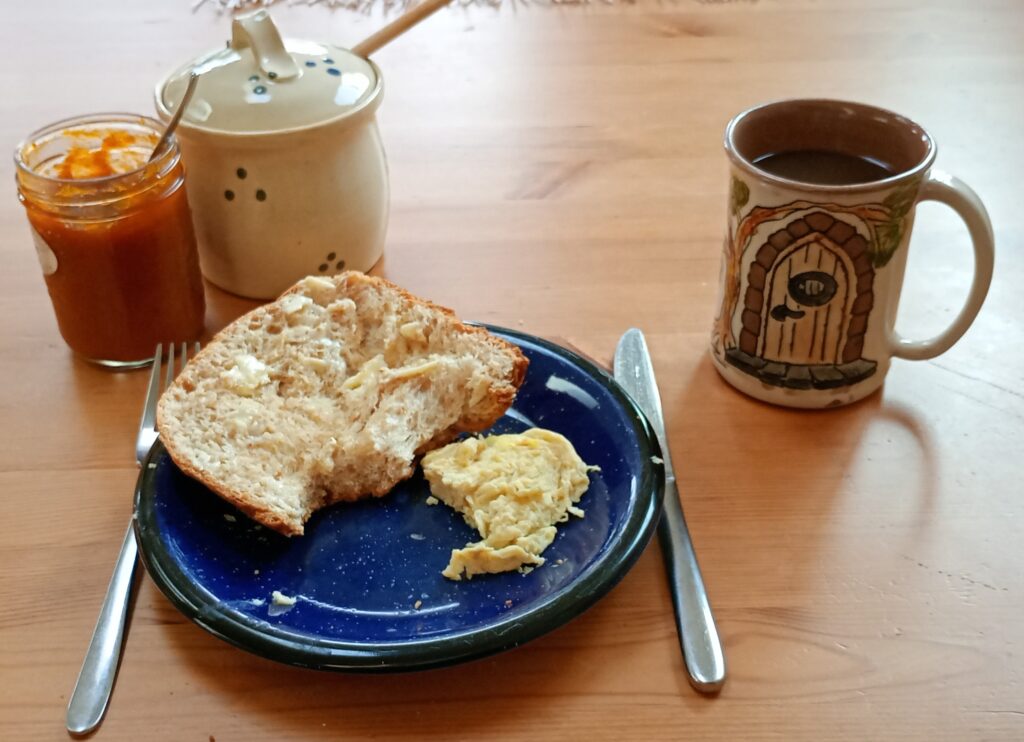
But with the MC of our story, oh dear me, no.

Yes, she also cracks eggs and slices bread. But before she does any of that, she has to make a fire. Probably on an open hearth, as this is a rural cottage in the woods—but we’ll be charitable and give her a closed stove (more on that in a minute).

So, making a fire. Probably raking out the ashes of last night’s fire, getting some kindling, hauling in (hopefully already chopped) wood, stacking the fire, setting it alight, waiting however long it takes for it to catch, then to sort of die down to something less than an enthusiastic flame… Truth be told, I’ve never actually cooked on a wood or coal stove, let alone an open fire, aside from roasting wieners or marshmallows on a stick (it’s on the things-to-learn list). But I’m pretty sure you can’t cook on a fire when you first set it alight, you have to let it establish itself. Especially when you want a sort of middling flame for your medium-hot pan, which you absolutely need for an omelet (the pan can’t be too hot—you don’t want to know how I know).

Okay, so now she’s waiting for the fire to get to cookable dimensions, which gives her time to work on her omelet. That’s not much different from what we do today—crack the eggs, beat them up with a fork, then… Is it a plain omelet? Or does it have cheese, and chopped onion, and maybe some chopped bell peppers or tomatoes or herbs…? All of which would need dicing, grating, otherwise preparing… Well, we’ll just go with a plain omelet, it’s easiest. So, beaten eggs are in a bowl, the fire is at a cookable state, you heat the pan to medium, melt the butter, pour egg into pan.

But then we get to the toast. Not just a slice of bread, toast. Which, in case you don’t know, is a slice of bread that’s toasted (you’re welcome). How does one make toast? Hang on, I can show you, I did a drawing (it was for a class):
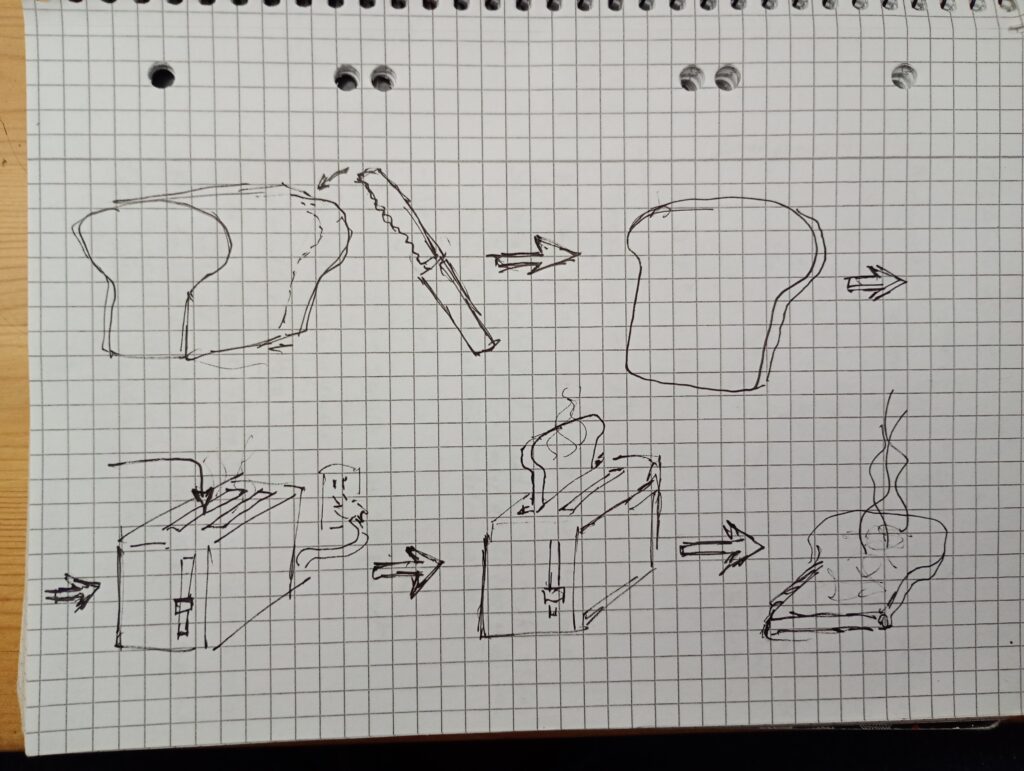
That’s how you make toast, right? Every one of my classmates drew something almost exactly like this.

But our intrepid MC, she doesn’t have a toaster. No simply sticking your bread slice into an electric machine and pushing down a lever, to have a crispy golden brown slice pop up a few minutes later, steaming, for your delectation. So, again, I haven’t really made toast on an open fire myself, but I’ve burned marshmallows, so I know that they don’t work terribly well for toasting on an open flame. They want glowing coals. Which requires letting the fire burn down. And then you’re sitting there, patiently, with your item-to-be-toasted skewered on your toasting fork, and you carefully hold it to the heat source trying not to burn it (Whoosh! Marshmallow torch! Oops, sorry, that’s your modern Canadian campfire. Back to the topic—toasting bread on a breakfast fire). Which is not something you can do at the same time as carefully cooking an omelet, in an open pan, over that same fire, as you only have two hands.

And then—I did say we’d come back to the “closed stove” topic—our MC, after having consumed her simple breakfast, takes the leftovers and “tucks them in the oven” for her still-sleeping friends. That’s why she has to have a closed stove available to her. But woodfired ovens even in a woodstove are notoriously difficult to handle, from what I’ve read. They aren’t just on with a nice even heat like our electrical thingamagigs, they require fiddling with and knowing exactly what you’re doing, so you’re not burning one side of whatever-is-in-there and having the other side go cold.

Conversely, if our MC’s cottage-in-the-backwoods didn’t have a closed stove but an open fire and a separate oven, which is more likely for that time and place, that oven would be one of those stone or brick recesses in the wall with a door in front, like the one in Hansel and Gretel. That kind of oven you heat by building a big fire inside of it (that’s what the witch had Gretel do, intending to cook her), then when it’s at the right temperature, you rake out all the hot coals and quickly shove your bread (or witch) inside, clapping the door shut, to bake things in the residual heat being held by the thick stonework around it. All extremely time-consuming, not to mention highly skilled work.

In other words, very, very far from simple.

Okay, you’re probably tired of my ranting here. But you get the point: if you’re writing a historic novel, please think through what life “back then” was actually like. What’s “simple” now was actually very complex in times past. It took a huge amount of labour. Labour that, in most cases, was done by servants, or by your wife. And if you didn’t have servants or a wife, as is the case for the MC in this novel, you just didn’t have the things that took work. You made toast for a treat for Sunday afternoon tea, not for a quick, simple breakfast. You didn’t “tuck things in the oven”, you maybe put them “to simmer on the back of the hob” (which I’m not entirely sure of what that means, either, but have read about lots of times), and reserved the oven for baking once a week or so.

Today, I can have fresh-baked or toasted bread, scrambled eggs, and hot coffee for my breakfast, because I have an electric breadmaker, and a toaster, and an electric stove, and a coffee machine. I have electric servants. So for me, that kind of breakfast is simple. But in 1911, the terms “cooked” and “simple breakfast” did not belong in the same sentence.

It annoys me when today’s writers or readers completely disregard the amount of sheer labour that goes into having everyday creature comforts in the absence of the convenience that today’s electric and electronic machinery can give you. We disregard the work that people had to do in the past to get what we totally take for granted. We disregard the value of labour, and that means we disregard the value of the people who did that labour. “Simple” things actually take a lot of work. Let’s honour the people who did that work, shall we?

So next time you give your servantless MC in her historic-cottage-in-the-woods a “simple breakfast”, make it a (cold) slice of bread and hardboiled egg (cooked last night when she made dinner). I promise I won’t jump on you for it.

Life, the Universe, and Cooking a Simple Breakfast. I do like my electric servants.

PS: If you want to read more on this topic, check out my post on my visit to the Charles Dickens museum: “Dahl’s Chickens, or: Why They Needed Servants in Those Days

PPS: I won’t tell you the title or author of the novel that I’m talking about here, because my rant only pertains to that one, tiny half-sentence. In all other respects it’s quite a good book, and I don’t want to spoil anyone’s enjoyment of it.

PPPS: I said I’d stop ranting, but, don’t even get me started on the labour of producing textile work and the authors that sneer at “homespun”… I know, I know, that’s a post for another day.

#ThrowbackThursday: Lenten Soup

A post from five years ago. I don’t have any Puy lentils at the moment, but I think I have some brown lentils on hand still. I might have to make this soup again soon.

lentil soup

It was so cold and miserable yesterday, I had to have something hot for lunch. There weren’t any leftovers, and I didn’t feel like having anything from a can. So I made some lentil soup, from Puy (French) lentils I’ve had in the cupboard for, oh, probably three or four years. (Me in bulk food store: “Oh, look at those lovely [lentils, peas, beans, walnuts, hazelnuts, mixed dried vegetables, chunks of chocolate, etc etc]! I’ve been meaning to try  making [lentil/pea/bean soup, nut bread, veg soup, real chocolate cake, etc etc.]” Buy food. Sit food in cupboard. Periodically open cupboard and consider food. “Oh, look, I never did get around to making [lentil/pea/bean soup etc etc]. Must do that.” Close cupboard, forget about food. Months later, open cupboard, consider food…)

Anyway, I just sort of randomly threw this soup together. Lentils have the advantage that they’re the instant-food variety of the legume world, i.e. they cook in under an hour, as opposed to dried beans which have to pre-soak and then simmer away most of the day. So lentils lend themselves relatively well to impulse cooking (haha, see what I did there? Im-pulse).

So here’s what I did:

Lentil Soup

3c stock (I used ham stock I had in the freezer, but I think even water would work)

1/2 c Puy lentils, rinsed

3/4 tsp salt (could have used less)

chopped green onions

1/2 grated carrot

black pepper, pinch of cayenne pepper

1/2 tsp dried lovage, pinch dried oregano, large five-finger pinch frozen parsley

Dump in pot, bring to boil, turn down heat, simmer for about 45 minutes. To serve, I threw in some grated cheese. Very tasty and warming.

I also found out something: for a while now, I had this theory that the words “lentil” and “lent” are related – that perhaps we call lent lent because people used to eat more lentils then; or vice versa. But, alas, I was wrong. “Lentil” comes from Latin lens, meaning, well, “lentil”, while “lent” comes from Old English lencten, meaning “springtime”. I guess eating lentils in lent is just a coincidence. It was a plausible theory though, don’t you think?

Life, the Universe, and Lenten Soup. I think I’ll have the rest of it today.

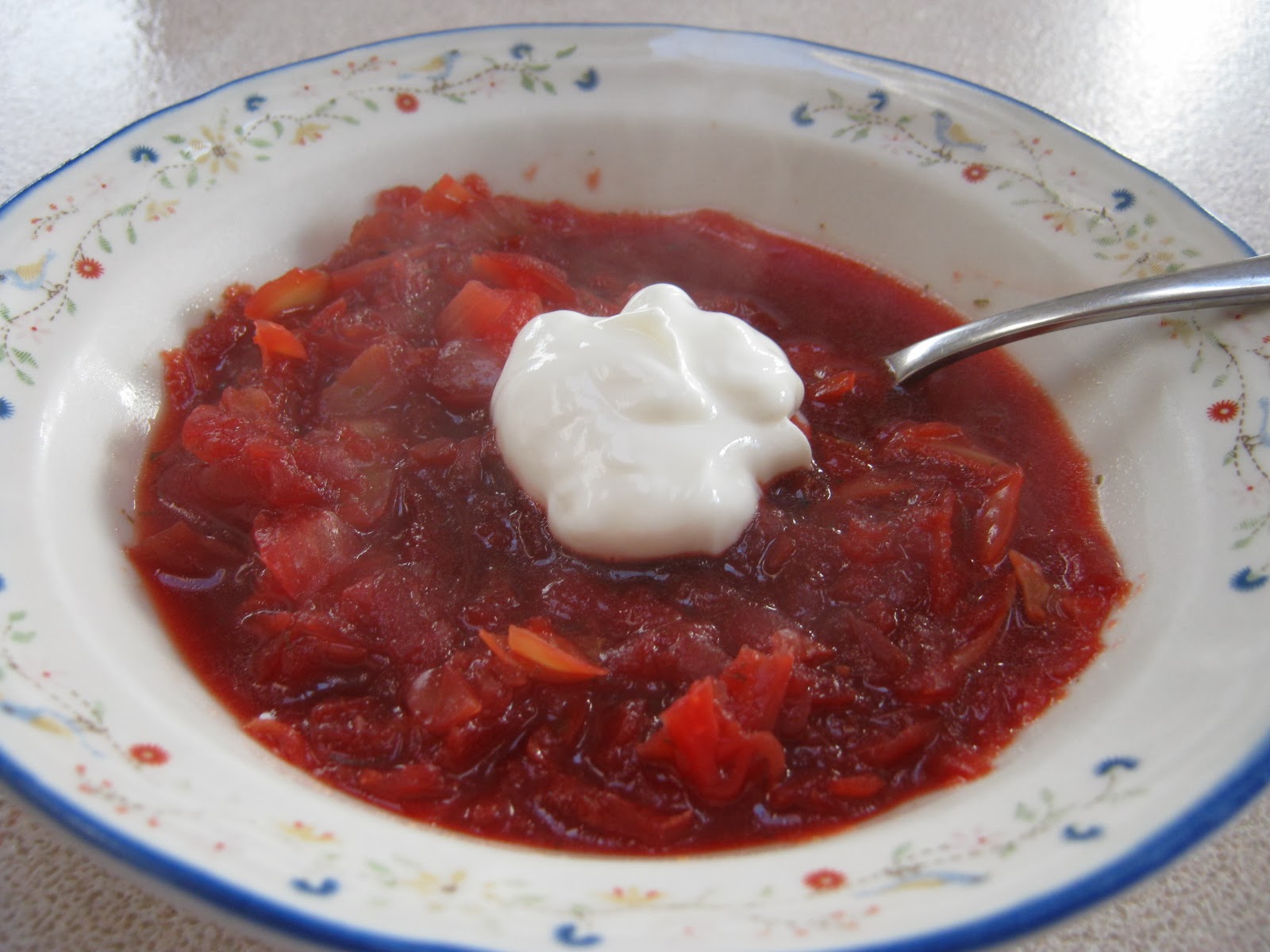
#ThrowbackThursday: Borscht

I made a pot of borscht the other day. Because, winter, and beets that needed cooking, and deliciousness. And I was reminded of this blog post from eight years ago, February 6, 2014, written while the Winter Olympics were on in Sochi, Russia. It being the Winter Olympics again, I thought you might like to read it and maybe cook your own borscht.

In honour of the Russian Olympics, I thought I’d cook me a pot of borscht. Well, actually, no, it’s not in honour of the Olympics at all, it’s in honour of the fact that I found a borscht recipe I really like and I wanted some. I hadn’t really ever made borscht before that one, as the man and most of the offspring wouldn’t be into eating it; but I’m on a bit of a food emancipation kick – I want to try new stuff, particularly new vegetable dishes – so I made some. A friend who happened to come by that day ate a bowlful and declared it good borscht, and as she’s of Ukrainian extraction, I feel this soup has received the stamp of approval.

The issue with making anything that involves beets is, of course, that it requires some pre-planning. You can’t just stick your head in the fridge half an hour before you want to eat, and go “Oh, there’s some beets, let’s make something with them” – they take far too long to cook for that. However, cooking them is really easy, and they keep cooked in the fridge for quite some time, so you can pre-cook them one day, and do your spontaneous borschting later in the week. To cook, just wash them off, dump them in a big pot, cover with water, put them on to boil, and bubble-bubble-toil-and-trouble for about an hour (depending on how fat they are – I don’t think you really can overcook beets, so better longer than shorter. Poke the biggest one with a sharp knife, and if the knife slides in easily, they’re done.). Drain them, let them cool (I fill up the pot again with cold water just to cool them off, because I’m too impatient to wait for them to cool on their own), and peel them. Peeling beets is funny – when they’re well-cooked, they slip right out of the skin, with sort of a sloosh kind of noise. I’d highly recommend wearing an apron and/or clothes you don’t care that much about, as your hands and the sink and everything around it will look like a bloodbath (I suppose it is, too – beet blood. Muahahahah!).

Okay, now you’ve got your beets cooked. So here’s the recipe (I got it from the More-With-Less Cookbook by Doris Janzen Longacre, which was the first cookbook I bought myself after I was married. If you can get a hold of that book, I highly recommend it. No, you can’t have my copy; it’s falling apart, anyway.)

Quick Beet Borsch (they spell it without the t. Apparently you can also spell it borshch, which is closer to the Ukrainian/Russian pronunciation. But it looks weird that way.)

1 c cabbage, finely chopped
1 onion, finely chopped
2 c water
cook 10 minutes. Add:
2 c stock or broth
2 medium beets, cooked and chopped
1/2 c beet juice (I leave that out)
1/2 t salt
dash pepper
1 T lemon juice.
bring to a boil, serve with sour cream.

Which is exactly what I’m going to do right now – serve it. Even if it’s just to myself.

Life, the Universe, and Borscht. Do they have cookoffs in the Olympics?

Note on the 2022 edition: these days, I don’t bother with the exact steps of this recipe. I grate/chop the vegetables, dump them in the pot with the seasonings and water or stock (whichever I have available), and simmer it for half an hour or so, until the veggies are soft. I also don’t put in lemon juice, but add some herbs (dill is good, or lovage). If you don’t have sour cream or want to make this a lighter dish, plain yogurt works really well, too. Guten Appetit!

A Day for Apple Pie: A Picture Essay

20180127164345_IMG_0327.jpg20180127165418_IMG_0328.jpg20180127170244_IMG_0329.jpg20180127170644_IMG_0331.jpg20180127170800_IMG_0332.jpg20180127171236_IMG_0334.jpg20180127181311_IMG_0336.jpg20180127184734_IMG_0337.jpgIMG_0339.jpg

APPLE PIE

-pastry for a 9” double-crust pie, rolled out (I use this recipe – had some in the freezer still)

-6 cups peeled & sliced apples (about 6-8 large)

-2 Tbsp flour

-2 tsp cinnamon

-2/3 cup brown sugar

Preheat the oven to 350°F (180°C). Put the filling ingredients together in a big bowl, toss until the apples are coated. Put into the pie shell, top with the lid, seal the edges. Slash holes in the top crust. Bake for 45-50 minutes until it’s golden brown and the juice bubbles up through the holes in the crust.

Life, the Universe, and Apple Pie. Perfect for a snowy day.

Lenten Soup

lentil soup

It was so cold and miserable yesterday, I had to have something hot for lunch. There weren’t any leftovers, and I didn’t feel like having anything from a can. So I made some lentil soup, from Puy (French) lentils I’ve had in the cupboard for, oh, probably three or four years. (Me in bulk food store: “Oh, look at those lovely [lentils, peas, beans, walnuts, hazelnuts, mixed dried vegetables, chunks of chocolate, etc etc]! I’ve been meaning to try  making [lentil/pea/bean soup, nut bread, veg soup, real chocolate cake, etc etc.]” Buy food. Sit food in cupboard. Periodically open cupboard and consider food. “Oh, look, I never did get around to making [lentil/pea/bean soup etc etc]. Must do that.” Close cupboard, forget about food. Months later, open cupboard, consider food…)

Anyway, I just sort of randomly threw this soup together. Lentils have the advantage that they’re the instant-food variety of the legume world, i.e. they cook in under an hour, as opposed to dried beans which have to pre-soak and then simmer away most of the day. So lentils lend themselves relatively well to impulse cooking (haha, see what I did there? Im-pulse).

So here’s what I did:

Lentil Soup

3c stock (I used ham stock I had in the freezer, but I think even water would work)

1/2 c Puy lentils, rinsed

3/4 tsp salt (could have used less)

chopped green onions

1/2 grated carrot

black pepper, pinch of cayenne pepper

1/2 tsp dried lovage, pinch dried oregano, large five-finger pinch frozen parsley

Dump in pot, bring to boil, turn down heat, simmer for about 45 minutes. To serve, I threw in some grated cheese. Very tasty and warming.

I also found out something: for a while now, I had this theory that the words “lentil” and “lent” are related – that perhaps we call lent lent because people used to eat more lentils then; or vice versa. But, alas, I was wrong. “Lentil” comes from Latin lens, meaning, well, “lentil”, while “lent” comes from Old English lencten, meaning “springtime”. I guess eating lentils in lent is just a coincidence. It was a plausible theory though, don’t you think?

Life, the Universe, and Lenten Soup. I think I’ll have the rest of it today.

Keeping Food for Winter

A reblog from William Savage, whose blog I discovered recently.
This post is quite fascinating. I’ve never eaten purslane, just pulled it out of my garden as a weed; it’s supposed to be quite good. Pickled asparagus, however, you can even buy in the grocery store here. Storing lettuce in sand for winter – never heard of that, but again, sometimes you can get “gourmet” lettuces here – little butterhead ones – with the roots still attached, which I guess is the same principle.
As for the word “walm” (check the footnote), I bet that that’s where we get “overwhelmed” from!
I want a copy of that “Compleat Housewife” book he talks about. Wonder where you could get it.