A post from five years ago. I don’t have any Puy lentils at the moment, but I think I have some brown lentils on hand still. I might have to make this soup again soon.
It was so cold and miserable yesterday, I had to have something hot for lunch. There weren’t any leftovers, and I didn’t feel like having anything from a can. So I made some lentil soup, from Puy (French) lentils I’ve had in the cupboard for, oh, probably three or four years. (Me in bulk food store: “Oh, look at those lovely [lentils, peas, beans, walnuts, hazelnuts, mixed dried vegetables, chunks of chocolate, etc etc]! I’ve been meaning to try making [lentil/pea/bean soup, nut bread, veg soup, real chocolate cake, etc etc.]” Buy food. Sit food in cupboard. Periodically open cupboard and consider food. “Oh, look, I never did get around to making [lentil/pea/bean soup etc etc]. Must do that.” Close cupboard, forget about food. Months later, open cupboard, consider food…)
Anyway, I just sort of randomly threw this soup together. Lentils have the advantage that they’re the instant-food variety of the legume world, i.e. they cook in under an hour, as opposed to dried beans which have to pre-soak and then simmer away most of the day. So lentils lend themselves relatively well to impulse cooking (haha, see what I did there? Im-pulse).
So here’s what I did:
Lentil Soup
3c stock (I used ham stock I had in the freezer, but I think even water would work)
Dump in pot, bring to boil, turn down heat, simmer for about 45 minutes. To serve, I threw in some grated cheese. Very tasty and warming.
I also found out something: for a while now, I had this theory that the words “lentil” and “lent” are related – that perhaps we call lent lent because people used to eat more lentils then; or vice versa. But, alas, I was wrong. “Lentil” comes from Latin lens, meaning, well, “lentil”, while “lent” comes from Old English lencten, meaning “springtime”. I guess eating lentils in lent is just a coincidence. It was a plausible theory though, don’t you think?
Life, the Universe, and Lenten Soup. I think I’ll have the rest of it today.
In a manner of speaking, this is a #ThrowbackThursday post. Not that it’s been posted before, but I started writing it exactly two years ago, on our last trip out of the country. Somehow, with the lockdown and everything, I never had the heart to finish it, but now, on the second anniversary of the trip, it seemed like a good time to dust it off and put it up. Now that things are opening up again, maybe it’ll be possible to go back there soon?
I was just on another jaunt to the Old Country. As I’ve said before, while living halfway across the globe from your family can be a pain in the neck (literally – those long flights are uncomfortable), a visit also makes for good opportunities to get in some sightseeing.
This time, I got to see the Dickens Museum at 48 Doughty Street in London*. Charles Dickens (whom, courtesy of Roald Dahl and his BFG, I am now always thinking of as Dahl’s Chickens) lived in this house in Bloomsbury from 1837 – 1839, at the very beginning of his writing career. He moved in as an unknown 25-year-old with a wife and one baby, and moved out two years later as a popular writer with two more children and an established name.
Doughty Street (the wrapped house at the edge of the picture is the Dickens house)
Now, I’m not a die-hard Dickens fan – truth be told, I’ve only read about half a dozen of his books so far. But this museum was fascinating in a way that wasn’t even directly about him. The house is a testament to the life of a middle-class family in the very earliest years of Victoria’s reign.
The Dickens family consisted of one young man (Twenty-five! He was just twenty-five!), his wife, her sister, and one-two-three babies. They had: on the ground floor, a dining room and morning room (basically Mrs Dickens’ office or place to hang out); on the first floor a drawing room and Dickens’ study; on the second floor two bedrooms (one for the Dickenses and one for sister-in-law); on the third floor, the nursery and servants’ bedroom; in the basement, the kitchen, scullery, and wash house (laundry room). That’s it.
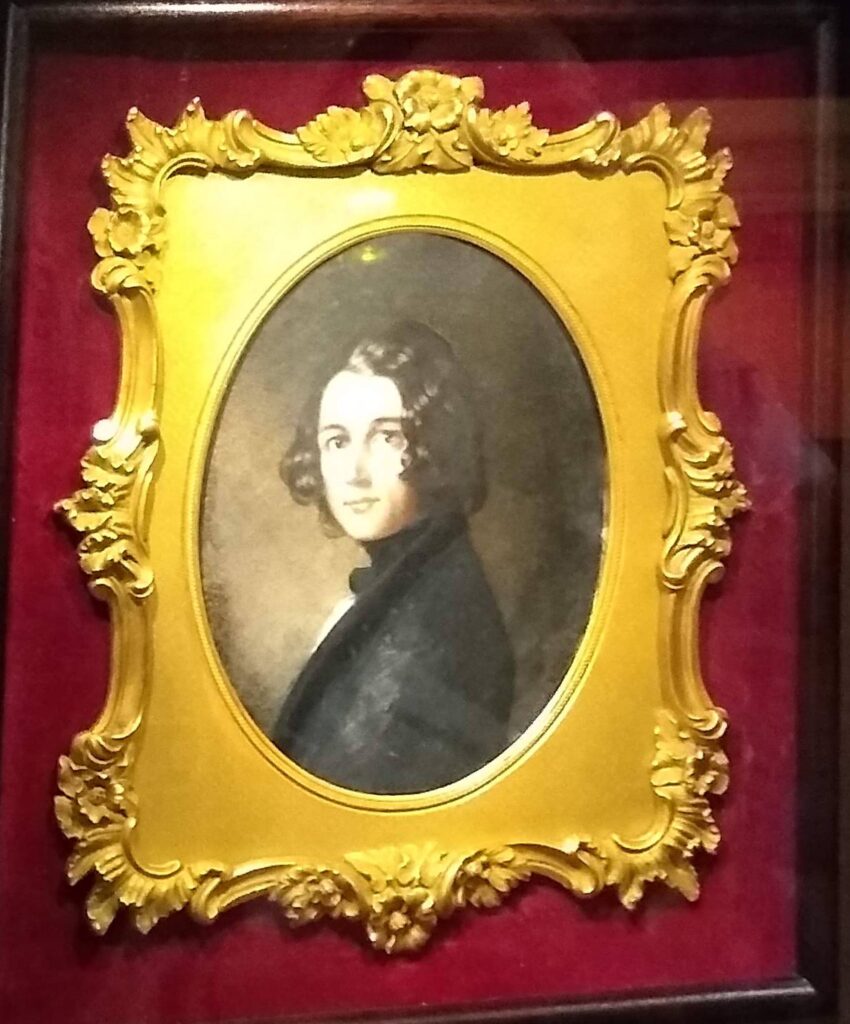
Young Charles Dickens, the “Lost Portrait” (which is no longer lost, but that’s another story)
“Oh, but of course the bathrooms, too,” you say? No. No bathrooms. No toilets**. No sinks, no places to wash hands, except for one stone sink in the basement scullery. So where did they do their, you know, business?
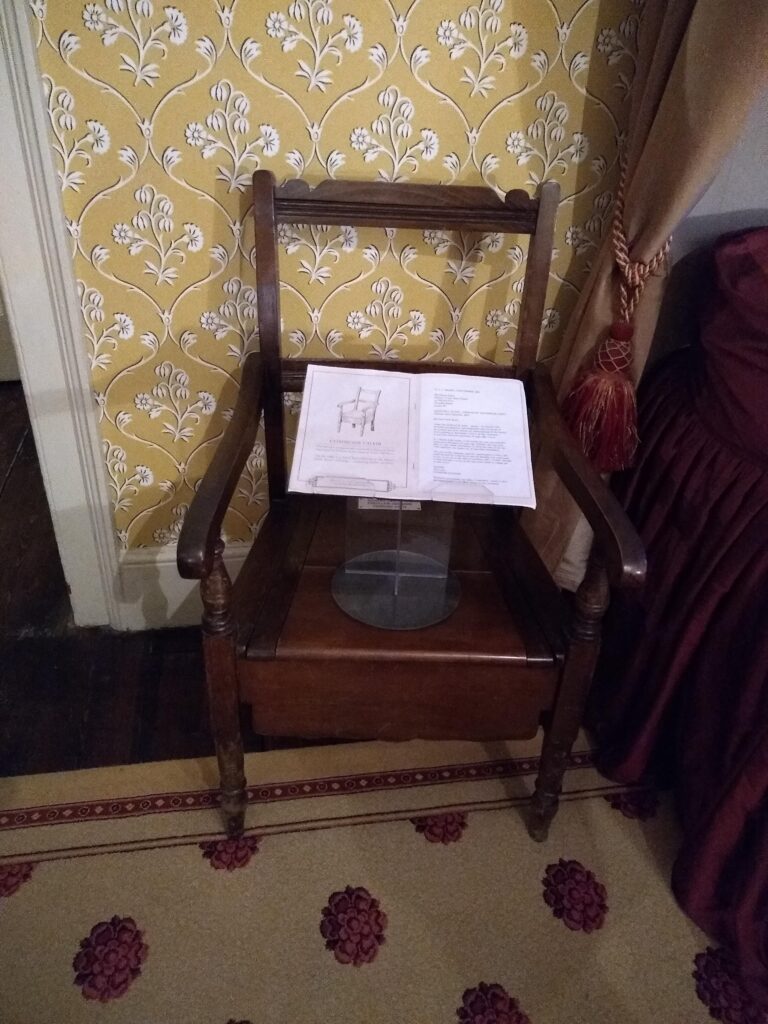
On chamberpots (ceramic bowls large enough to sit on) and commodes, which are basically chairs with a hole in the seat and a potty under it. And you guessed it: somebody had to empty them out. Somebody had to carry porcelain bowls full of smelly, stinky, gross you-know-what down three flights of stairs and dump them.
The commode
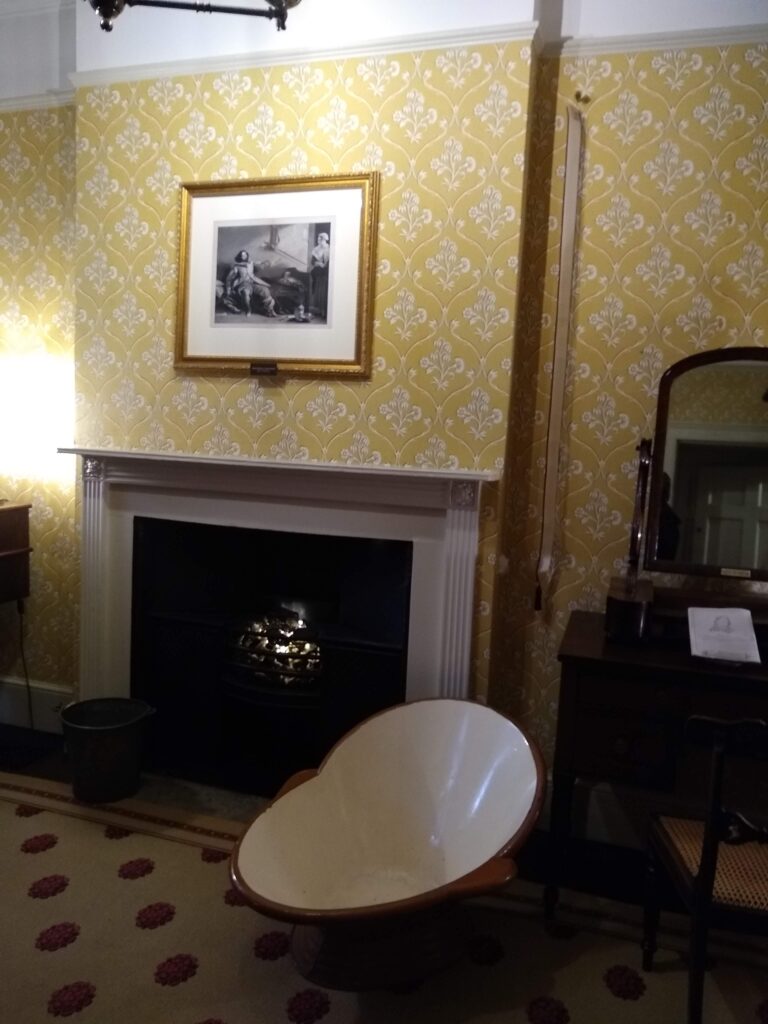
And that same somebody also got to lug pots full of hot water up the stairs every morning so the family could have a wash. In fact, if Mrs Dickens wanted a bath, she had it in front of the fire in her bedroom. The tub on display at the museum is a little hip bath – small enough that it can be carried while full. Let me repeat that: a tub full of water—let’s say, at a minimum five to ten gallons, or twenty to forty litres/kilos—carried down three flights of stairs. With how small people were in those days, that’s probably half the body weight of the person who had to do the carrying.
The hip bath in the bedroom
The maid who had to do the carrying. Because it sure wasn’t Mr Dickens himself, or his wife, or his sister-in-law.
Hence the servants’ bedroom on the third floor. The young Dickens family in that Doughty Street house, an ordinary middle class family whose sole wage earner was at the beginning of his career, consisted not only of Mr, Mrs, Miss, and Babies, but also a cook, a house/parlour maid, and a nanny. And they needed those servants, because without them, things would have been pretty darn uncomfortable. Servants’ wages and room and board were a normal part of the expenses of any middle class household; not having servants, i.e. having to do the work yourself, was the very definition of “working class.”
I had never really thought about that before. Indoor plumbing with hot and cold water at the push of a button is something we take for granted today; central heating and electric stoves and washing machines and vacuum cleaners are something we don’t even think about.
But in Dickens’ time, indoor plumbing was provided by the servants carrying jugs and buckets and tubs full of water and sewage up and down stairs. Heat to keep you warm and to cook with (Every. Single. Cup of tea!) and hot water to wash or bathe in were supplied by the servants lighting and stoking and cleaning out and re-lighting fireplaces. The scrubbing action and spin cycle of the washing machine came from the servants rubbing and plungering and wringing laundry in the cold stone-flagged wash house in the basement, and the vacuuming of carpets was accomplished by the servants lugging them out back and beating the dirt out of them with a carpet beater.
The wash house with the copper in the corner (for Mrs Cratchit to boil the pudding in)
A lot of us (myself included) have this nostalgia for the days of the past, would like to spend our imaginary lives back in the days “when life was simple,” want to hang out with Elizabeth Bennet and Mr Darcy and Ebenezer Scrooge (once he got his head screwed on straight). But life “in those days” actually wasn’t simple—it was quite complex. And it was almost entirely human-powered. We measure a car’s engine in horsepower—maybe we should measure indoor plumbing and electric washing machines in human-power (“This latest model of Maytag has a 5hu-p/day capacity and is able to draw 8hu-p of hot water in less than two minutes…”).
I’m not going to give up mentally living in the past, but visiting the Dickens Museum has given me a whole new appreciation for just how privileged we are today. Next time you flush the toilet in your second-floor bathroom or crank the handle in the tub to instantly have hot water raining on your head, give a thought to that unnamed woman who, 185 years ago, carried enormous buckets full of water and slop up and down the steep stairs of a small London house, so that a gifted young man could sit in his study and write wonderful stories about Oliver Twist and Nicholas Nickleby that are still with us today.
Life, the Universe, and Indoor Plumbing. Charles Dickens would have been nothing without his servants.
*I can highly recommend the website of the Dickens Museum at https://dickensmuseum.com. Lots of interesting information, and you can take a whole virtual tour of the museum, including admiring the hip bath by the bedroom fire! **2022 addition: Apparently, as I just found out, there was actually one “water closet” (toilet) on the ground floor and one in the basement, but firstly, that was a new and unusual thing for the day, and secondly, the servants still had to carry all the wash water and chamberpot waste up and down the stairs to the upper floors.
I made a pot of borscht the other day. Because, winter, and beets that needed cooking, and deliciousness. And I was reminded of this blog post from eight years ago, February 6, 2014, written while the Winter Olympics were on in Sochi, Russia. It being the Winter Olympics again, I thought you might like to read it and maybe cook your own borscht.
In honour of the Russian Olympics, I thought I’d cook me a pot of borscht. Well, actually, no, it’s not in honour of the Olympics at all, it’s in honour of the fact that I found a borscht recipe I really like and I wanted some. I hadn’t really ever made borscht before that one, as the man and most of the offspring wouldn’t be into eating it; but I’m on a bit of a food emancipation kick – I want to try new stuff, particularly new vegetable dishes – so I made some. A friend who happened to come by that day ate a bowlful and declared it good borscht, and as she’s of Ukrainian extraction, I feel this soup has received the stamp of approval.
The issue with making anything that involves beets is, of course, that it requires some pre-planning. You can’t just stick your head in the fridge half an hour before you want to eat, and go “Oh, there’s some beets, let’s make something with them” – they take far too long to cook for that. However, cooking them is really easy, and they keep cooked in the fridge for quite some time, so you can pre-cook them one day, and do your spontaneous borschting later in the week. To cook, just wash them off, dump them in a big pot, cover with water, put them on to boil, and bubble-bubble-toil-and-trouble for about an hour (depending on how fat they are – I don’t think you really can overcook beets, so better longer than shorter. Poke the biggest one with a sharp knife, and if the knife slides in easily, they’re done.). Drain them, let them cool (I fill up the pot again with cold water just to cool them off, because I’m too impatient to wait for them to cool on their own), and peel them. Peeling beets is funny – when they’re well-cooked, they slip right out of the skin, with sort of a sloosh kind of noise. I’d highly recommend wearing an apron and/or clothes you don’t care that much about, as your hands and the sink and everything around it will look like a bloodbath (I suppose it is, too – beet blood. Muahahahah!).
Okay, now you’ve got your beets cooked. So here’s the recipe (I got it from the More-With-Less Cookbook by Doris Janzen Longacre, which was the first cookbook I bought myself after I was married. If you can get a hold of that book, I highly recommend it. No, you can’t have my copy; it’s falling apart, anyway.)
Quick Beet Borsch (they spell it without the t. Apparently you can also spell it borshch, which is closer to the Ukrainian/Russian pronunciation. But it looks weird that way.)
1 c cabbage, finely chopped 1 onion, finely chopped 2 c water cook 10 minutes. Add: 2 c stock or broth 2 medium beets, cooked and chopped 1/2 c beet juice (I leave that out) 1/2 t salt dash pepper 1 T lemon juice. bring to a boil, serve with sour cream.
Which is exactly what I’m going to do right now – serve it. Even if it’s just to myself.
Life, the Universe, and Borscht. Do they have cookoffs in the Olympics?
Note on the 2022 edition: these days, I don’t bother with the exact steps of this recipe. I grate/chop the vegetables, dump them in the pot with the seasonings and water or stock (whichever I have available), and simmer it for half an hour or so, until the veggies are soft. I also don’t put in lemon juice, but add some herbs (dill is good, or lovage). If you don’t have sour cream or want to make this a lighter dish, plain yogurt works really well, too. Guten Appetit!
Seeing as it’s the Winter Olympics again, I thought it might be time for this repeat blog post from February 2014, written during the Sochi Olympics:
Steve ready to cheer Canada in the Olympics
I don’t give a rip about hockey. Oops, did I say that out loud? I might have just jeopardised my chances of ever getting Canadian citizenship. Oh, wait! Wait! Before you send me hate mail, delete the link to my blog, unfriend me on Facebook and refuse to ever speak to me again, hear me out.
It’s true, I’m afraid – I don’t care about hockey, and I really know nothing about it. But one thing I do know, and that’s that Canadians care passionately about this game. I found out just how passionately four years ago, this very Sunday, during the Vancouver Winter Olympics 2010. The Man and I wanted to go for lunch, and we made the mistake of picking the local pub to get our eats. We got into the pub, and it was crowded – really crowded. Maple leaf motifs everywhere. And there was such a sense of excitement the air was practically crackling with it. We did get a seat, and then we realised that on the big TV screens there were guys on skates, and a big arena – that, in fact, they were winding up for the gold medal game, the final day, the BIG ONE – men’s hockey, Canada vs. the USA (which tells you right there where our heads were at; we didn’t even know it was on that day). I tell you, it was just a little scary. We were there early enough to be able to get our food and get out of there before the game started – slink out, rather. It would have been more than my life would have been worth to say out loud what I just said up top there; the crowd might have just torn me to pieces and fed me to the nearest coyotes. Besides, we knew our seats would get snapped up the minute we left. So we went home, and the Man and the offspring watched the game on TV – I went and had a nap, I’m afraid. But when I got up from my nap, I found out that Canada had, indeed, got the gold; at overtime, in a very dramatic play, no less.
And you know what? I was thrilled! I was so very, very excited. Not because the game means anything to me, but because the whole country erupted in celebration. All around me, people were ecstatic. The atmosphere of triumph, of victory, was fantastic. And it was EVERYWHERE. To have won the gold medal in Canada’s sport on Canadian home soil – there was nothing like it. Canada was one big party zone that day. It was wonderful.
The 2010 Olympic Flame coming through our little town
I might not care about the game, but I care about the people who care about the game – so I guess, in a sense, I do care about hockey, after all. I care because others care. I care because I live in Canada, and Canada cares about hockey. I’m actually quite nervous about the game that is being played as I write this, Canada vs. the US in the semi-finals. I’m not watching it, because, other than the fact that I really don’t know what’s going on on the ice, I find the tension hard to handle. There are too many people to whom this matters so very much. As for the men’s gold medal game on Sunday, I’ll be sure to stay out of the pub. I might just stay off the internet, too, until it’s over – just tell me who won afterwards, will you? If it’s gold for Canada, I’ll be very happy.
Canada is terribly passionate about hockey – my boys got to watch yesterday’s women’s gold medal game in school, one in math class, the other in the school theatre on the big screen while they were supposed to have gym class. I ask you, what other country would put their high school classes on hold so they could watch a sports game? Canucks have their priorities.
Life, the Universe, and Olympic Hockey. I guess I’m a hockey fan by proxy.
This is a post from eight years ago, July 8, 2012, from my old blog over on Blogger. Still valid. Hmm, I think I could start rereading those M. M. Kaye mysteries again; I’ve probably forgotten whodunnit by now.
It’s a Mystery
I really like mystery novels. It’s a little odd, that, as I loathe and abhor violence, and you pretty much can’t get any more violent that murder. But for some reason, reading about cranky old rich men being offed for their money doesn’t disturb me, probably because it’s not a fate that’s likely to ever befall me – I’m not a man, will (alas) probably never be rich, and as for being cranky and old, I’m hoping to stave those off for a while yet.
Actually, there is a weird sense of safety in reading murder mysteries – the kind I like, anyway, which are the English cozies, preferably the genuine “Golden Age” article à la Agatha Christie & Co. They’re set in a proscribed circle of people, in a time and place far removed from my own reality, and the sleuth always finds out whodunnit, so justice is served and peace restored. And if the story includes a charming romance between a pretty young girl and a handsome young man (amateur detective, part of “the Force”, or simply mysterious stranger, I’m not picky on that), then my satisfaction is complete. Ah, escapism.
However, there’s one thing that strikes me as being a genuine mystery, in reading mysteries. It concerns those aforementioned charmingly beautiful young girls. In addition to being charming and beautiful, they are usually also quite intelligent – it’s part of what makes them so well suited for being a focal point of the story. They see the clues, they sense that something is wrong, they shiver in the cold draft emanating from the sinisterly-left-open window and jump when the soft-footed tabby cat silently brushes by them in the darkened room where they sit, thinking about the handsome young man who is so disturbing to their tender feelings but might still be the murderer. They even almost solve the mystery, usually. However, they seem to be afflicted by a peculiar disability.
See, it’s like this: whenever one such girl is told, usually by said handsome young man of chiselled brow and masterful demeanor, that she should not, under any circumstances, tell anyone of her suspicions (which she has just voiced to him in the darkness of the night, leaning on the balcony railing overlooking the rose garden) – or, alternatively, that she should not, whatever else she may do, leave the house without informing him of it (this is usually accompanied by a look of more than usual seriousness from the grey/brown/deep-blue eyes of said handsome gent) – somehow or other it seems to cause the girl’s brains to trickle out of her pink and shell-like ears. Or something like it.
Because as soon as a directive of this kind is issued, the girl is guaranteed to do the very thing she was told not to do. She hears the command, fully agrees to it, but somehow always figures that it must not apply to Mrs White (who is, after all, only the cook), or Colonel Mustard (who is surely too pukka sahib to have done anything so sordid as commit the murder), with the inevitable result that she spills the beans to and/or leaves the house in the company of the murderer him- or herself. Of course, as anybody could tell her, it directly leads to her undergoing several pages’ worth of hair-raising suspense, being menaced by said murderer in the kitchen/conservatory/ball room with the revolver/rope/lead pipe while he or she monologues about his or her reasons for committing the murder and gleefully prophecies that no one will ever find the girl’s body, foolish thing. All of which she could have avoided if she had only paid attention to what she was told.
So what do you think – auditory processing disorder? Something that affects only one very small part of what she’s hearing? Because it can’t be stupidity; the whole rest of the book establishes very clearly that the girl in question is not stupid.
Ah well. It doesn’t really matter all that much, because, fortunately, in the nick of time, just as the murderer is about to pull the trigger/tighten the rope/swing the lead pipe, he of the chiselled features comes bursting (or, alternatively, stealthily creeping) through the french doors, incapacitates the villain (having taken careful note of the monologued confession which clears up the remaining questions about the murderer’s guilt), then roughly pulls the girl into his arms while angrily exclaiming “Don’t ever do this again, darling!” and presses a hard kiss on her trembling lips, thereby removing the last vestiges of doubts that the girl had about her feelings for him, and/or making her realize for the first time why she always went weak at the knees whenever he glared at her (which she had previously taken for a sign of dislike). D’oh. The End.
Life, the Universe, and Mysteries. It’s a mystery, what?