Clay Palooza and Imposter Syndrome

“Hi!” came a cheerful email from our local arts centre. “Would you be interested in being on a discussion panel of potters during Clay Palooza? Bob Kingsmill is going to be on the panel. And we have a few competitions to participate in, too, would you like to do one of those?”
Gulp.
Me? On a discussion panel? With Bob Kingsmill?

Let me explain.
First of all, Clay Palooza: it’s a fun day full of clay events in the context of the local Winter Carnival. I missed it last year, the first time it was held, but I was looking forward to attending it this year. I was just going to go as a visitor, watch other potters – you know, real potters – do fun stuff such as compete in challenges like “blindfolded throwing” or “who can throw the biggest bowl”.
Then, Bob Kingsmill. He’s a local master potter. I found out about him a couple of years ago, when a friend gave me a beautiful little ramen bowl of his for my birthday; and then last summer, I saw some of his pieces at the Vancouver Art Gallery. That’s the kind of potter he is.
And I was being asked to be on a panel with him.

“Yikes,” I told the organizer, “that’s scary. How many others are going to be on that panel?” Maybe I could hide behind some of them.
“Oh,” she said, “we’re aiming to have four or five potters of varying levels.”
Varying levels? That was okay then! I could provide the bottom level.
Actually, once I thought of it, I realized that it was the perfect opportunity to get on my bandwagon: Pottery is for Everyone! You don’t have to be a master to make perfectly useful, functional, beautiful work! I still use one of the first bowls I handbuilt when I was thirteen as my everyday fruit bowl.

So I said yes, shaking in my boots.
And I signed up for one of the challenges, too – “Handbuild a Mug in 15 Minutes”. I practiced, to make sure I could hold my own with all those other amazing ceramicists that would be there strutting their stuff.

Turns out I wasn’t the only one shaking in their boots about having been asked to be on the panel. I didn’t find someone to hide behind, but I found someone for mutual propping up. It was good to have another person to share trepidations with – “Oh no, we’re on! What do we do? Where do we sit?”
And it turned out really great.

I brought along some of my pieces – tiny ones, because that’s what I do, and they’re very portable. A couple of Tiny Gnomes, a little vignette with a tiny table and mug and book, a Cheesymouse. I sat them in front of me on the panel table.
“My goodness,” Bob Kingsmill said when he saw them, “let me see your hands!” Well, yes, I do make tiny stuff. With my fingers (and some tools, like discarded dental tools). I was flattered to get that kind of attention from the master. Who is a lovely, hilarious, kind person, and I was so glad to meet him.

The panel discussion was so interesting. We answered questions such as “How long have you been working with clay?” (apparently Bob opened his first studio the year I was born. That’s… a long time ago), and “What’s a mistake you still make?” I learned so much from everyone else! And one of the biggest thing I learned is humility. The people who’ve done this for decades still say they “don’t know anything”. Which is, of course, not true – they know and can do so much! – but it was hugely encouraging to hear that even after all that time, they still feel like that.

And then Bob almost made me cry.
“What still inspires you to work with clay?” was one of the panel questions.
With tears in his eyes, Bob brought up the horrific tragedy of the school shooting that happened in Northern BC last week. And he said (I can’t remember his exact words, but this is the gist of it) that art is one of the ways people can cope. He gestured to my little gnomes, and he said, “This is the sort of thing that counters the awful stuff in the world.”
Oh my word.
My Tiny Gnomes. Little mice sitting on cheeses.
A counterpoint to the big, awful, overwhelmingness of the world.
That is so much what I want to do with my art – both clay and words. Set little pinpricks of joy that help us to keep living.

It didn’t matter anymore that I’m not a master, that even the invitation to this panel triggered a roaring case of Imposter Syndrome.
I’m not good at throwing straight pots on the wheel. I don’t sell a lot of my pieces. My sculptures are not terribly innovative and artistic. I make tiny gnomes, not high art. But those tiny gnomes are art. They’re the kind of thing that can bring tiny moments of joy in the midst of the world’s darkness.
It was such an incredible validation of what I’m trying to do.
Small art for small people. Art is for Everyone.

And then I went on to the “Handbuild a Mug in 15 Minutes” challenge, and my mug-on-a-mug missed getting first place by half a point (but I got a prize anyway!). And at the last minute I’d signed up for the “Team-Build a Trophy” challenge, and in that one my team did get first place (also by half a point), and we had so much fun. No strutting was involved, we just all enjoyed ourselves. Because the pottery community is like that.

I’ll probably not ever get rid of Imposter Syndrome where my ceramics and my writing is concerned. But it doesn’t matter. What matters is that my work, even my very small work, can be a part of the light that counteracts the darkness.

Life, the Universe, and Small Art. Even a Tiny Gnome can play a part.

(Photo credits of events: Emma Kopp)

Apple Bowl Cottage, or: The Comfort of Story

It is a dark and gloomy day… inside and out. The news is bad, friends are going through tough times, the weather is screwed up, and everything is playing merry hell with my moods. As is usual for late January, there is a cloud over the Valley that feels like a giant hand clapped a lid on and is pressing down tight.

I come downstairs in the dark, and I light a candle on the coffee table. Then I light another one—the little tea light that’s inside the fairy house sitting next to the candle. “Apple Bowl Cottage” has been to a couple of art shows this winter, but it didn’t find a new home yet. Maybe that’s just as well; I needed it today.

I sip my coffee, enjoying the soft glow of the candlelight, then I turn on the big light and write in my journal for a while. By now, there is daylight outside, such as it is. Not much of it (did I mention Lid-on-the-Valley weather?). But it’s time for breakfast, so I blow out the candle.

And in those two seconds that I watch the smoke curl out of the chimney of the fairy house, I have a sudden flash of Story.

The fairies turned off their lights, I think, and they’re off to work. No, actually, they don’t go to work outside of home; the fairy that lives in this house is getting ready for her day of cooking and washing and making apple pies. She turned off the light because it’s bright enough outside now she doesn’t need the lamp. I wonder what she’s going to do today? I think after she’s turned the apples in the bowl into a pie, she might be looking forward to reading her book; she just got to the best part yesterday.

And just like that, the world has become brighter. Warmer. Safer.

I don’t know her name, the little fairy that lives in the tiny ceramic cottage on my coffee table today. But the light shining from her little home, and the warm smoke curling from the chimney, has cheered my day. There is still a Lid on the Valley and bad things in the news, but I’ve been reminded of joy and warmth and comfort and whimsy and brightness.

And those are as real as anything else.

Life, the Universe, and Apple Bowl Cottage. The comfort of Story.

(Apple Bowl Cottage with a quarter to show scale. Also, that’d be a heck of a lot of money, by comparison! A coin as big as your table top…)

PS: Yes, Apple Bowl Cottage is for sale, and I think the fairy would be very happy to move to your house (and I’d be happy to share her)! If you’re interested send me a message, here.

Dreams I Didn’t Know I Had

Me & a Gnome, Digital Illustration (Procreate)

Sometimes, you get to fulfil a dream you didn’t know you had.

Writing novels was one such dream for me. I always loved books, but I didn’t know that writing them was something that was within my reach. I’ve told you about that before, more than once: I didn’t know that novel-writing was a dream I could have until I did it. (It was the blue bowl that started it all…)

Another such fulfilled dream just showed up in my mailbox yesterday: I got a certificate from Art School. A real, live, honest-to-goodness, serious ART SCHOOL! And in Illustration, no less!

It all started during Covid. No, actually, it started much longer ago, just after I came to Canada (I was young…). I met a 50-something lady who was in the process of getting her Bachelor of Fine Arts.

“So you must be really good at drawing and painting, to be able to go to art school, right?” I said.

“Oh no,” she serenely replied. “That’s what you go to art school for, to learn it!”

WHAT??? You can learn to be an artist???

Being able to paint was a dream of mine. But I always thought that was something one “just knew how to do”, because back in school, there were people who could do it, and others (like me) who, well, not really.

(Tiny little side rant: letter grades in any creative field should be forbidden, abolished, banned, and fed-through-the-shredder. If it hadn’t been for those C’s in art class in high school, I might have become an artist much sooner. Because obviously, if a teacher tells you in writing you’re no better than “adequate”, you might as well give it up. Pfffffft…)

Anyway! After that revelation, when a local artist started offering art classes, I took the chance – and I learned to draw, and to paint watercolours (among other things, because said art teacher, unlike my high school one, had the attitude that anyone can learn to paint, and she was amazingly encouraging. I’m forever grateful to her). It was a wonderful hobby, and I loved it – but it was still just a hobby. I mean, the likes of me wouldn’t be able to go to art school…

But then, I was doing university studies by distance ed. This was back in the days, last century, when – hold onto your hat – distance ed meant doing things BY SNAIL MAIL. My university offered a handful of 100-level Fine Arts courses that were a collaboration between BC Open University and what was then called Emily Carr Academy, the premier art school in Western Canada. And I thought, hey, I can get credits towards my degree by taking art courses? Sure, why not? Among other things, I wanted to see if I could hold my own with real art school students (come to think of it, that desire to see if I could play with the big kids has been a rather significant motivator in my life…). So I signed up for FINA 110, Colour Theory. The supplies came with the course, and, oh my, getting the box in the mail was like Christmas. Oil paints, brushes, palette knives, ginormous sheets of paper… Too much fun.

So I learned colour theory, painting swatches on those big pieces of paper, mailing them back and forth with my instructor in Vancouver (I recall one of the assignments was to replicate the colours of a piece of fruit or vegetable. I’d meant to do an apple or orange, but my kids ate all my models before I got to them, so in the end I had to do a potato. My instructor loved it). I took all the Fine Arts courses on offer at BCOU, applied the credits to my BA, and that was that.

How to Make a Cup of Coffee in Ten Easy Steps. Ink & Watercolour Illustration of a simple set of instructions. Because everyone needs to know how to make a cup of coffee.

So. Fast-forward some twenty years to a world pandemic (bleh). For some reason, I started thinking about those distance ed art courses, and I got to wondering if Emily Carr still offered them; you know, just curious.

Oh my. This was 2021 – the world had learned to Zoom.Not only did Emily Carr (which is now called Emily Carr University of Art + Design) have a few-odd courses, their Continuing Studies department had whole online certificates available. One of those certificates was in Illustration.

Violet the Fairy Punkmother. 9×12″, Watercolour and Ink Illustration of a mythological character. I wanted my Fairy Godmother to be as un-Disney-like as I could make her. And that’s a prince, not a princess. Just sayin’.

Now, illustration, storytelling in pictures, is something I’d admired for a long time – but again, not something I had the chops for, I figured. However, just on spec, and for fun, I signed up for the “Introductory Illustration” course – you know, just seeing if I could hold my own (etc etc). And again, I lucked out with a teacher who was fantastically enthusiastic and encouraging. “Sure you have what it takes!” she told me. Really? I mean, really?

Spot Illustration to go with The Fairy Punkmother.

Still, I wasn’t going to sign up for the certificate – but I’d just, you know, take another course, because it was so interesting. And another one, and… I learned so much. Illustration techniques. Industry standards. Digital illustration. So much fun (yes, stressful, too – deadlines are always pressure – but overall, fun). And then, I’d gone so far, I figured I might as well keep going. I was even able to apply a couple of those from-the-dark-ages undergrad courses to my certificate – no need to paint another potato – and then took the last few required classes on professional practices for creatives, and – and – and… I WAS DONE!

Sweet Porridge (Der süße Brei), Mixed Media Illustration of a fairy tale (Grimms’ KHM 103). Ink, wash, and porridge (yes, actual porridge) on paper.

I got an Illustration Certificate, from Emily Carr University of Art + Design. A credential from a real art school. I have the piece of paper to prove it! I reached a goal I didn’t even know I had, fulfilled a dream that I didn’t know was mine to dream.

I even learned how to make my own book covers. I learned Procreate, Photoshop, a smattering of graphic design and typography… So here we are, the cover for the new edition of Seventh Son, my first own book, made all by me myself: a blend of both those dreams-that-I-didn’t-know-I-had, but fulfilled nonetheless. I became a writer, and I became an illustrator.

Full wrap-around book cover for SEVENTH SON, digital (Procreate, Photoshop)

Now, one more thing: none of this is meant as a brag – I know full well that in all of those skills, I’m still a beginner, the Queen of 101. But that’s okay. What I mean to say by all of this is that sometimes, we have dreams that we don’t even know are ours to dream. Goals that seem so far out of reach it doesn’t even occur to us to aim for them.

But what if they actually are much more attainable than we think?

What do you think – might there be something that you’ve not even thought to dream of that is actually quite within your reach…? I guess you won’t know until you reach out and find it in your grasp – that’s what happened to me.

Life, the Universe, and Dreams Fulfilled That I Didn’t Know I had. Start reaching, I’d say.

Jill of All Trades: a Self-Portrait. Pen and Ink and Watercolour.

I Cooked a Simple Breakfast

“I cooked a simple breakfast of omelet and toast,” says the main character of a historic novel I recently read, in a throwaway half sentence. A simple breakfast. Of omelet and toast. In a cottage in the backwoods of Ireland, in 1911. Wait, simple?

Let’s break this down, shall we.

In order to make an omelet (or omelette, depending on where you live), you need to, of course, crack eggs, and… Hold on, back up.

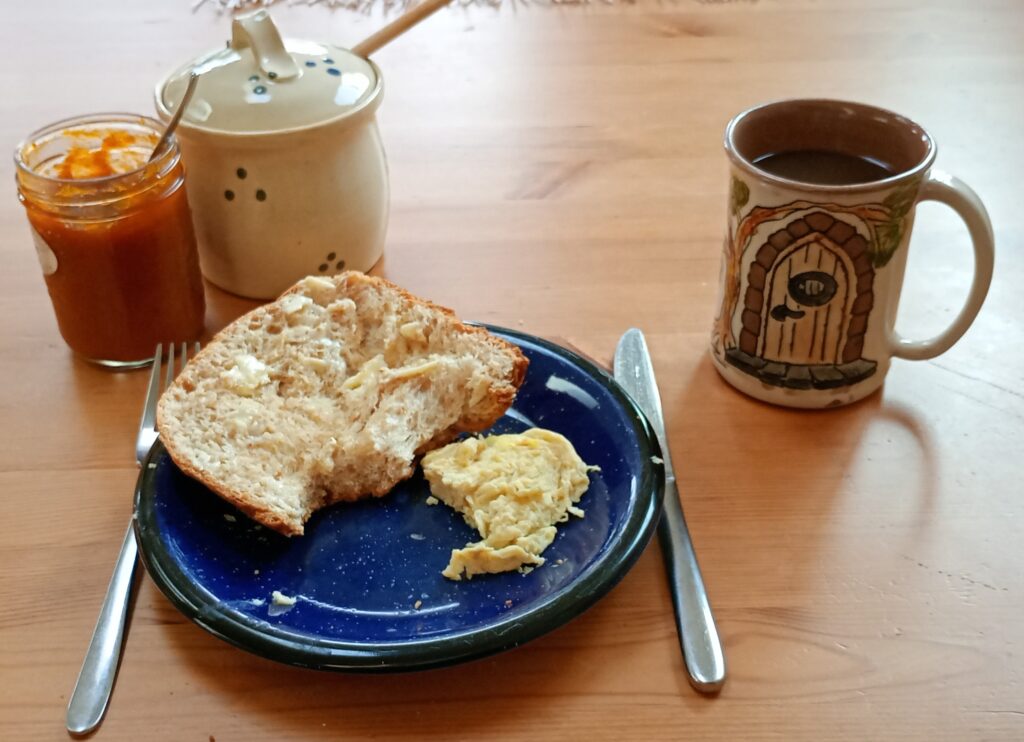
I, too, had a simple breakfast this morning of eggs and fresh-baked bread (yes, I know! Just bear with me). At 8am, my breadmaker beeped, whereupon I dumped the loaf out of the bread pan and set it to cool on a rack. At around 8:30, I cracked an egg into a bowl, bunged a frying pan onto the stove, turned the knob to medium, melted a bit of butter in the pan, poured the egg into the pan, pushed it around with a spatula, then put it on a plate with the buttered end of the warm loaf of bread. I poured myself another cup of coffee from the coffeemaker, and voilà, my simple breakfast!

But with the MC of our story, oh dear me, no.

Yes, she also cracks eggs and slices bread. But before she does any of that, she has to make a fire. Probably on an open hearth, as this is a rural cottage in the woods—but we’ll be charitable and give her a closed stove (more on that in a minute).

So, making a fire. Probably raking out the ashes of last night’s fire, getting some kindling, hauling in (hopefully already chopped) wood, stacking the fire, setting it alight, waiting however long it takes for it to catch, then to sort of die down to something less than an enthusiastic flame… Truth be told, I’ve never actually cooked on a wood or coal stove, let alone an open fire, aside from roasting wieners or marshmallows on a stick (it’s on the things-to-learn list). But I’m pretty sure you can’t cook on a fire when you first set it alight, you have to let it establish itself. Especially when you want a sort of middling flame for your medium-hot pan, which you absolutely need for an omelet (the pan can’t be too hot—you don’t want to know how I know).

Okay, so now she’s waiting for the fire to get to cookable dimensions, which gives her time to work on her omelet. That’s not much different from what we do today—crack the eggs, beat them up with a fork, then… Is it a plain omelet? Or does it have cheese, and chopped onion, and maybe some chopped bell peppers or tomatoes or herbs…? All of which would need dicing, grating, otherwise preparing… Well, we’ll just go with a plain omelet, it’s easiest. So, beaten eggs are in a bowl, the fire is at a cookable state, you heat the pan to medium, melt the butter, pour egg into pan.

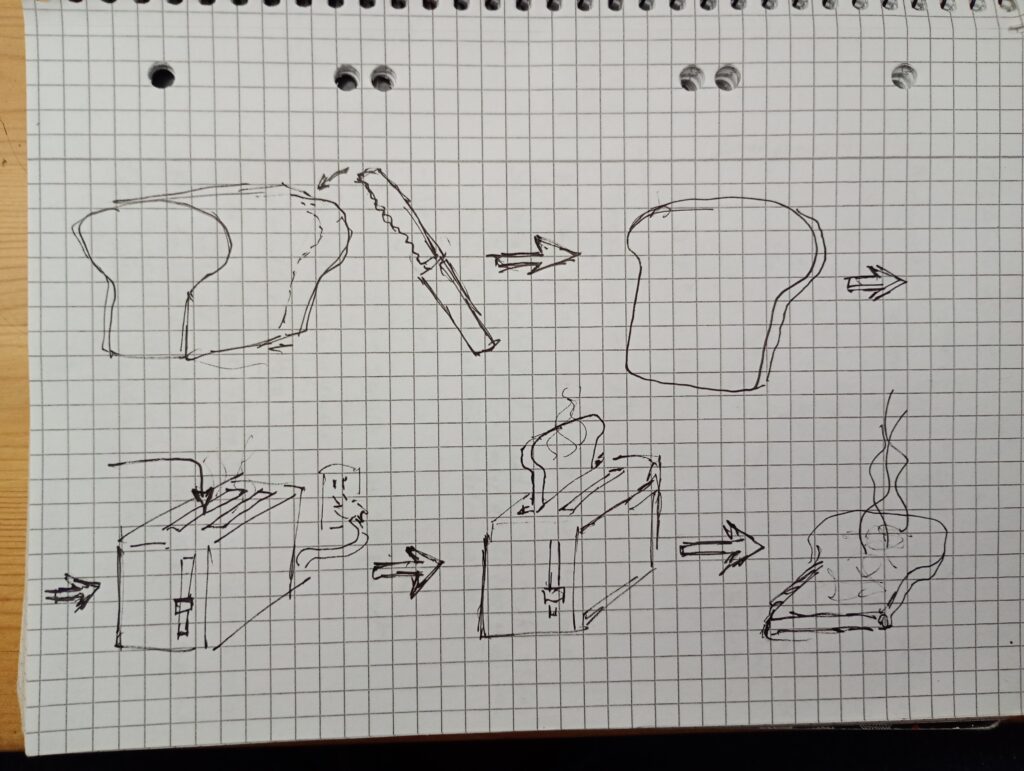
But then we get to the toast. Not just a slice of bread, toast. Which, in case you don’t know, is a slice of bread that’s toasted (you’re welcome). How does one make toast? Hang on, I can show you, I did a drawing (it was for a class):

That’s how you make toast, right? Every one of my classmates drew something almost exactly like this.

But our intrepid MC, she doesn’t have a toaster. No simply sticking your bread slice into an electric machine and pushing down a lever, to have a crispy golden brown slice pop up a few minutes later, steaming, for your delectation. So, again, I haven’t really made toast on an open fire myself, but I’ve burned marshmallows, so I know that they don’t work terribly well for toasting on an open flame. They want glowing coals. Which requires letting the fire burn down. And then you’re sitting there, patiently, with your item-to-be-toasted skewered on your toasting fork, and you carefully hold it to the heat source trying not to burn it (Whoosh! Marshmallow torch! Oops, sorry, that’s your modern Canadian campfire. Back to the topic—toasting bread on a breakfast fire). Which is not something you can do at the same time as carefully cooking an omelet, in an open pan, over that same fire, as you only have two hands.

And then—I did say we’d come back to the “closed stove” topic—our MC, after having consumed her simple breakfast, takes the leftovers and “tucks them in the oven” for her still-sleeping friends. That’s why she has to have a closed stove available to her. But woodfired ovens even in a woodstove are notoriously difficult to handle, from what I’ve read. They aren’t just on with a nice even heat like our electrical thingamagigs, they require fiddling with and knowing exactly what you’re doing, so you’re not burning one side of whatever-is-in-there and having the other side go cold.

Conversely, if our MC’s cottage-in-the-backwoods didn’t have a closed stove but an open fire and a separate oven, which is more likely for that time and place, that oven would be one of those stone or brick recesses in the wall with a door in front, like the one in Hansel and Gretel. That kind of oven you heat by building a big fire inside of it (that’s what the witch had Gretel do, intending to cook her), then when it’s at the right temperature, you rake out all the hot coals and quickly shove your bread (or witch) inside, clapping the door shut, to bake things in the residual heat being held by the thick stonework around it. All extremely time-consuming, not to mention highly skilled work.

In other words, very, very far from simple.

Okay, you’re probably tired of my ranting here. But you get the point: if you’re writing a historic novel, please think through what life “back then” was actually like. What’s “simple” now was actually very complex in times past. It took a huge amount of labour. Labour that, in most cases, was done by servants, or by your wife. And if you didn’t have servants or a wife, as is the case for the MC in this novel, you just didn’t have the things that took work. You made toast for a treat for Sunday afternoon tea, not for a quick, simple breakfast. You didn’t “tuck things in the oven”, you maybe put them “to simmer on the back of the hob” (which I’m not entirely sure of what that means, either, but have read about lots of times), and reserved the oven for baking once a week or so.

Today, I can have fresh-baked or toasted bread, scrambled eggs, and hot coffee for my breakfast, because I have an electric breadmaker, and a toaster, and an electric stove, and a coffee machine. I have electric servants. So for me, that kind of breakfast is simple. But in 1911, the terms “cooked” and “simple breakfast” did not belong in the same sentence.

It annoys me when today’s writers or readers completely disregard the amount of sheer labour that goes into having everyday creature comforts in the absence of the convenience that today’s electric and electronic machinery can give you. We disregard the work that people had to do in the past to get what we totally take for granted. We disregard the value of labour, and that means we disregard the value of the people who did that labour. “Simple” things actually take a lot of work. Let’s honour the people who did that work, shall we?

So next time you give your servantless MC in her historic-cottage-in-the-woods a “simple breakfast”, make it a (cold) slice of bread and hardboiled egg (cooked last night when she made dinner). I promise I won’t jump on you for it.

Life, the Universe, and Cooking a Simple Breakfast. I do like my electric servants.

PS: If you want to read more on this topic, check out my post on my visit to the Charles Dickens museum: “Dahl’s Chickens, or: Why They Needed Servants in Those Days

PPS: I won’t tell you the title or author of the novel that I’m talking about here, because my rant only pertains to that one, tiny half-sentence. In all other respects it’s quite a good book, and I don’t want to spoil anyone’s enjoyment of it.

PPPS: I said I’d stop ranting, but, don’t even get me started on the labour of producing textile work and the authors that sneer at “homespun”… I know, I know, that’s a post for another day.

It’s Been a Year

January Fog

It’s been a long, full, busy, and tiring year. I scrolled through my photos, and pulled out the most representative ones – just a few, you know – and ended up with nearly 80 of them. Yeah, like that.

That’s too many to put in a blog post, so I put them together into a video, just in case you’d like to see (if you can’t see the video above, click on the post title so you can look at it in your browser). It’s mostly about art and travelling, because that’s what I have photos of; the ordinary everyday things, like cooking and spending time with family and friends and sorting and cleaning cupboards and all that – you know, the stuff that makes up the bulk of one’s life – doesn’t show up in photos as readily (and if it does, it’s not that interesting).

The other thing is that it is, once again, the midnight of the year. Did I mention I’m tired? So I think I’ll draw the curtains, turn down the lights, grab my bear, and snuggle under the covers.

I’ll see you when it gets light again – say, around Candlemas?

Life, the Universe, and Time for a Break. Happy New Year to all, and to all a good night!

On Cinnamon and Peacocks

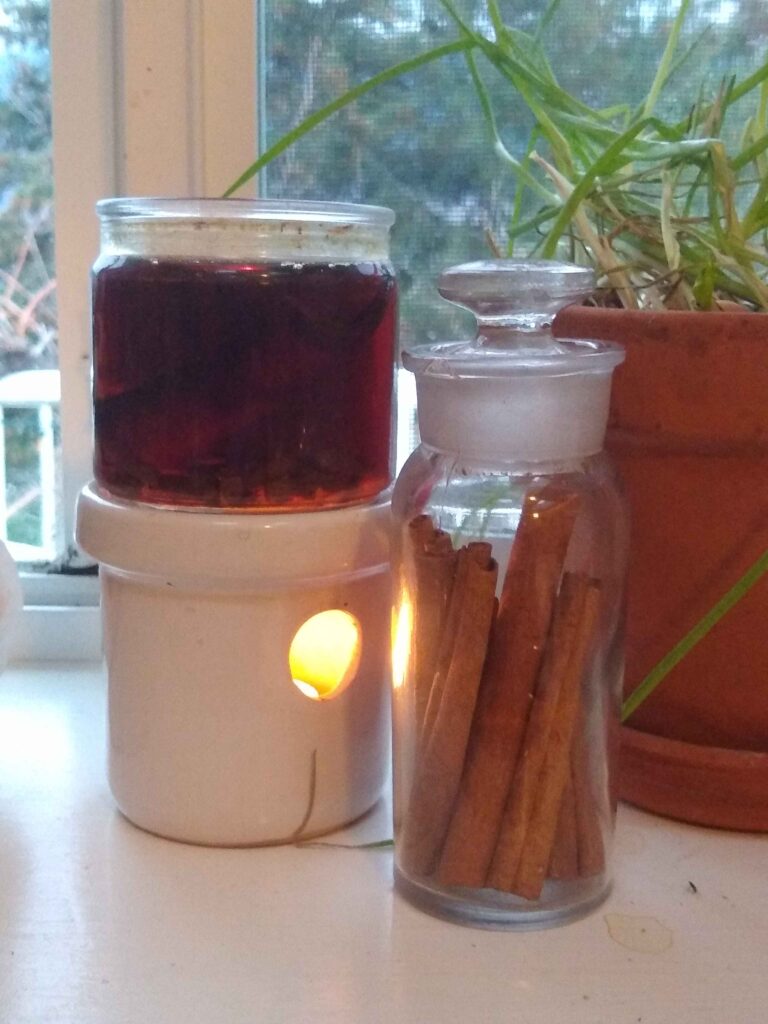
(‘Tis the season of cinnamon. I’m simmering some cinnamon sticks in my potpourri burner on the kitchen windowsill as I write this, just because I like the smell. And every time I put a fresh stick of cinnamon into the little pot on the burner, or liberally sprinkle cinnamon on apples for a pie or onto rolled out dough for cinnamon buns, I think about what a luxury it is to be able to do that. I wrote about it many years ago, in 2011, on my old Blogger blog, and though the prices quoted here have changed a lot, the rest of it still holds true. So I thought I’d share it again.)

2024 cinnamon stick simmering

26 November 2011

I went shopping the other day at our lovely local bulk foods store. We were running dismally low on such necessities of life as dried beans, rolled oats, and large chunks of chocolate, so the situation had to be remedied. Besides, Christmas is coming up, and it was imperative that I lay in the required supplies. One of the things I love about the bulk food store is the way it smells; they sell spices and other delectables from open bins with just a loose lid on them, so the scent permeates the whole shop. As it did my car, on the half-hour drive home.

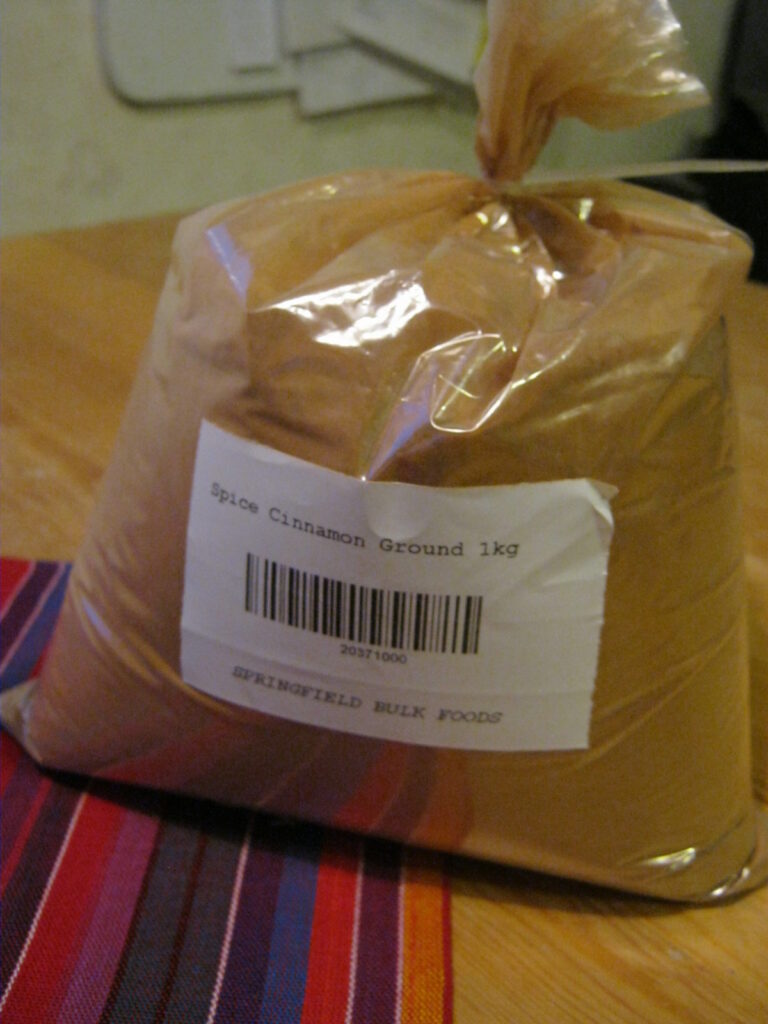
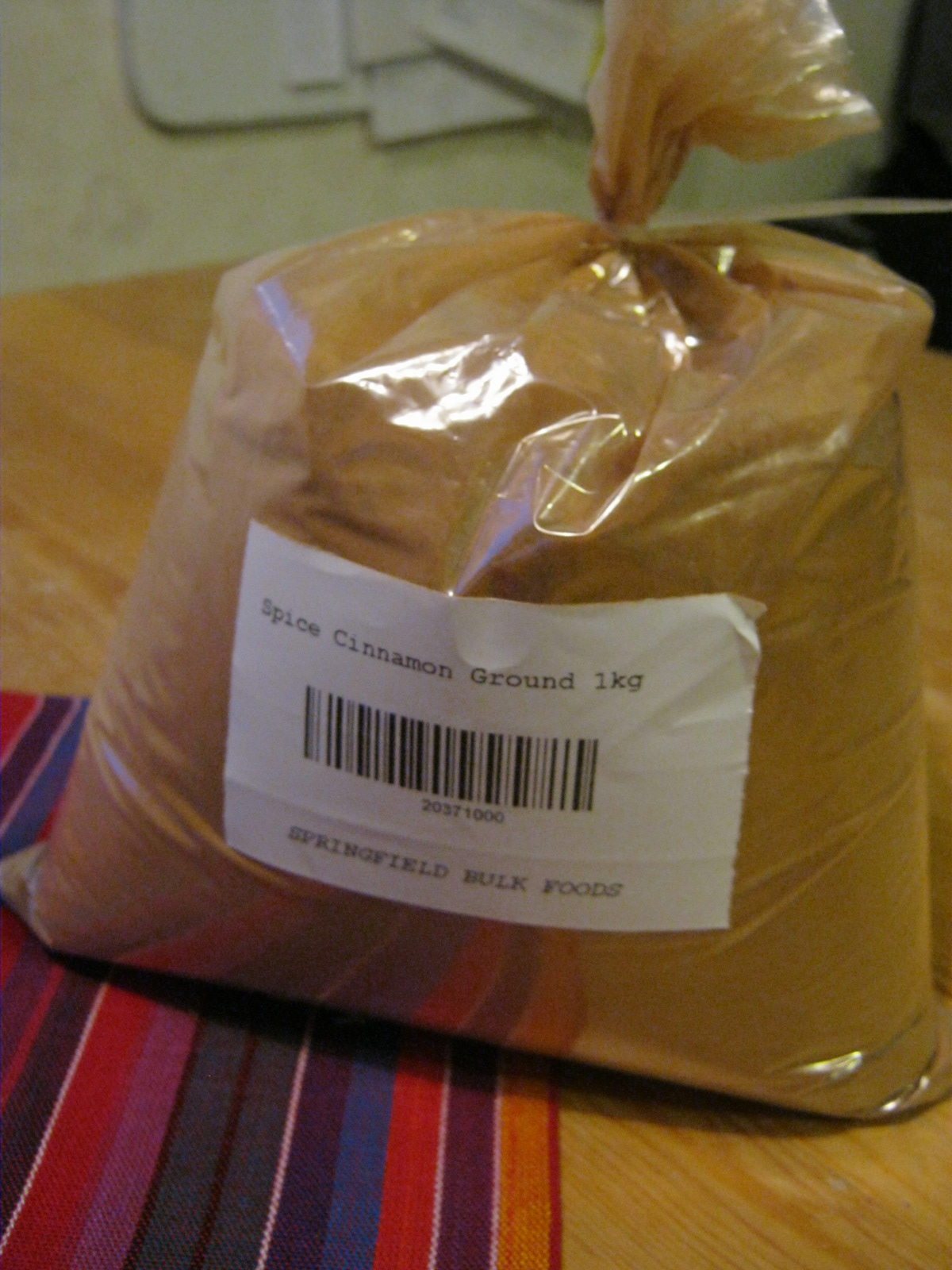
This, dear people, is a bag of cinnamon. A one-kilogram bag of cinnamon. For those of you in the US, that’s two-point-two pounds. And what I paid for it is $4.97. Four Canadian dollars, and ninety-seven cents. For those of you in Europe, that’s about €3.55. For those of you in the US, that’s $4.97. And for everyone else, that’s just plain ridiculous.

(2024 addendum: as I mentioned above, prices have changed a lot since then. At that same store, a kilo of Saigon [fancier] cinnamon now costs $25.56 – I just phoned them and asked. However. In 2011, minimum wage in this province was $8.75/hr; today it’s $17.40. So at minimum wage in 2011 you had to work for about 3/4 of an hour for a kilo of cinnamon, today it’s more like an hour and a half – not much more. Which is still ridiculous, because…)

You see, it was snowing that day as I was driving home, inhaling cinnamon scents all the way. Cold, white, soft flakes of snow. Temperatures just around the freezing point. And no, that’s not terribly unusual here for this time of year, even though, contrary to what you might think, I do not live in an igloo year-round, and my car moves on tires, not sled runners. (I live in Canada, not next door to Father Christmas and the North Polar Bear. Just sayin’.) But, my point is I’m driving home, through the snow, with a one-kilo bag of cinnamon in the car that I paid five bucks for.

For the last few years around Christmas, the local educational TV station has been broadcasting this very interesting show called “A Tudor Feast at Christmas” (2024 note: you can watch it on Youtube here). A team of English historians dress up in outfits from the late 16th century, go to an old manor house, and spend three days preparing a meal like the highest rungs of the social ladder in Elizabethan England would expect to be fed at a Christmas celebration (including a roasted peacock, ultra-elaborate and fancy). They use only the technology, ingredients and methods that would have been used at the time; and talk to the camera about how much bloomin’ work it is to grind almonds for marzipan in a mortar and pestle instead of using a food processor. Now that’s my kind of reality television!

So one of the blurbs that really stuck with me is where this food historian talks about cinnamon. He says, if I recall correctly, that cinnamon was nearly as precious as gold in those days – if not more so. Say, an English merchant outfitted three whole sailing ships, vessel, crew, supplies, everything, and sent those three ships off to the Spice Islands. He waits a full year for their return. Two of the ships are lost entirely, sunk off the coast of India in a storm. Just one of the ships makes it back to the cooler climates of Europe, its cargo hold loaded with the little fragrant brown sticks. That merchant, in spite of having lost two-thirds of an enormous investment, has just made his fortune for life.

Countries where it can snow in November are constitutionally incapable of growing cinnamon, so they have to bring it from elsewhere, from the far-away exotic shores of hot climates. Cinnamon, by rights, should be expensive around here. I have a feeling that my one-kilo bag of cinnamon, finely ground and powdery, probably equates to a wealthy person’s yearly income by 1597’s standards. But in case you were wondering, $4.97 doesn’t go very far in today’s Canada (note: in 2024, neither does $25.56). In fact, it’s only about twice of what I might pay for an equivalent weight in apples, which I could have picked from the trees in the orchard down the street a few months ago (note: now that isn’t actually true today – apples are way cheaper than that. But replace “apples” with “bread”, and it comes out about right).

I wonder if the price on whole roasted peacock with the skin put back on, presented at the table in all its peacocky splendour, is going to go through a similar price drop anytime soon?

Life, the Universe and Cinnamon. Steve says he’s looking forward to gingerbread. (2024: I’ll have to ask him if he wants any gingerbread this year too. Stuffed bears – they can be so demanding…)

Aurora, or: What Really Matters

For the last couple of months or so, I’ve been meaning to write a blog post. I was going to call it “Unsocial Media”, and it was meant to have been all about why I haven’t posted much for most of this year. I was going to be eloquent, and witty, make excuses and give explanations, be philosophical, tell you all about the important things in life…

But then, last night, this happened.

It was literally awesome.

I’ve been hoping and wishing to see the Aurora Borealis for years. It’s been a bucket list item for me. I’m on an Aurora Watch mailing list that sends me notifications with yellow alerts and red alerts when there’s likely to be one in my area. But I’d never actually seen them. Until a couple of days ago, when one of the Offspring came home after dark and dragged me outside: “You gotta see this!”

Truth be told, I needed to have them pointed out to me. I’d been expecting and looking for something spectacular, bright, red-and-green, undulating in the sky exacly north of here. But what I saw were some brightish, whitish, streaky things that I could have easily mistaken for clouds, in the Eastern sky, no less.

That’s them? That’s the Northern Lights?

It was. And once I knew what I was looking for, I saw them. All over the sky, not just the North like I expected. They come and go so quickly, you can miss them if you don’t pay attention. And to the naked eye they’re mostly white, at least the ones I saw were.

But they do dance. And they are spectacular. And there are colours – just not quite what I had expected. In fact, it’s quite possible that this was not actually the first time I’ve seen the Aurora Borealis; in all my times of hopefully gazing north, I might well have been looking right at them, and not known what I was seeing.

Last night, I was ready with my fancy camera and tripod. And I caught pictures of them, and the camera saw things my eyes did not and showed me the colours. But that’s not even that important. I sat outside on my balcony for more than an hour, wrapped in a hoody and a blanket and a poncho, and I think I had a big huge silly grin on my face for almost the entire time. I saw the Aurora.

So I’ll spare you my eloquence on that other stuff, there is no need for it.

Because this, my friends, is Life, the Universe, and the Things That Really Matter. It truly was awesome.