Soft Launch and Meatloaves (with Recipe!)

I’ve got a book coming out today. Did you know about this? Possibly not; I made very little fanfare about it.

I just took a webinar on Book Marketing, too. It was a good webinar; I learned some valuable material. But one of the things the presenter said was that book marketing should start way, way before the release date—like months before. And I thought to myself, well, I missed that boat with The Garden of Good Things.

But then—that was pretty much intentional. The fact of the matter is that I didn’t want to make a big deal of this book release. I have done so in the past; Seventh Son, on its first release, got all the fanfare I could throw at it. I even baked it a cake, and I splashed the book around on all the social media I was on at the time, brought print copies to real life events, etc etc.

You see, Seventh Son was a much, much bigger deal for me. It was the first book I ever wrote, the first book I learned self-publishing on, the first time I had made a real novel.

With Garden of Good Things, I just wrote it for fun one NaNoWriMo; and then after leaving it to languish in a drawer for about ten years I polished it up (with the help of my friend-and-editor Louise Bates, of course), packaged it into a novel, and put it online. And now you can read it and have fun with it, too. Not that big a deal.

It reminds me of the time an older, very accomplished friend of mine proudly announced on Facebook that he had just made a meatloaf, for the first time ever.

Full disclosure, I did have a small inward chuckle at his announcement. His first meatloaf, ever? I’ve been making meatloaf* for decades. Ditto for loaves of bread, jars of jam or canned peaches, cakes of any description, pots of stew, knitted socks, and so on. Announcing them on Facebook would get rather monotonous – they’re just not a big deal to me anymore.

There are other things that are a big deal to me at the moment—they make me so nervous they keep me up at night for weeks beforehand, even though they probably make you chuckle quietly to yourself and say “What’s the big deal?” Selling my ceramics at markets and in shops is one of them for me right now—eeep, yikes, look what I did!

But as for meatloaves and jams and socks, no big deal.

The thing is that they’re just ordinary, everyday, commonplace meatloaves and jams and socks. We eat them or wear them, and sometimes they’re a little burnt or there’s a missed stitch—last year’s apricot jam has bits of an apricot pit in it that accidentally got beaten up with the pulp. Less than perfect, but perfectly alright for everyday.

That’s all I want for my meatloaves and jams and socks. I don’t intend to sell them, and I don’t want to win prizes with them; they don’t need fanfare, they just need to fulfil their purpose.

In the case of hand-knitted socks, that’s especially pertinent. Because for me, the point of making socks is to make them. I enjoy knitting; having something to wear at the end is a beneficial byproduct.

That’s kind of what happened with The Garden of Good Things, too. I wrote it for the fun of writing it, and then I had a book, so I thought I might as well publish it. But I don’t want to make a big deal of it, because it’s not a big-deal kind of book.

But that’s just me and this particular book (and a few others like it that I have on the back burner). I don’t mean to say that writing a book is not a big deal (good grief, no!). But not every book needs to have a big fanfare blown for it. There’s room for the everyday kind of books, too, just for fun.

My friend’s meatloaf was a big deal because it was his first one. Other people’s meatloaves might be a big deal because they’re gourmet, the pinnacle of meatloafness; or because selling meatloaves is this person’s business. My meatloaves, tasty though they are, are kind of ordinary and, as such, no big deal.

Some books of mine are a big deal for one reason or another, and hopefully there’ll be more of those in the future. Other people’s books are a big deal, for them and for their readers, not least because they might aim to make money on them. And those big-deal books, like some meatloaves, deserve all the fanfares and advertising campaigns. But you don’t have to blow the fanfare for every one of them.

So as for The Garden of Good Things, it’s getting a soft launch. This is me, just quietly saying “I made a book, wanna read it?” You might enjoy it, and just like handknitted socks warm your toes and meatloaves warm your belly, I hope it warms your soul.

And that’s Life, the Universe, a Soft Launch and Meatloaves. Go here or contact me for the The Garden of Good Things, and keep reading for the meatloaf recipe.
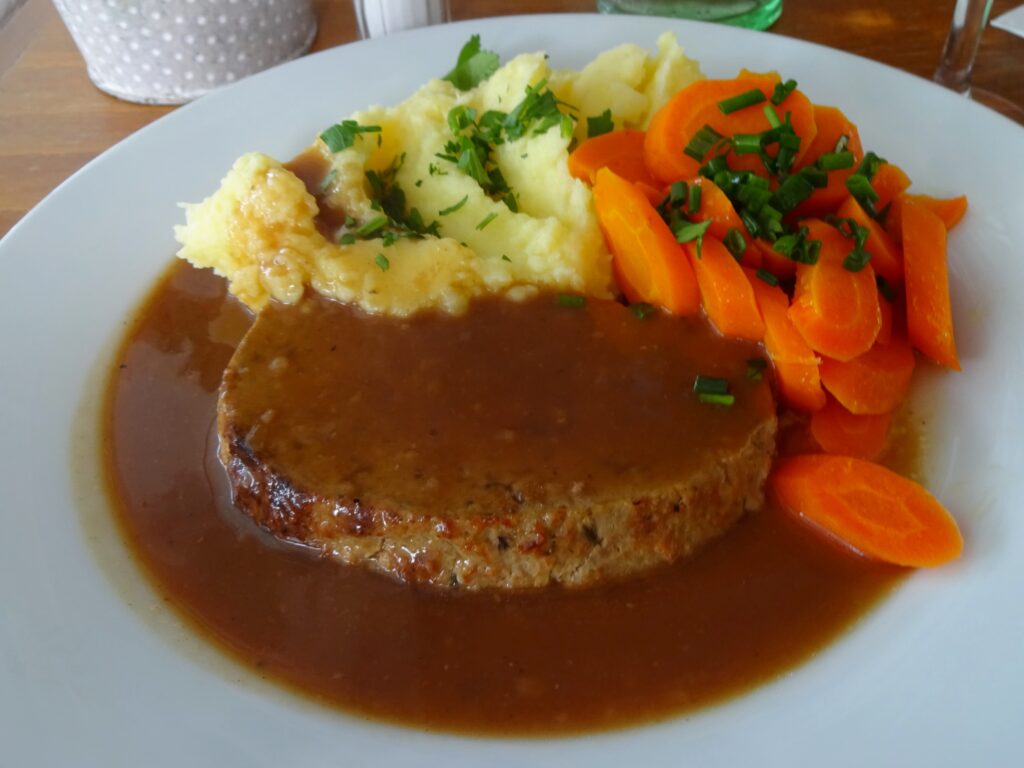
Photo credit: Benreis, CC BY-SA 4.0 https://creativecommons.org/licenses/by-sa/4.0, via Wikimedia Commons

PS: So you can make your very own meatloaf to eat while you read the book, here’s my recipe:

*GERMAN MEATLOAF by Angelika

1-2 lbs/500-800g of ground beef (or pork or chicken)
1 stale (day-old) Kaiser bun, or the equivalent amount of sliced bread (I save the heel of loaves and let them dry out in the back of the breadbox especially for this purpose)
1 egg
1 small onion
1 tsp salt (or less, according to taste)
1/4 tsp pepper or a few grinds of the pepper mill
1 tsp dried parsley, or 2 Tbsp chopped fresh
1/2 tsp dried oregano (or chopped fresh)
1/4 tsp ground paprika

-finely mince the onion. Sauté it in a bit of oil until translucent.
-soak the dry bread in water, then squeeze it out like a wet dishcloth.
-put all ingredients together in a medium-sized bowl.
-squish everything together with your hands until well combined. If that’s too icky for you, mix it with a spoon or potato masher, but hands work best.
-put it in a 5×9” loaf pan, or form into a round loaf shape and put in a larger pan or cookie sheet with high rim. Poke 3-4 holes in the middle (optional, makes it cook more evenly).
bake at 350° for 1 hr.
-let stand for five minutes or so, then slice and serve! We like it with gravy, rice or mashed potatoes, and a salad.
Note: If there’s any left over, it’s really good cold, sliced thinly on sandwiches. Also, this mixture makes great hamburgers or meatballs (fry in a pan, or bake or broil for 20 minutes).
Guten Appetit!
I Cooked a Simple Breakfast

“I cooked a simple breakfast of omelet and toast,” says the main character of a historic novel I recently read, in a throwaway half sentence. A simple breakfast. Of omelet and toast. In a cottage in the backwoods of Ireland, in 1911. Wait, simple?

Let’s break this down, shall we.

In order to make an omelet (or omelette, depending on where you live), you need to, of course, crack eggs, and… Hold on, back up.

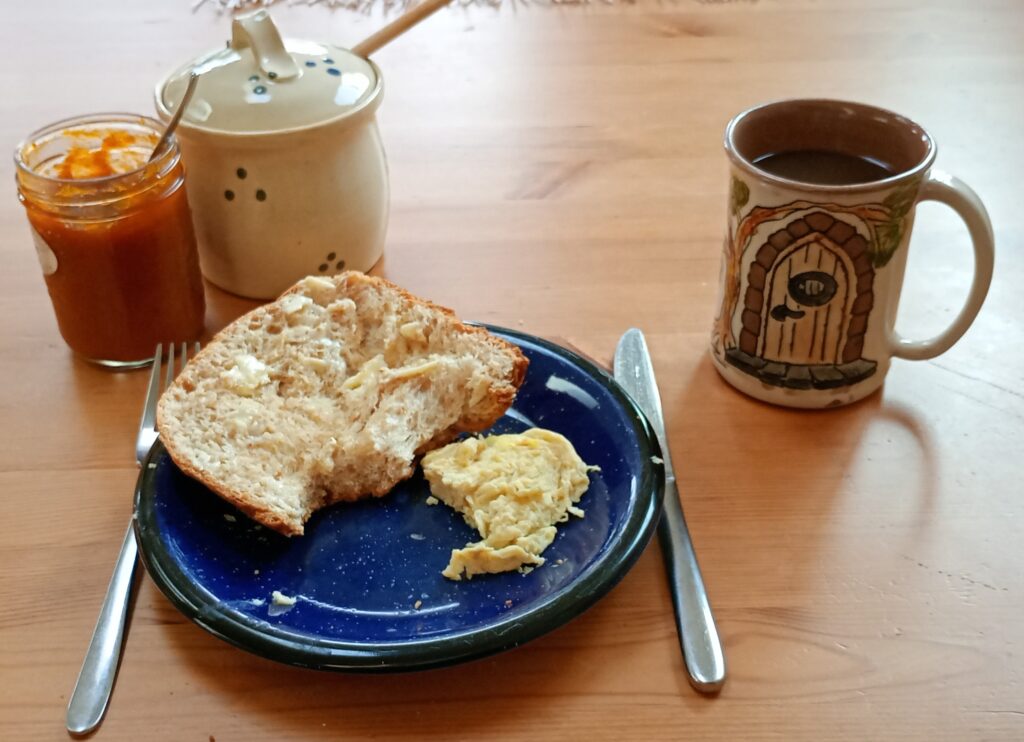
I, too, had a simple breakfast this morning of eggs and fresh-baked bread (yes, I know! Just bear with me). At 8am, my breadmaker beeped, whereupon I dumped the loaf out of the bread pan and set it to cool on a rack. At around 8:30, I cracked an egg into a bowl, bunged a frying pan onto the stove, turned the knob to medium, melted a bit of butter in the pan, poured the egg into the pan, pushed it around with a spatula, then put it on a plate with the buttered end of the warm loaf of bread. I poured myself another cup of coffee from the coffeemaker, and voilà, my simple breakfast!

But with the MC of our story, oh dear me, no.

Yes, she also cracks eggs and slices bread. But before she does any of that, she has to make a fire. Probably on an open hearth, as this is a rural cottage in the woods—but we’ll be charitable and give her a closed stove (more on that in a minute).

So, making a fire. Probably raking out the ashes of last night’s fire, getting some kindling, hauling in (hopefully already chopped) wood, stacking the fire, setting it alight, waiting however long it takes for it to catch, then to sort of die down to something less than an enthusiastic flame… Truth be told, I’ve never actually cooked on a wood or coal stove, let alone an open fire, aside from roasting wieners or marshmallows on a stick (it’s on the things-to-learn list). But I’m pretty sure you can’t cook on a fire when you first set it alight, you have to let it establish itself. Especially when you want a sort of middling flame for your medium-hot pan, which you absolutely need for an omelet (the pan can’t be too hot—you don’t want to know how I know).

Okay, so now she’s waiting for the fire to get to cookable dimensions, which gives her time to work on her omelet. That’s not much different from what we do today—crack the eggs, beat them up with a fork, then… Is it a plain omelet? Or does it have cheese, and chopped onion, and maybe some chopped bell peppers or tomatoes or herbs…? All of which would need dicing, grating, otherwise preparing… Well, we’ll just go with a plain omelet, it’s easiest. So, beaten eggs are in a bowl, the fire is at a cookable state, you heat the pan to medium, melt the butter, pour egg into pan.

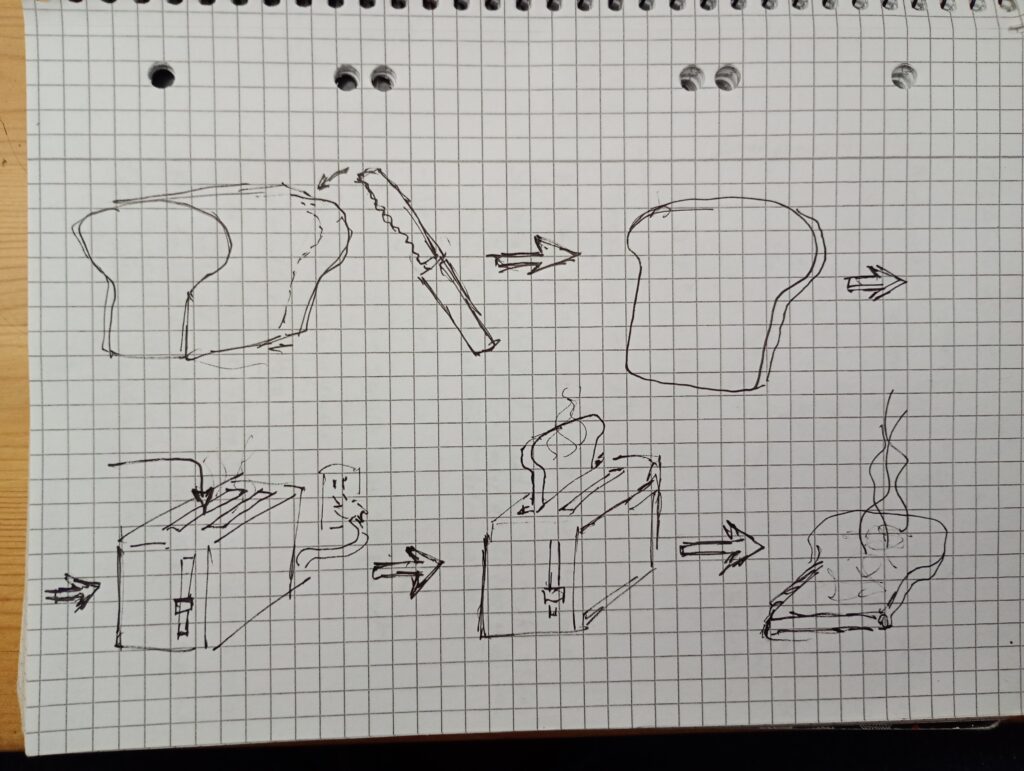
But then we get to the toast. Not just a slice of bread, toast. Which, in case you don’t know, is a slice of bread that’s toasted (you’re welcome). How does one make toast? Hang on, I can show you, I did a drawing (it was for a class):

That’s how you make toast, right? Every one of my classmates drew something almost exactly like this.

But our intrepid MC, she doesn’t have a toaster. No simply sticking your bread slice into an electric machine and pushing down a lever, to have a crispy golden brown slice pop up a few minutes later, steaming, for your delectation. So, again, I haven’t really made toast on an open fire myself, but I’ve burned marshmallows, so I know that they don’t work terribly well for toasting on an open flame. They want glowing coals. Which requires letting the fire burn down. And then you’re sitting there, patiently, with your item-to-be-toasted skewered on your toasting fork, and you carefully hold it to the heat source trying not to burn it (Whoosh! Marshmallow torch! Oops, sorry, that’s your modern Canadian campfire. Back to the topic—toasting bread on a breakfast fire). Which is not something you can do at the same time as carefully cooking an omelet, in an open pan, over that same fire, as you only have two hands.

And then—I did say we’d come back to the “closed stove” topic—our MC, after having consumed her simple breakfast, takes the leftovers and “tucks them in the oven” for her still-sleeping friends. That’s why she has to have a closed stove available to her. But woodfired ovens even in a woodstove are notoriously difficult to handle, from what I’ve read. They aren’t just on with a nice even heat like our electrical thingamagigs, they require fiddling with and knowing exactly what you’re doing, so you’re not burning one side of whatever-is-in-there and having the other side go cold.

Conversely, if our MC’s cottage-in-the-backwoods didn’t have a closed stove but an open fire and a separate oven, which is more likely for that time and place, that oven would be one of those stone or brick recesses in the wall with a door in front, like the one in Hansel and Gretel. That kind of oven you heat by building a big fire inside of it (that’s what the witch had Gretel do, intending to cook her), then when it’s at the right temperature, you rake out all the hot coals and quickly shove your bread (or witch) inside, clapping the door shut, to bake things in the residual heat being held by the thick stonework around it. All extremely time-consuming, not to mention highly skilled work.

In other words, very, very far from simple.

Okay, you’re probably tired of my ranting here. But you get the point: if you’re writing a historic novel, please think through what life “back then” was actually like. What’s “simple” now was actually very complex in times past. It took a huge amount of labour. Labour that, in most cases, was done by servants, or by your wife. And if you didn’t have servants or a wife, as is the case for the MC in this novel, you just didn’t have the things that took work. You made toast for a treat for Sunday afternoon tea, not for a quick, simple breakfast. You didn’t “tuck things in the oven”, you maybe put them “to simmer on the back of the hob” (which I’m not entirely sure of what that means, either, but have read about lots of times), and reserved the oven for baking once a week or so.

Today, I can have fresh-baked or toasted bread, scrambled eggs, and hot coffee for my breakfast, because I have an electric breadmaker, and a toaster, and an electric stove, and a coffee machine. I have electric servants. So for me, that kind of breakfast is simple. But in 1911, the terms “cooked” and “simple breakfast” did not belong in the same sentence.

It annoys me when today’s writers or readers completely disregard the amount of sheer labour that goes into having everyday creature comforts in the absence of the convenience that today’s electric and electronic machinery can give you. We disregard the work that people had to do in the past to get what we totally take for granted. We disregard the value of labour, and that means we disregard the value of the people who did that labour. “Simple” things actually take a lot of work. Let’s honour the people who did that work, shall we?

So next time you give your servantless MC in her historic-cottage-in-the-woods a “simple breakfast”, make it a (cold) slice of bread and hardboiled egg (cooked last night when she made dinner). I promise I won’t jump on you for it.

Life, the Universe, and Cooking a Simple Breakfast. I do like my electric servants.

PS: If you want to read more on this topic, check out my post on my visit to the Charles Dickens museum: “Dahl’s Chickens, or: Why They Needed Servants in Those Days

PPS: I won’t tell you the title or author of the novel that I’m talking about here, because my rant only pertains to that one, tiny half-sentence. In all other respects it’s quite a good book, and I don’t want to spoil anyone’s enjoyment of it.

PPPS: I said I’d stop ranting, but, don’t even get me started on the labour of producing textile work and the authors that sneer at “homespun”… I know, I know, that’s a post for another day.

Have Bear, Will Travel: Part 2; a.k.a. Lunches and Flowers and Bears, Oh My!

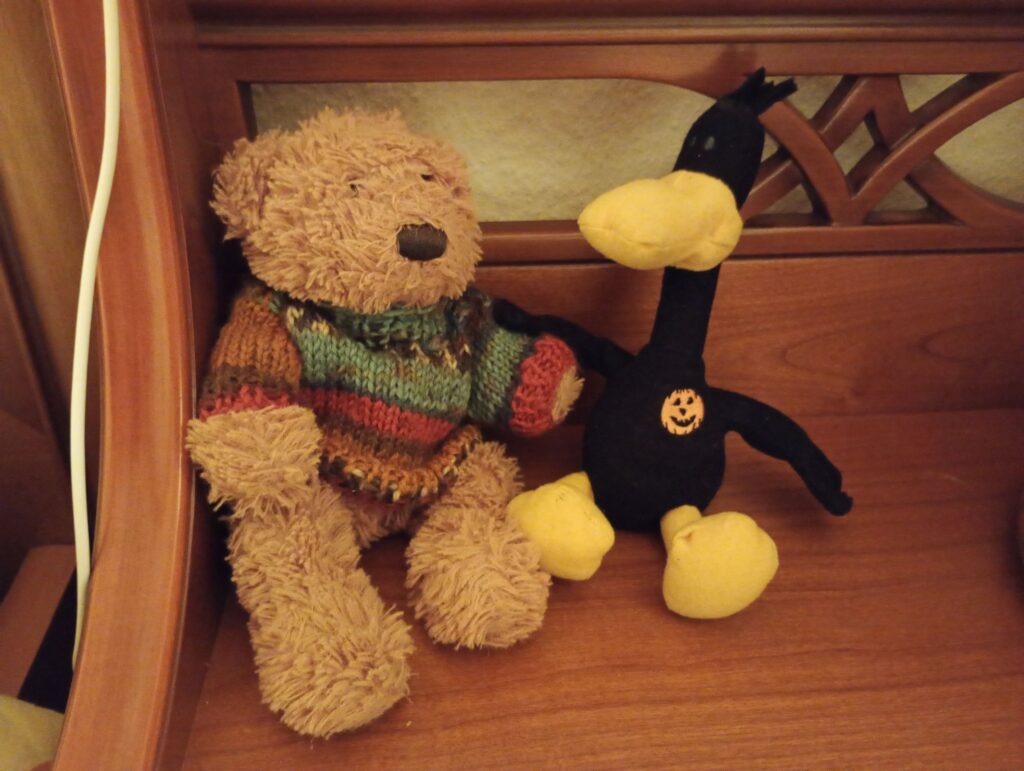
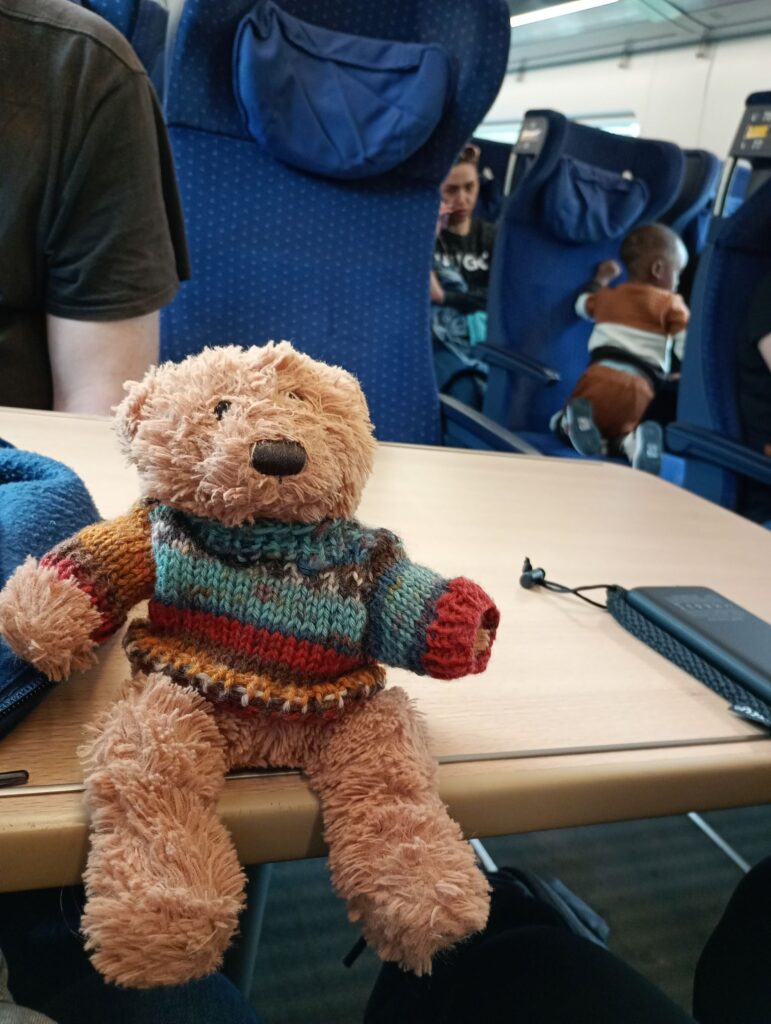
Bear on family visit
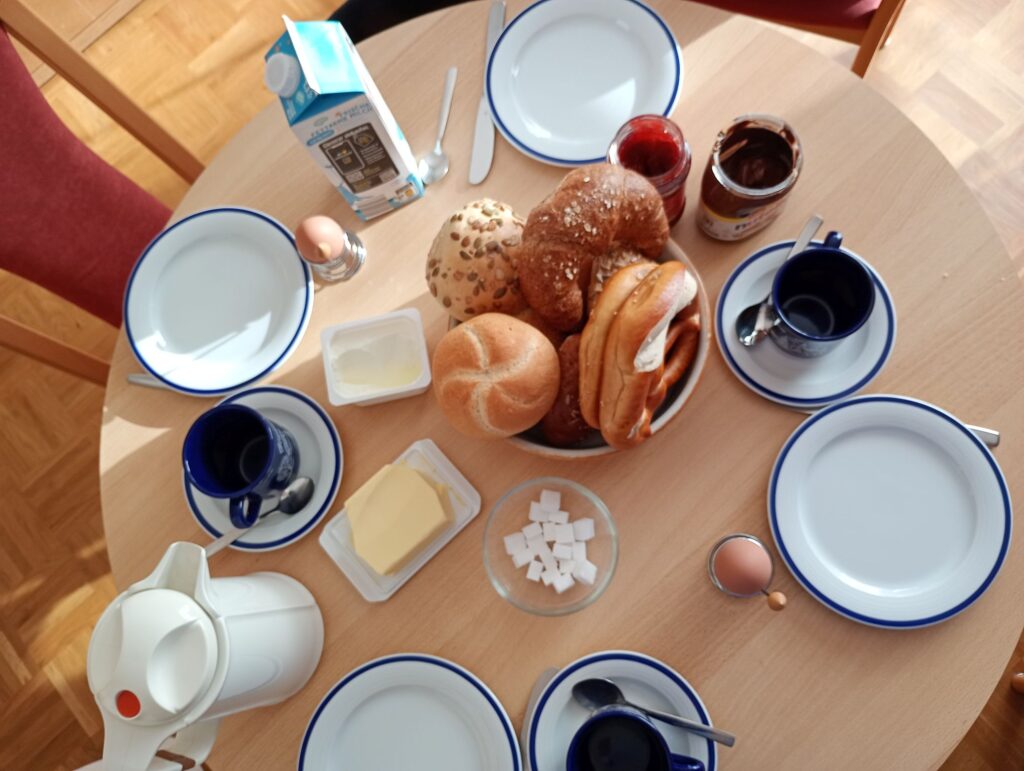
German breakfast
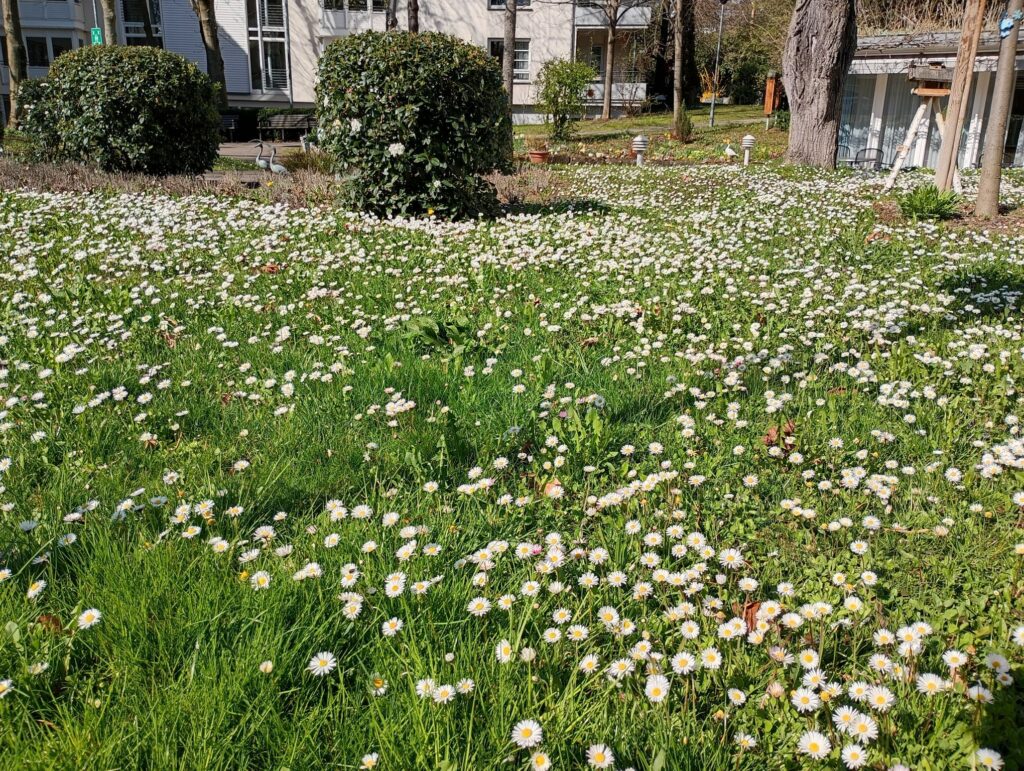
Daisies
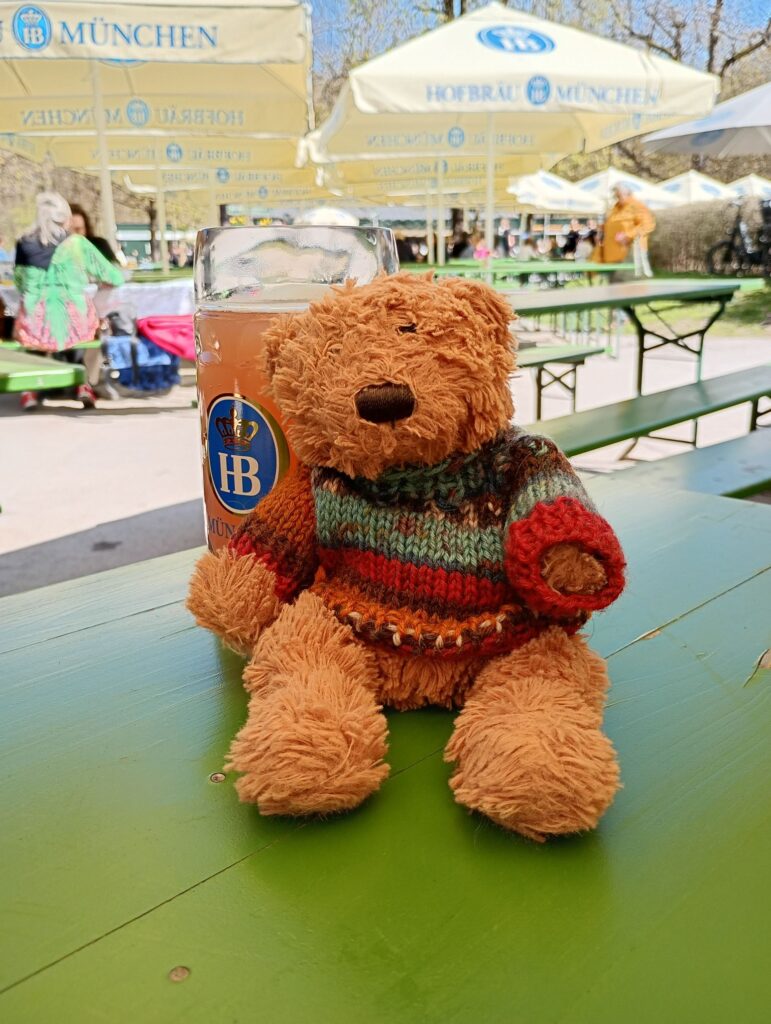
Bear in Munich
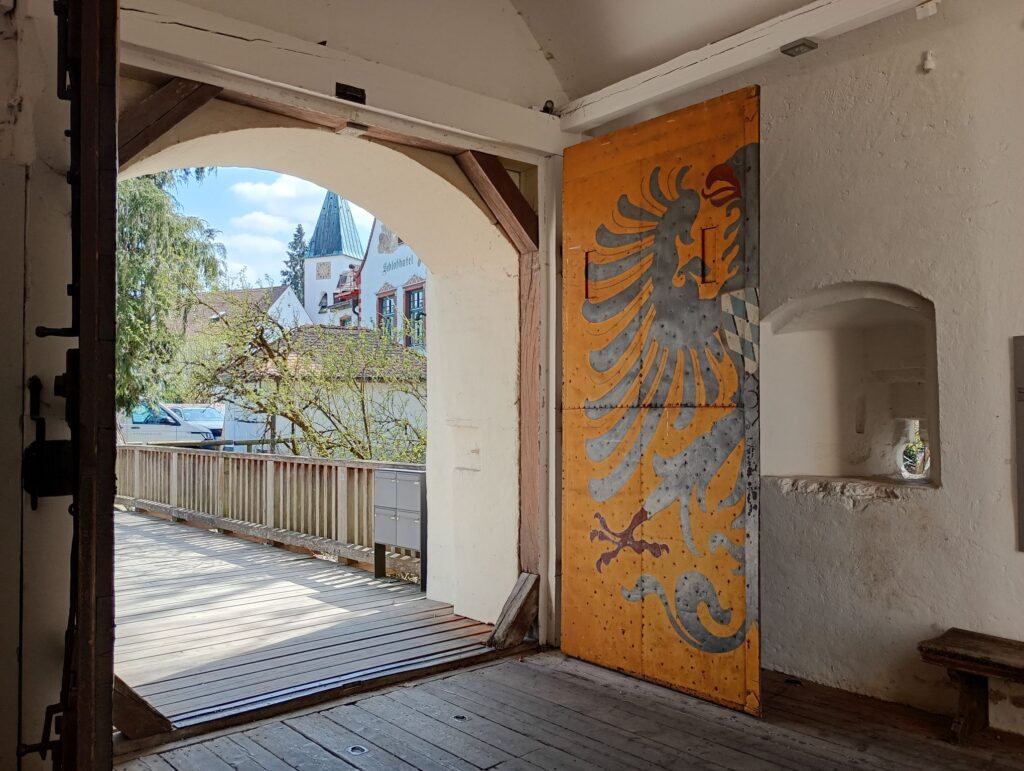
Looking at a castle (Burg Grünwald)
Bloomin’ wild cherry in forest
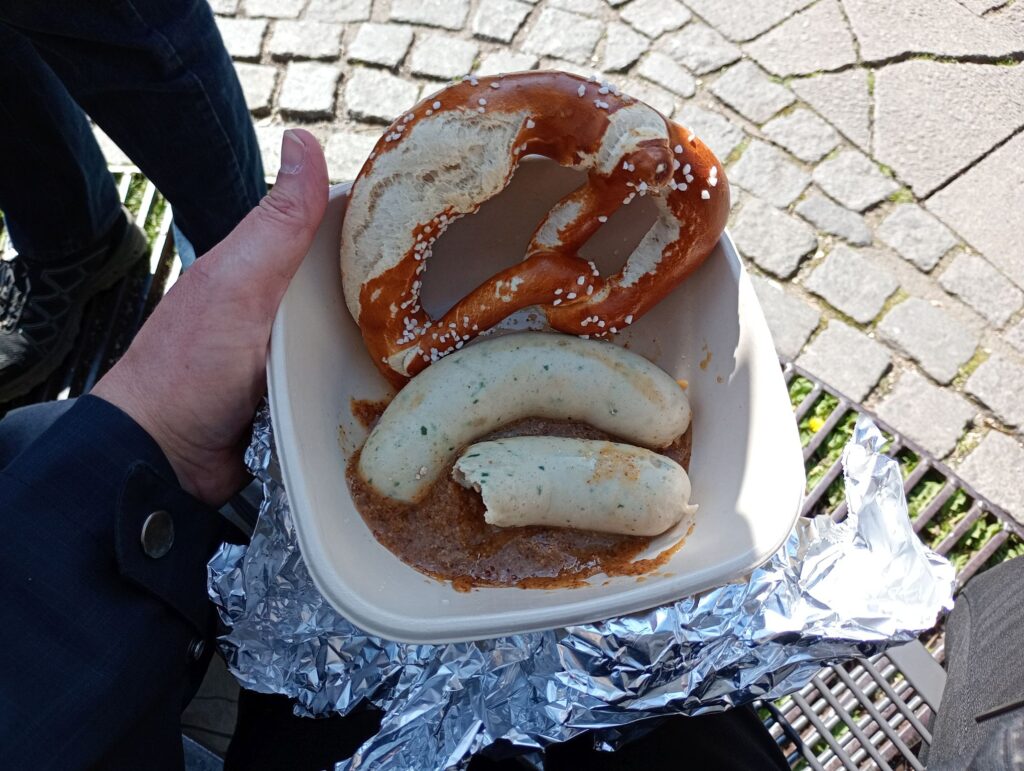
Bavarian lunch (Weißwurst und Breze)
Looking at a Bavarian lake (Ammersee)
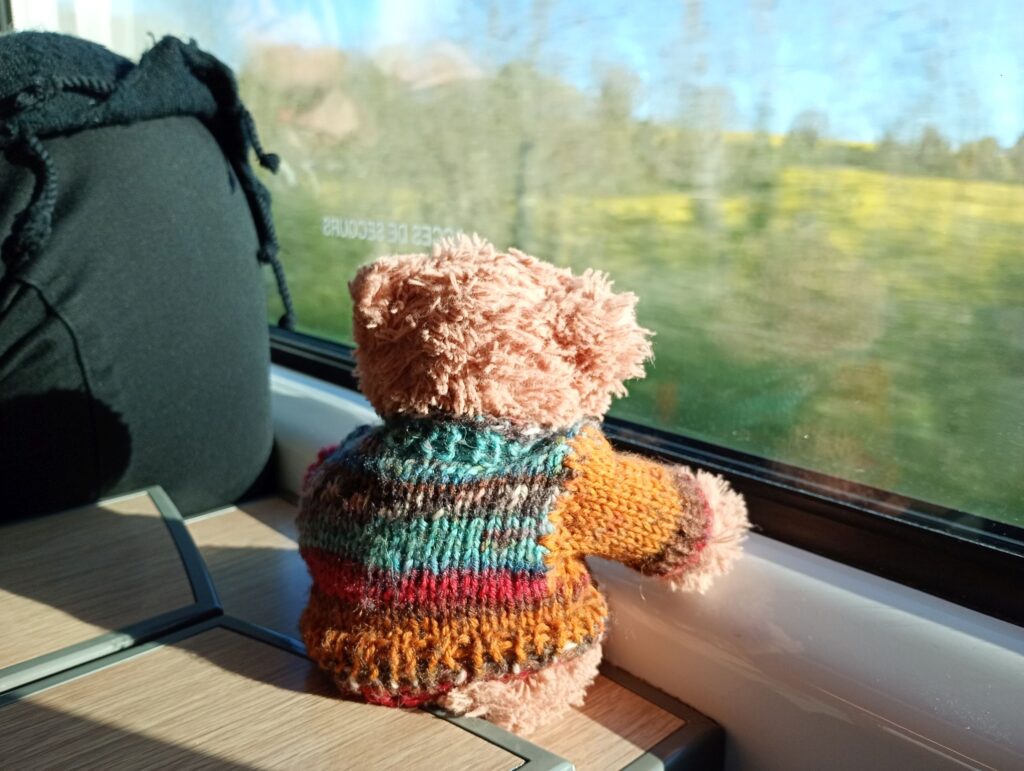
Bear on train to Paris
Japanese cherry blossoms in Paris
Bear on train to Normandy
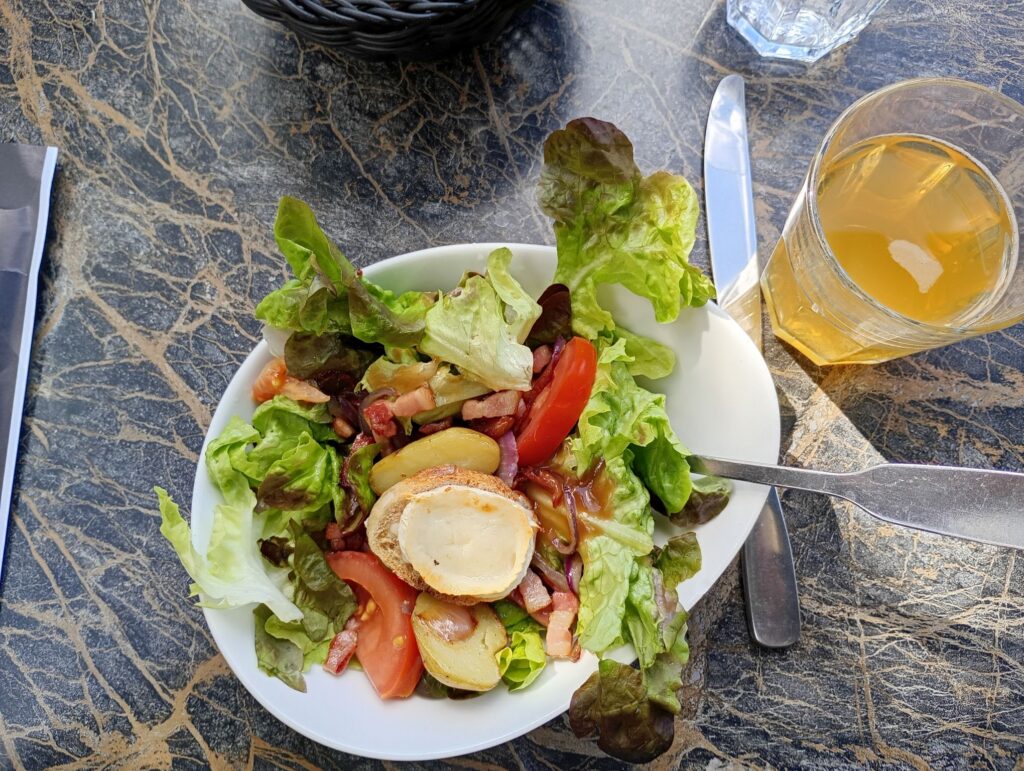
Norman lunch (chevre salad and cidre)
Looking at Bayeux
Gargoyle in Bayeux (not a bear, we think)
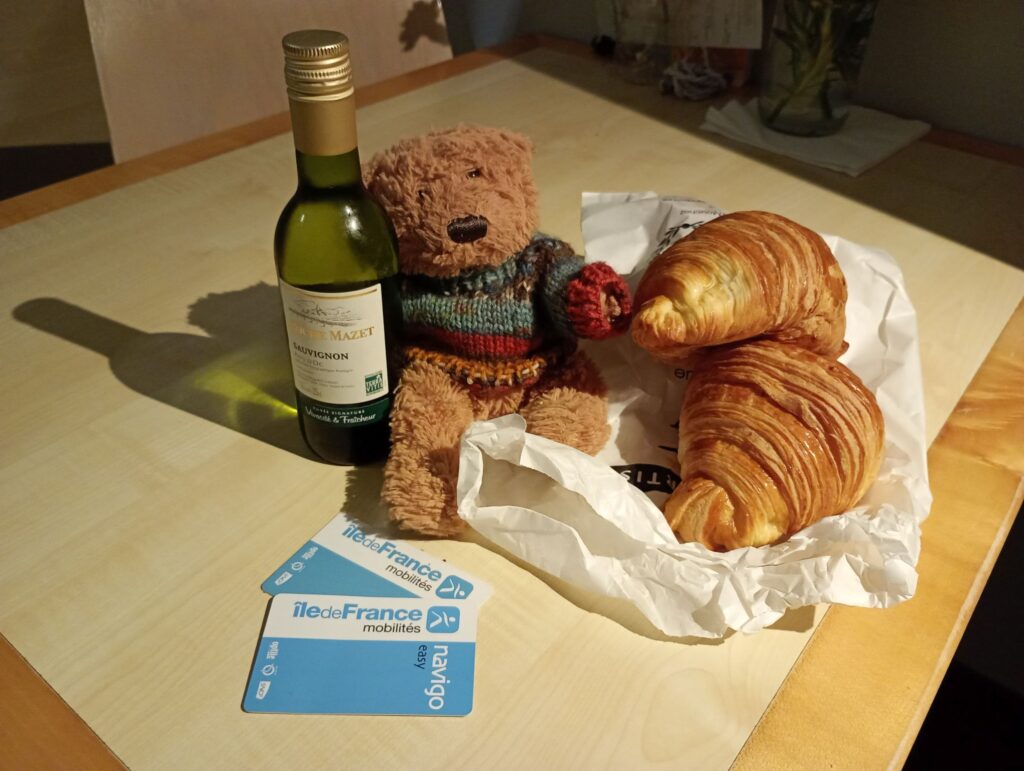
Bear enjoying the amenities of Paris (tiny bottle of wine and big fluffy croissants) before it’s time to head home

Pfannkuchen, or, A Recipe Page

For quite some now I’ve been tossing around the idea of building a recipe website. Not one of those food blogs, where you find out about the latest and greatest in cookery trends, or where I pontificate about the most, ahem, righteous way to eat – just a simple page where I can share some of the skills and recipes I’ve gathered in my many years of feeding a family. Because cooking really isn’t hard, and there are a lot of things one can do with not very many or very fancy ingredients. But above all, because good food is just a very good thing.

I’ve been learning a bit (a tiny bit – no, make that a very, very tiny bit) about web design recently, and I thought I’d try out what a recipe page could look like. I already had this German Pancake recipe written out for another purpose, and as it was Shrove Tuesday (aka Pancake Tuesday) this past week, it seems apt. Don’t you think?

So here we go! (I’m especially proud of the “Jump to Recipe” button…)

Pfannkuchen (German Pancakes or Crepes)

Jump to Recipe

This was a common and popular dinner at our house when I was growing up. It usually started with soup, then pancakes and a side dish of fruit such as applesauce. I made them for my own kids who called them Petzi Pancakes, after a picture book series about a small world-travelling bear named Petzi who ends every one of his trips back at his mother’s house, eating a big stack of rolled up pancakes filled with jam.

Ingredients:

  • 250 g (1 1/2 c) Flour
  • 2 Eggs
  • 1 tsp Salt
  • 3/8 l (1 1/2 c) Milk
  • Oil for frying

(makes enough for 2 people as a meal, or 4 as a side dish)

Instructions:

With a wire whisk or beaters, beat flour, eggs, salt, and half the milk until smooth. Gradually add the remaining milk until you have a runny batter the consistency of thick cream or gravy.

Heat a not-too-heavy frying pan on medium-high heat. Add 1 tsp. oil to coat the bottom. When the oil is very hot (the surface shimmers and you can feel the heat rising from the pan), pick up the pan and pour in a small ladleful of batter; it should hiss. Tilt the pan to make the batter coat the whole bottom of the pan (that’s why it needs to be a not-too-heavy pan; it’s the only dish I don’t use my cast iron for).

Bake until the whole surface is dry, then flip over with a spatula. Or, if you want to show off your kitchen acrobatics, shake the pan until the pancake comes loose, and with a flick of your wrist flip it in the air (I’ve never managed to do that myself).

Bake until the bottom is brown (lift one edge with the spatula to check).

Stack them on a plate with a lid on top or put in the slightly heated oven to keep warm.

To serve, sprinkle with sugar, spread with jam, or drizzle with syrup, then roll up with your fingers and take a bite! Serve with applesauce or other fruit on the side.

Alternatively, since there is no sugar in the batter, these also work for savoury dishes, for example as a side dish for cooked vegetables, filled with creamed mushrooms, etc.

The batter is very similar to the dough for homemade noodles, so leftover Pfannkuchen can even be used in soup:

Flädle Suppe

  • 1 l (4 c) hot broth – beef, chicken, vegetable, etc
  • 2-3 cold leftover Pfannkuchen
  • Optional: 1 Tbsp of finely chopped chives

Roll up the pancakes, slice into very thin strips like fettucini. Bring the broth to a boil, dump in the pancake “noodles”, give it a stir, sprinkle on some chives and serve immediately.

Flädle Suppe

Guten Appetit!
On Cinnamon and Peacocks

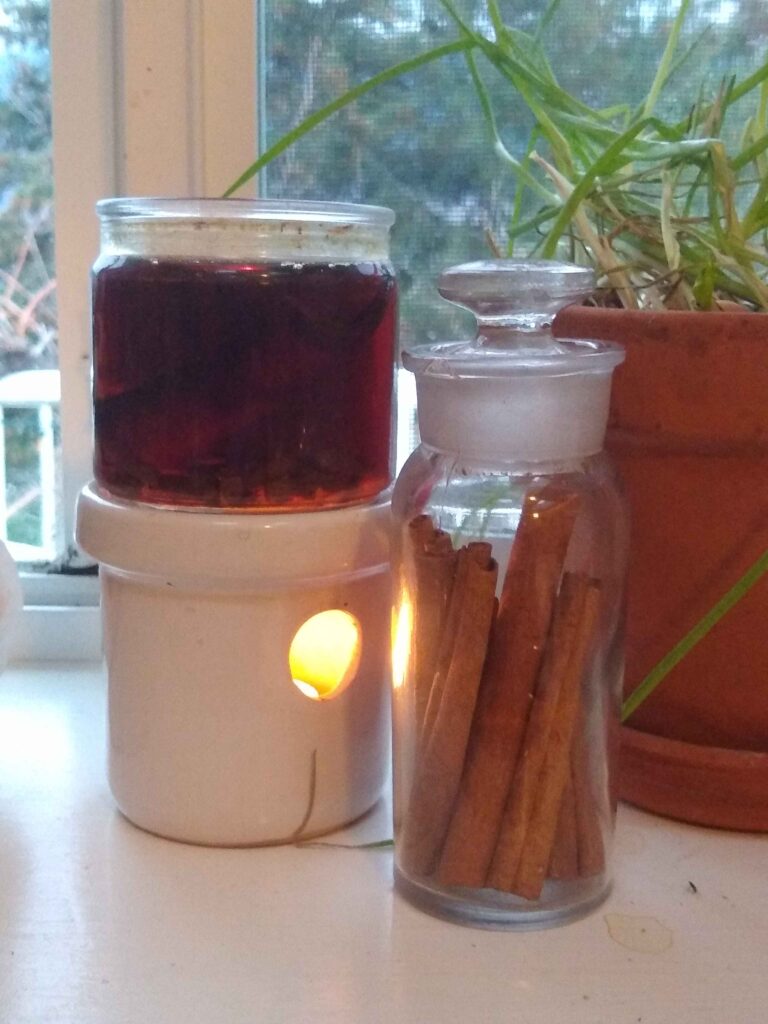
(‘Tis the season of cinnamon. I’m simmering some cinnamon sticks in my potpourri burner on the kitchen windowsill as I write this, just because I like the smell. And every time I put a fresh stick of cinnamon into the little pot on the burner, or liberally sprinkle cinnamon on apples for a pie or onto rolled out dough for cinnamon buns, I think about what a luxury it is to be able to do that. I wrote about it many years ago, in 2011, on my old Blogger blog, and though the prices quoted here have changed a lot, the rest of it still holds true. So I thought I’d share it again.)

2024 cinnamon stick simmering

26 November 2011

I went shopping the other day at our lovely local bulk foods store. We were running dismally low on such necessities of life as dried beans, rolled oats, and large chunks of chocolate, so the situation had to be remedied. Besides, Christmas is coming up, and it was imperative that I lay in the required supplies. One of the things I love about the bulk food store is the way it smells; they sell spices and other delectables from open bins with just a loose lid on them, so the scent permeates the whole shop. As it did my car, on the half-hour drive home.

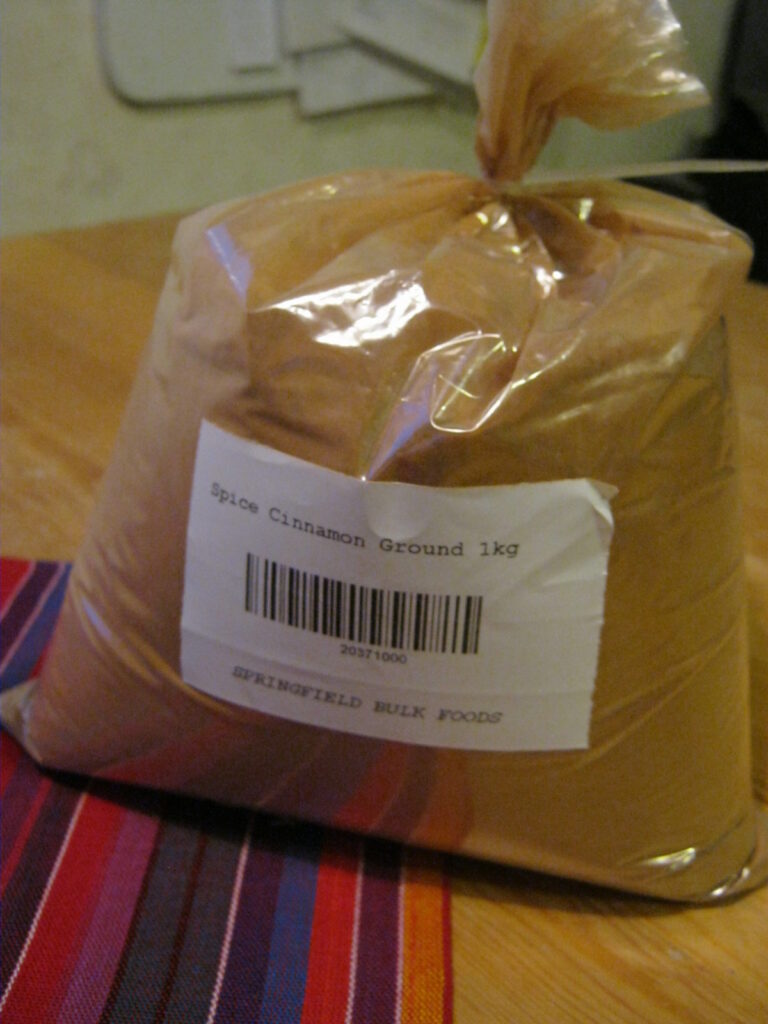
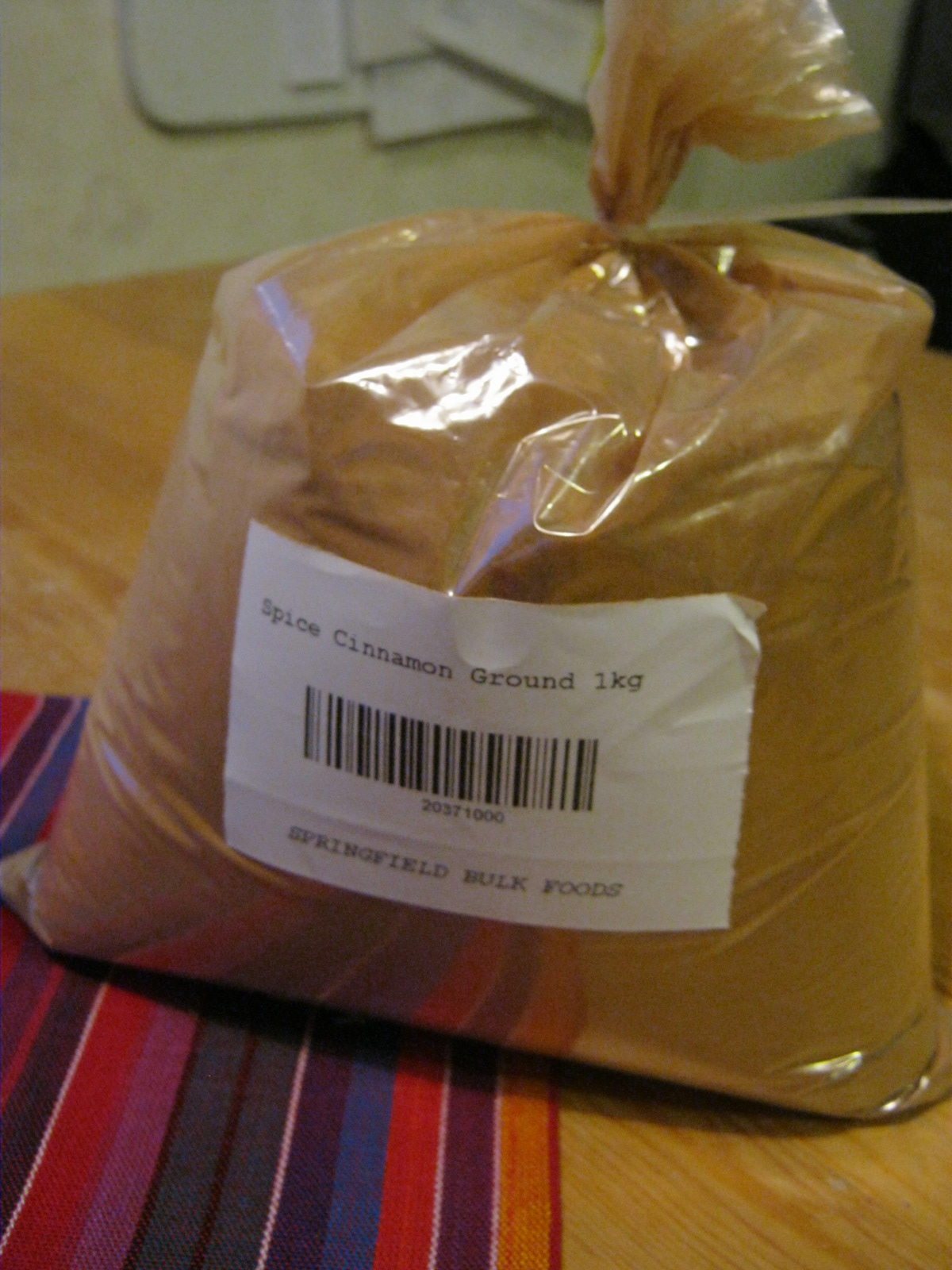
This, dear people, is a bag of cinnamon. A one-kilogram bag of cinnamon. For those of you in the US, that’s two-point-two pounds. And what I paid for it is $4.97. Four Canadian dollars, and ninety-seven cents. For those of you in Europe, that’s about €3.55. For those of you in the US, that’s $4.97. And for everyone else, that’s just plain ridiculous.

(2024 addendum: as I mentioned above, prices have changed a lot since then. At that same store, a kilo of Saigon [fancier] cinnamon now costs $25.56 – I just phoned them and asked. However. In 2011, minimum wage in this province was $8.75/hr; today it’s $17.40. So at minimum wage in 2011 you had to work for about 3/4 of an hour for a kilo of cinnamon, today it’s more like an hour and a half – not much more. Which is still ridiculous, because…)

You see, it was snowing that day as I was driving home, inhaling cinnamon scents all the way. Cold, white, soft flakes of snow. Temperatures just around the freezing point. And no, that’s not terribly unusual here for this time of year, even though, contrary to what you might think, I do not live in an igloo year-round, and my car moves on tires, not sled runners. (I live in Canada, not next door to Father Christmas and the North Polar Bear. Just sayin’.) But, my point is I’m driving home, through the snow, with a one-kilo bag of cinnamon in the car that I paid five bucks for.

For the last few years around Christmas, the local educational TV station has been broadcasting this very interesting show called “A Tudor Feast at Christmas” (2024 note: you can watch it on Youtube here). A team of English historians dress up in outfits from the late 16th century, go to an old manor house, and spend three days preparing a meal like the highest rungs of the social ladder in Elizabethan England would expect to be fed at a Christmas celebration (including a roasted peacock, ultra-elaborate and fancy). They use only the technology, ingredients and methods that would have been used at the time; and talk to the camera about how much bloomin’ work it is to grind almonds for marzipan in a mortar and pestle instead of using a food processor. Now that’s my kind of reality television!
So one of the blurbs that really stuck with me is where this food historian talks about cinnamon. He says, if I recall correctly, that cinnamon was nearly as precious as gold in those days – if not more so. Say, an English merchant outfitted three whole sailing ships, vessel, crew, supplies, everything, and sent those three ships off to the Spice Islands. He waits a full year for their return. Two of the ships are lost entirely, sunk off the coast of India in a storm. Just one of the ships makes it back to the cooler climates of Europe, its cargo hold loaded with the little fragrant brown sticks. That merchant, in spite of having lost two-thirds of an enormous investment, has just made his fortune for life.

Countries where it can snow in November are constitutionally incapable of growing cinnamon, so they have to bring it from elsewhere, from the far-away exotic shores of hot climates. Cinnamon, by rights, should be expensive around here. I have a feeling that my one-kilo bag of cinnamon, finely ground and powdery, probably equates to a wealthy person’s yearly income by 1597’s standards. But in case you were wondering, $4.97 doesn’t go very far in today’s Canada (note: in 2024, neither does $25.56). In fact, it’s only about twice of what I might pay for an equivalent weight in apples, which I could have picked from the trees in the orchard down the street a few months ago (note: now that isn’t actually true today – apples are way cheaper than that. But replace “apples” with “bread”, and it comes out about right).

I wonder if the price on whole roasted peacock with the skin put back on, presented at the table in all its peacocky splendour, is going to go through a similar price drop anytime soon?

Life, the Universe and Cinnamon. Steve says he’s looking forward to gingerbread. (2024: I’ll have to ask him if he wants any gingerbread this year too. Stuffed bears – they can be so demanding…)

Bringing Breakfast

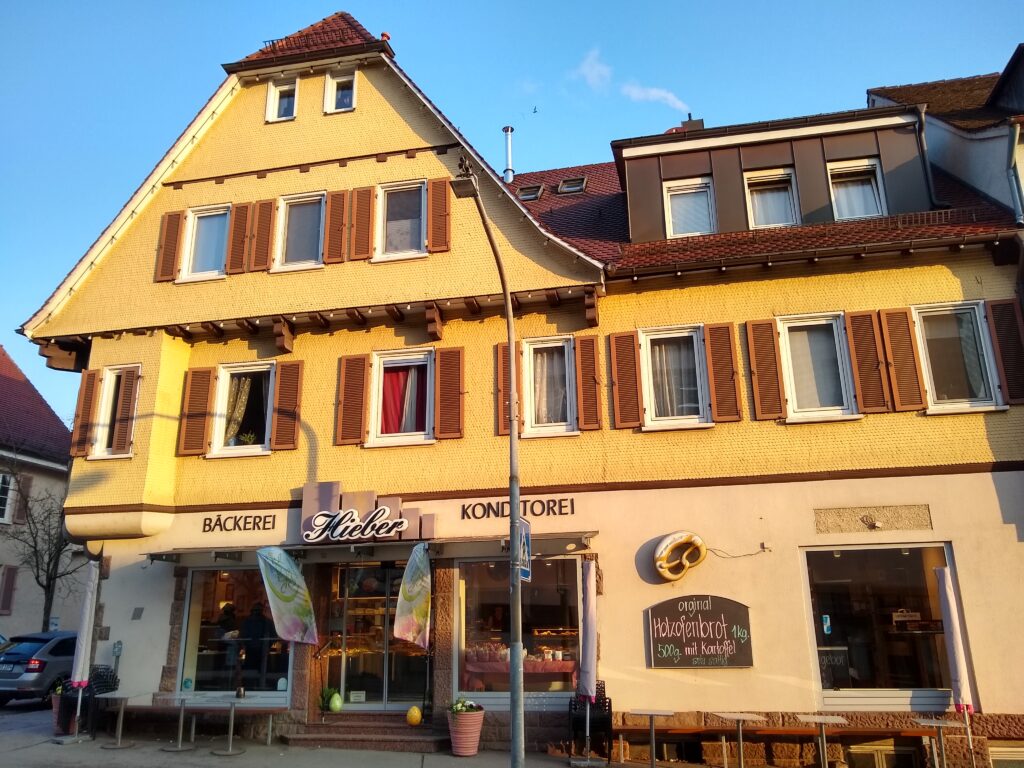
7:45 on an almost-spring morning in a small town in Southern Germany. It’s still chilly enough that I need my fingerless gloves, but the sun is rising in a clear sky, setting the golden stucco of the old bakery at the street corner aglow with the promise of a beautiful day. The upper two stories of the old building look hardly different from how they’ve been for the last century or so, the window shutters beneath the half-hipped red tile roof folded back against the wall to show net-curtain-shrouded windows behind which the inhabitants are starting their day.

But the ground-floor shop windows are as modern as they come. I step through the automatic sliding glass doors into the warm scent of the fresh-baked breads and rolls and pastries that are piled on the shelves against the back wall and displayed behind the glass counter that runs the whole length of the shop.
On the far left, at a small café table a couple of men in business suits down a quick cup of coffee and a roll on their way to catch the train for work. The baker emerges from the back room with an enormous tray piled with fresh pretzels, which he unceremoniously dumps on the counter. Good! Those are just what I’m after. This is Swabia, the original birthplace of the pretzel, and nowhere else are they as good as here. A few salt kernels – not too many – speckle the deep, glossy, mahagony brown of the fat part with the deep slash exposing its creamy interior; the two little twisted arms are thin and crispy. Legend has it they are modelled on the first pretzel baker’s wife’s crossed arms as she watched him bake.

When I turn back to the counter to place my order, I find that two small girls are in line ahead of me, buying a sausage roll, a bread roll, and a couple of pastries for their breaktime snack at school – they’re probably in Grade 1 or 2, no more. “That’ll be €3.40,” the sales lady says as she hands over the paper bag with their goodies, and one of the girls stretches as high as she can to lay her coins on the little wooden tray that sits on top of the glass counter for the purpose. She can barely reach, but she pushes the coins across, grabs her bag, and with a cheerful “Tschüss!” she and her friend skip away. They should still make it in time for school to start at 8:00.

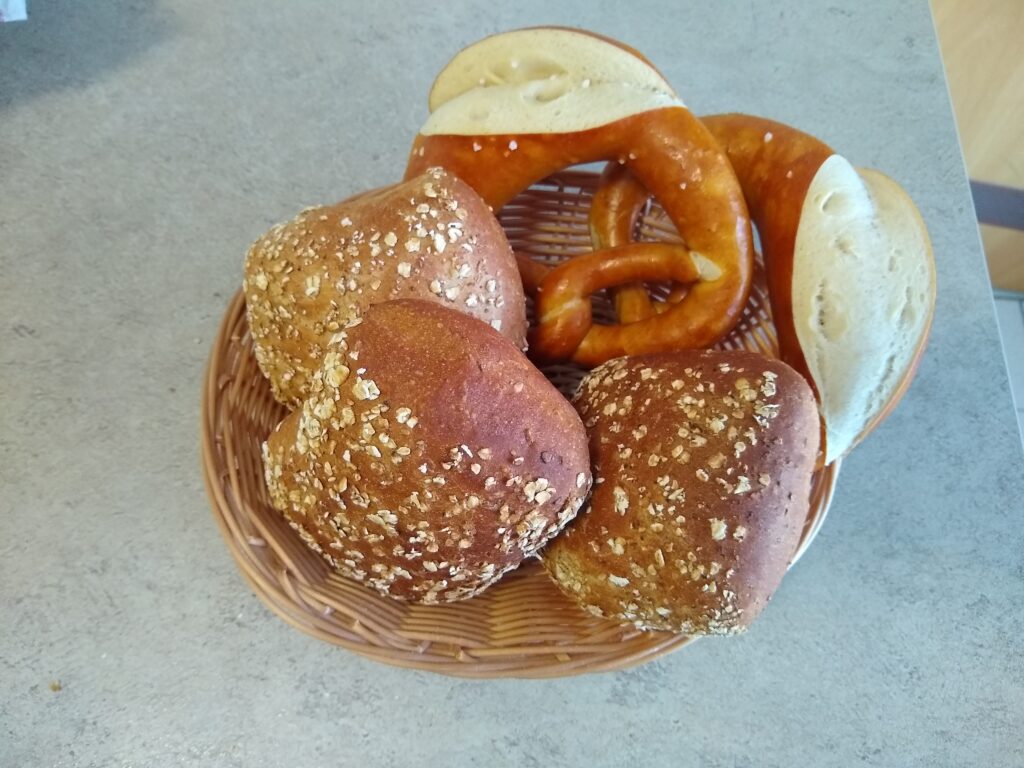
It’s my turn. I can’t be bothered to make a lot of decisions today, choosing from the dozen or more varieties of fresh, crispy bread rolls – white, brown, rye, plain, seeded, sunflower and pumpkin, long or plump or round – so I just ask for three of my favourites, Dinkelbrötchen or spelt rolls: a crispy crust covered in oat flakes, a tender interior with soft chewy spelt kernels throughout. Perfect for a spread of Quark, soft white cheese, topped with strawberry jam. And I ask for two Brezeln, of course.

Their warmth is seeping through the paper bag as I step back out into the street. I’m tempted to hug it to myself to warm my hands, but in true European fashion I tuck it into my backpack to carry it the two blocks to where I’m going. The golden hands of the clock tower show five minutes to eight as the drugstore around the corner and the supermarket down the street are getting ready to open their doors to customers. A new day is beginning in this small town.

The bakery has been operating in that building for more than four generations. For over a hundred years, children have been stretching to put their coins on the counter to buy a bread roll for recess, then run off to get to school before the bell rings at 8:00; working people bought their coffee and pastry and headed for the train; and folks like myself today with a little time to spare bought fresh, still-warm-from-oven rolls and pretzels to take home for a leisurely breakfast of coffee and bread and cheese and jam. The baker has been up since 3:00am to make it all happen, as did his father and grandfather and great-grandfather before him, and perhaps his daughter and granddaughter will do after him. For all the automatic sliding doors and gleaming plate glass display windows, there is a thread of continuity that runs through the fabric of existence here.

I find my soul being nourished by the warmth that gently seeps out of my bag of Brötchen und Brezeln, and I revel in that sense of being tied into a web of culture that has been in place for generations and will continue for generations to come. It’s unlikely that any children and grandchildren of mine will buy breads and cakes in this place where my grandparents and great-grandparents got theirs, but someone’s children will. The thought is as warm as the rolls and pretzels in my bag.

Life, the Universe, and a visit to the German bakery. I’m bringing breakfast today.

Three Weeks of Europe in One Dozen Shots

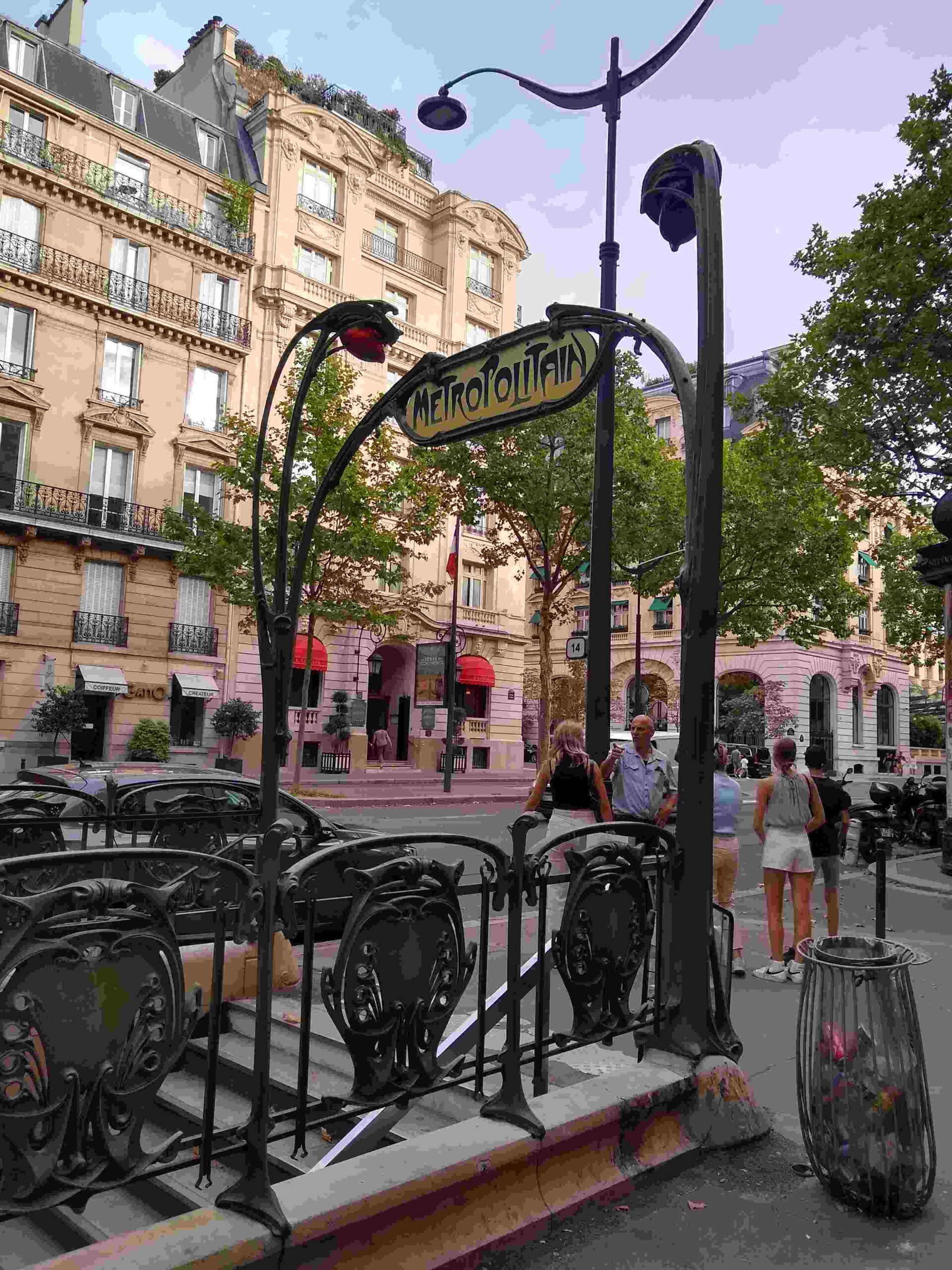
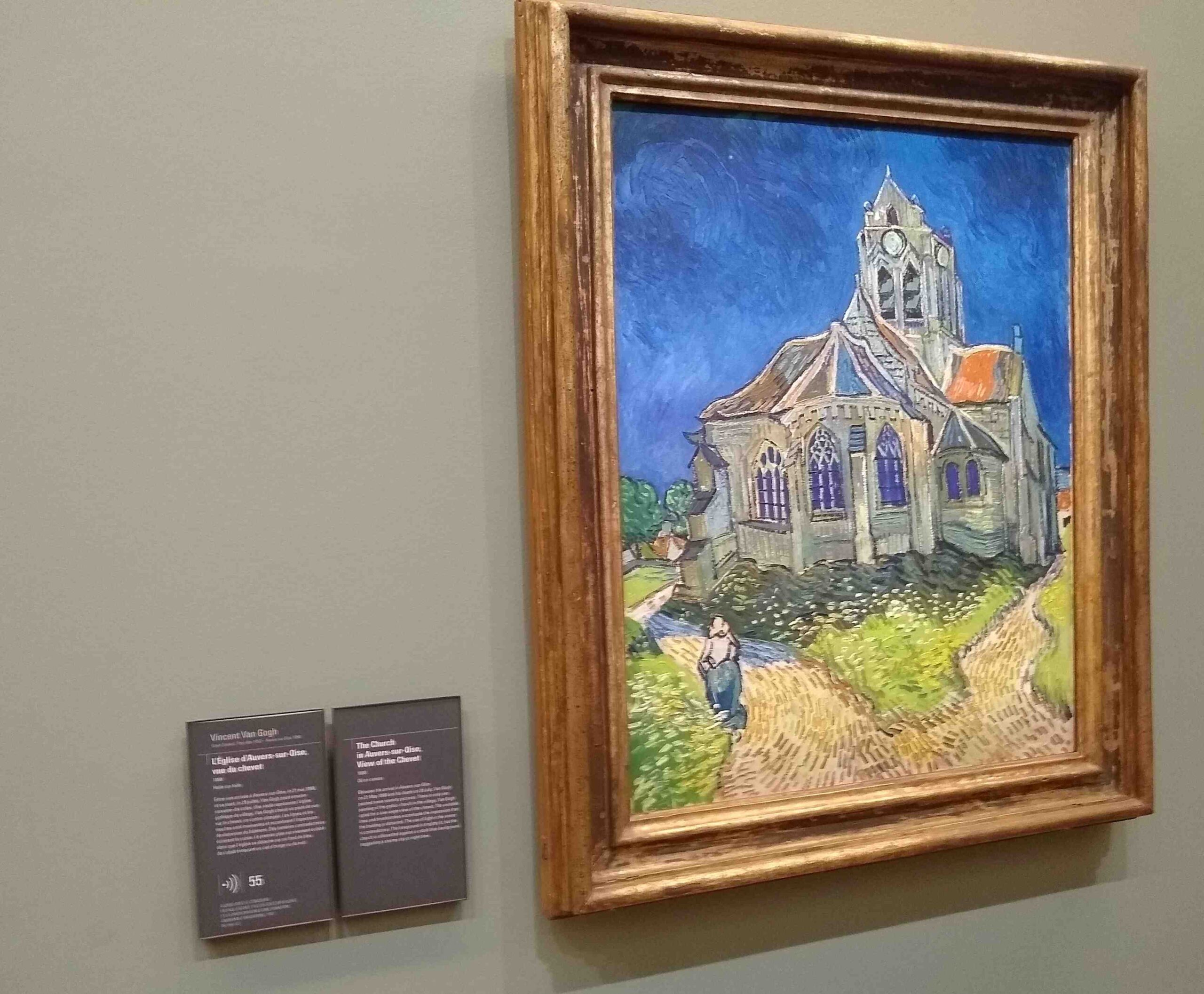
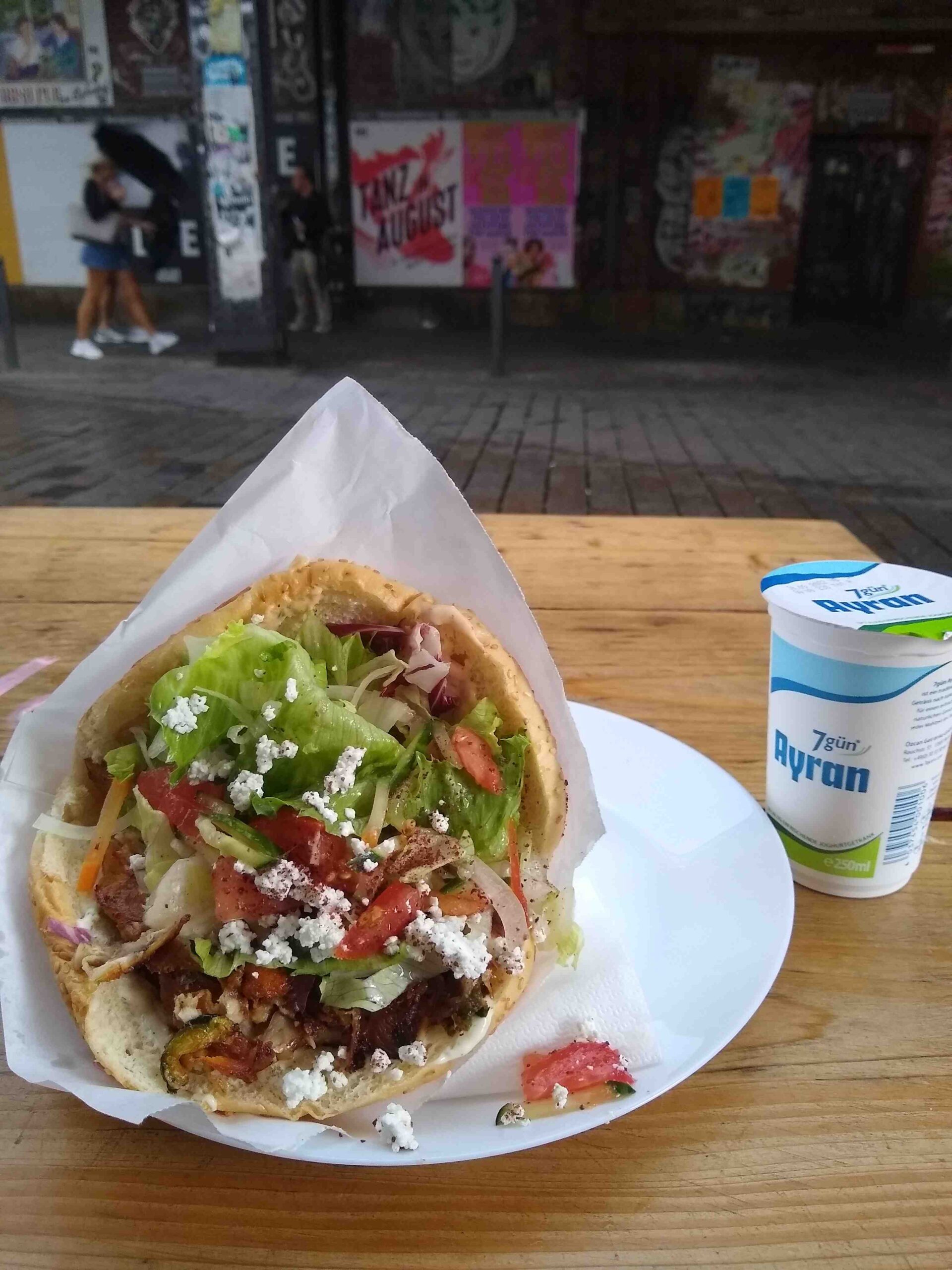
It’s been a week since Steve and I have been back from Europe. 888 photos later, we’ve seen Paris and Berlin, and we… Hah, no, we haven’t. We’ve seen a very, very small part of those amazing world cities. There’s not too much you can do in three days each; the main purpose of the trip was, as always, to visit family, so the bulk of our time was taken up with that. But we got in some great sightseeing regardless!

So here, in a nutshell (you can decide what kind of nut) are some of the most basic impressions. One dozen photos, two countries, three cities.

Life, the Universe, and a Trip to Europe, in One Dozen Shots.

#ThrowbackThursday: Lenten Soup

A post from five years ago. I don’t have any Puy lentils at the moment, but I think I have some brown lentils on hand still. I might have to make this soup again soon.

lentil soup

It was so cold and miserable yesterday, I had to have something hot for lunch. There weren’t any leftovers, and I didn’t feel like having anything from a can. So I made some lentil soup, from Puy (French) lentils I’ve had in the cupboard for, oh, probably three or four years. (Me in bulk food store: “Oh, look at those lovely [lentils, peas, beans, walnuts, hazelnuts, mixed dried vegetables, chunks of chocolate, etc etc]! I’ve been meaning to try  making [lentil/pea/bean soup, nut bread, veg soup, real chocolate cake, etc etc.]” Buy food. Sit food in cupboard. Periodically open cupboard and consider food. “Oh, look, I never did get around to making [lentil/pea/bean soup etc etc]. Must do that.” Close cupboard, forget about food. Months later, open cupboard, consider food…)

Anyway, I just sort of randomly threw this soup together. Lentils have the advantage that they’re the instant-food variety of the legume world, i.e. they cook in under an hour, as opposed to dried beans which have to pre-soak and then simmer away most of the day. So lentils lend themselves relatively well to impulse cooking (haha, see what I did there? Im-pulse).

So here’s what I did:

Lentil Soup

3c stock (I used ham stock I had in the freezer, but I think even water would work)

1/2 c Puy lentils, rinsed

3/4 tsp salt (could have used less)

chopped green onions

1/2 grated carrot

black pepper, pinch of cayenne pepper

1/2 tsp dried lovage, pinch dried oregano, large five-finger pinch frozen parsley

Dump in pot, bring to boil, turn down heat, simmer for about 45 minutes. To serve, I threw in some grated cheese. Very tasty and warming.

I also found out something: for a while now, I had this theory that the words “lentil” and “lent” are related – that perhaps we call lent lent because people used to eat more lentils then; or vice versa. But, alas, I was wrong. “Lentil” comes from Latin lens, meaning, well, “lentil”, while “lent” comes from Old English lencten, meaning “springtime”. I guess eating lentils in lent is just a coincidence. It was a plausible theory though, don’t you think?

Life, the Universe, and Lenten Soup. I think I’ll have the rest of it today.

#ThrowbackThursday: Borscht

I made a pot of borscht the other day. Because, winter, and beets that needed cooking, and deliciousness. And I was reminded of this blog post from eight years ago, February 6, 2014, written while the Winter Olympics were on in Sochi, Russia. It being the Winter Olympics again, I thought you might like to read it and maybe cook your own borscht.

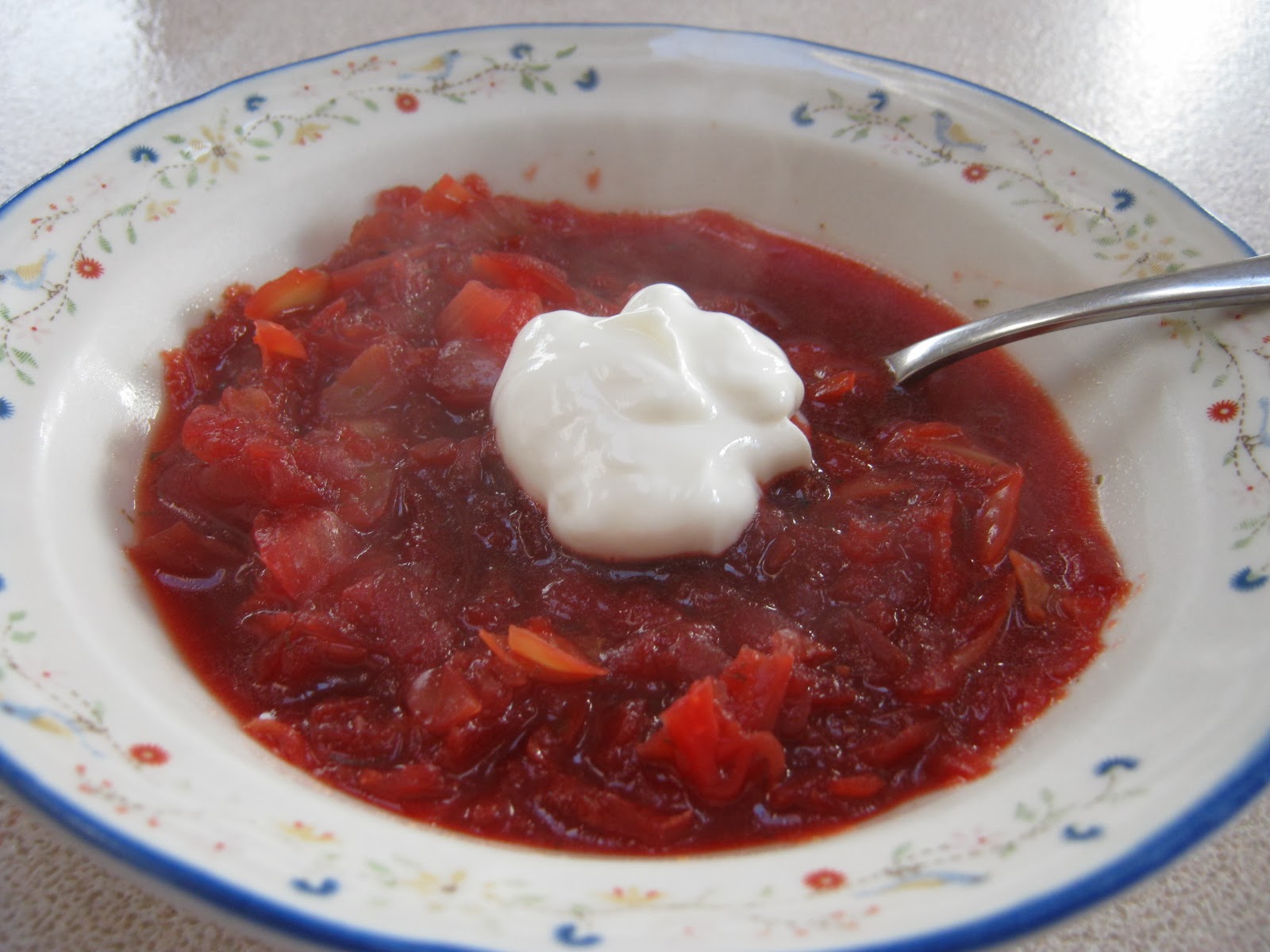
In honour of the Russian Olympics, I thought I’d cook me a pot of borscht. Well, actually, no, it’s not in honour of the Olympics at all, it’s in honour of the fact that I found a borscht recipe I really like and I wanted some. I hadn’t really ever made borscht before that one, as the man and most of the offspring wouldn’t be into eating it; but I’m on a bit of a food emancipation kick – I want to try new stuff, particularly new vegetable dishes – so I made some. A friend who happened to come by that day ate a bowlful and declared it good borscht, and as she’s of Ukrainian extraction, I feel this soup has received the stamp of approval.

The issue with making anything that involves beets is, of course, that it requires some pre-planning. You can’t just stick your head in the fridge half an hour before you want to eat, and go “Oh, there’s some beets, let’s make something with them” – they take far too long to cook for that. However, cooking them is really easy, and they keep cooked in the fridge for quite some time, so you can pre-cook them one day, and do your spontaneous borschting later in the week. To cook, just wash them off, dump them in a big pot, cover with water, put them on to boil, and bubble-bubble-toil-and-trouble for about an hour (depending on how fat they are – I don’t think you really can overcook beets, so better longer than shorter. Poke the biggest one with a sharp knife, and if the knife slides in easily, they’re done.). Drain them, let them cool (I fill up the pot again with cold water just to cool them off, because I’m too impatient to wait for them to cool on their own), and peel them. Peeling beets is funny – when they’re well-cooked, they slip right out of the skin, with sort of a sloosh kind of noise. I’d highly recommend wearing an apron and/or clothes you don’t care that much about, as your hands and the sink and everything around it will look like a bloodbath (I suppose it is, too – beet blood. Muahahahah!).

Okay, now you’ve got your beets cooked. So here’s the recipe (I got it from the More-With-Less Cookbook by Doris Janzen Longacre, which was the first cookbook I bought myself after I was married. If you can get a hold of that book, I highly recommend it. No, you can’t have my copy; it’s falling apart, anyway.)

Quick Beet Borsch (they spell it without the t. Apparently you can also spell it borshch, which is closer to the Ukrainian/Russian pronunciation. But it looks weird that way.)

1 c cabbage, finely chopped
1 onion, finely chopped
2 c water
cook 10 minutes. Add:
2 c stock or broth
2 medium beets, cooked and chopped
1/2 c beet juice (I leave that out)
1/2 t salt
dash pepper
1 T lemon juice.
bring to a boil, serve with sour cream.

Which is exactly what I’m going to do right now – serve it. Even if it’s just to myself.

Life, the Universe, and Borscht. Do they have cookoffs in the Olympics?

Note on the 2022 edition: these days, I don’t bother with the exact steps of this recipe. I grate/chop the vegetables, dump them in the pot with the seasonings and water or stock (whichever I have available), and simmer it for half an hour or so, until the veggies are soft. I also don’t put in lemon juice, but add some herbs (dill is good, or lovage). If you don’t have sour cream or want to make this a lighter dish, plain yogurt works really well, too. Guten Appetit!