I spent the weekend at the Ceramics Congress, which is an international multi-cultural multi-lingual ceramics arts festival that’s all online. It was awesome.
Here’s one thing I learned, in a workshop by Julissa Llosa Vite from Peru (as in, actually from Peru. That’s where she was teaching from. Did I mention “international”?): How to make a bird flute. I’d made ocarinas before, but had never quite figured out the voicing, i.e. the bit that makes the sound. It was always a hit-and-miss thing; after lots of fiddling, some worked, some didn’t. This time, it worked right off the bat!
Trying out the bird flute, still wet/leatherhard. (Behind me on the studio wall you can see my one-and-only self-portrait from, umm, a while ago. The advantage of painted self-portraits over videos is that you can make them look flattering. So this is me, the way I look when I’m at work and not planning on having anyone watching me.)
Life, the Universe, and the Ceramics Congress. I think I’ll go carve some feathers on that bird now.
PS: The next Ceramics Congress is going to be at the end of November. If you’re at all interested in clay, check it out – the tickets start at only US $10!
PPS: If you want to learn how to make a bird flute, too, wait a few weeks, and Julissa’s workshop will be uploaded at the Ceramic School where you can purchase a ticket to watch it.
Finally, after three years of absence (one due to holidays, two to You-Know-What), this past weekend Steve and I got to go to a real-life, in-person Writers Conference again. People! Writers! Books! Workshops and conversations about plot and character and publishing and writing software and essays and food writing and the difficulties of switching genre and getting things done and how weird it is to be, well, as weird as we are… It was glorious.
What did I learn, you wonder? Well, aside from all the stuff I really can’t summarize in a little blog post—you had to have been there, that’s what we take those workshops for—there are two thoughts I came away with. Neither one of which should have been news, but they kind of were.
Thought #1: Writers don’t look like their publicity photos. Well, okay, some do; they’re just naturally handsome and photogenic and we all hate them for it. But several times that weekend, when a writer was introduced and walked up on stage, I had a little “Oh!” moment. As in, “Oh, they actually look like a normal person! They’re older/larger/less perfectly groomed/more grey-haired/whatever than I thought!” With some of them the “Oh!” moment happened when they started reading from their work: in their writing, they’re so eloquent, so polished, so poised—but on stage, there might have been a slight stammer or a lisp, or they read their work with less expression than it deserved, or their hands were shaking just a bit.
Writers, I realized, are just normal people. Even those “big names” with multiple published works and bestsellers to their credit, whom I look up to with a tinge of envy. Reading the eloquence of their writing, and looking at their attractive and polished photos, I got intimidated; then I saw them in the flesh, and they turned out to be—well, real. Actual human beings. I haven’t lost one iota of my admiration for them, I’m just not intimidated by them personally anymore (well, not as much). I can be inspired instead.
Thought #2: There is more than one way of doing things. “Thou shalt outline!”—“I can’t outline my novels, I have to write several discovery drafts and throw out the first three until I figure out what happens.”—“Write a synopsis first and work from that!”—“I don’t know what the book is about until I’ve written it.” All of those statements came from successful authors with several published books to their credit. Directly contradicting what the last successful author with several published books to their credit had said.
That there is more than one way of doing things is a revelation that I had about more than one creative field in the last couple of years. I wrote about it with regards to knitting (and life) two years ago, and just a few months back, I realized it about pottery: I was taught one particular way to throw on the wheel, and I was getting frustrated because I wasn’t doing very well with it. I concluded that it’s because I didn’t know the right way to do it. I started watching online videos, and several of the instructors were quite dogmatic about how it’s supposed to be done: Never, never use a sponge to pull up—no, always use a sponge to pull up! Wedge every piece you throw and make sure you put it on the wheel the right way around—no, just smack it into a ball, it doesn’t matter which way it lands on the wheel! This is the only right way to do it—no, this is the only right way to do it! The more online videos I watched and books I read, the more different ways of doing it I saw. And all of these people produce beautiful work.
It seems that that also holds true for writing (which, in case you missed the point, is my revelation du jour). Plotting, pantsing, structured, unstructured, according to a map, discovering as you go—what it comes down to is that you need to do what works. What matters is that you get the thing written. It’s irrelevant if you’ve outlined or inlined (I just made that up), as long as you get a piece of writing out of it. There is not just one way of doing things, and the really exciting thing about that is that because there are so many ways of doing things, you always have another option—if this doesn’t work for you, try that instead.
That’s what’s so wonderful about events like Writers Festivals: so many opportunities to learn different ways of doing things! And as exciting as it was to get back to an in-person conference, the Pandemic [ugh!] has actually had a good effect here. If you can’t make it to a real-life festival (either because you can’t afford it, or you live too far away, or, which is a perfectly legitimate reason, you’re not comfortable being physically close to so many germ-breathing strangers yet), the number of online options have proliferated in the last couple of years. You can attend festivals and learn from those amazing pros from the comfort of your own personal computer chair, finding out all about novel structure or how to plot a mystery, or, for that matter, how to sculpt a ceramic camel using newspaper as armature.
And I can tell you that the learning experience in an online conference can be just as intense; you need just as much time to recover from it as from a real-life convention (i.e., you spend the day afterwards collapsed on the couch, trying to let your poor brain recover from all the input). Speaking of which, I think Steve still hasn’t got over this one; he’s gone missing. I know he came home with me—here he is in the kitchen perched on the stack of books we brought home—but I haven’t been able to find him anywhere since. Well, I’m sure he’ll resurface once he’s had a long nap and revitalized his woolly brain.
Life, the Universe, and a Writers Conference. Writers are normal people, and there is more than one way of doing things.
They came around the corner, and there it was in front of them. The blossom, enormous like a vast bowl, more than six men could span. The soft pink of the petals had a velvet sheen to it; in the centre, the golden richness of the stamens beckoned.
“The Giant Water Lily of Medulisan!” Mardrom breathed, once again exercising his proclivity for stating the obvious.
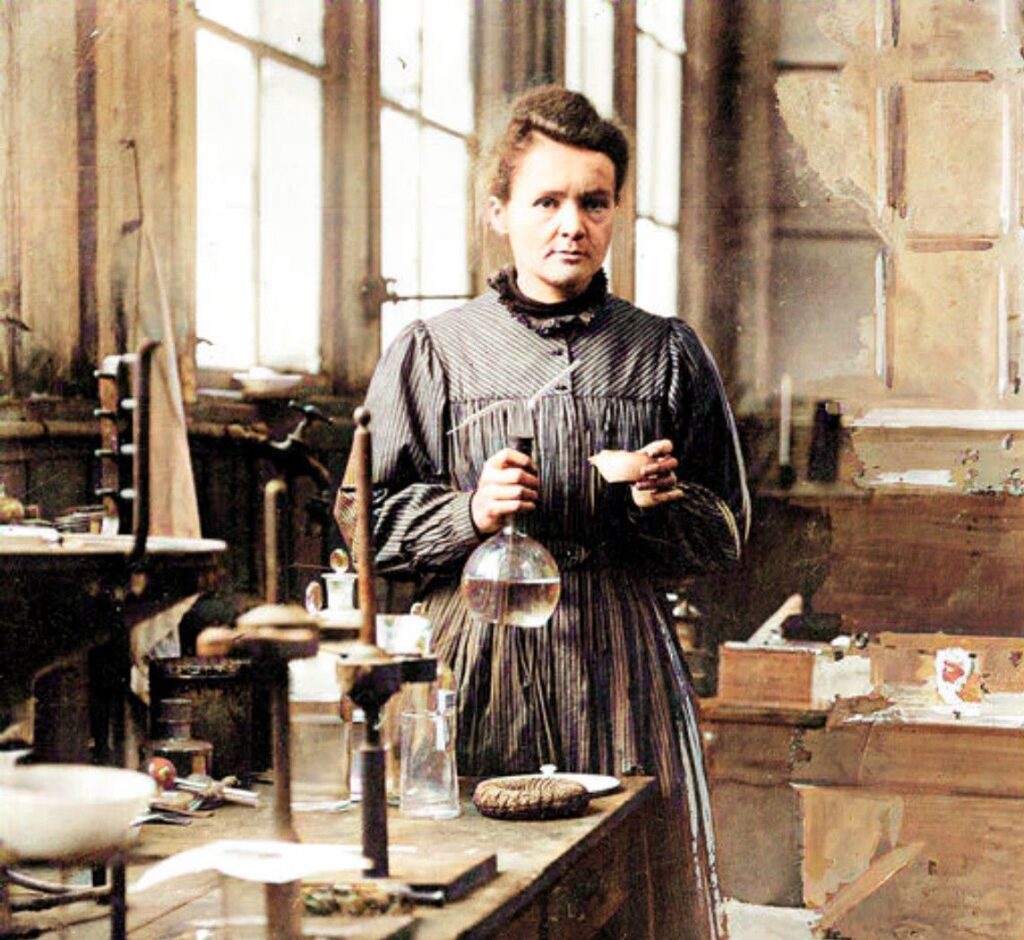
I must have been around nine or ten, reading an article in the yearly Reader’s Digest Youth Anthology about Marie Curie. You know, the famous scientist? First woman to receive a Nobel Prize? First woman to receive multiple Nobel Prizes, in fact? Only person ever to get a Nobel Prize in two different fields? Yeah, her. So inspiring, such a role model.
There’s one sentence that stuck out to me so much I still remember it forty-odd years later. The article was talking about Mme Curie’s life, and it described how she would get ready for her day at the research lab, making sure her two little girls were looked after, putting a stew on the back burner for their dinner. A little while later, she would be in the lab, and, so the article said, “adjusted the flame of her Bunsen burner with the same care that she had used for the flame of the stew pot that morning…”
Ah, thought little pig-tailed nine-year-old me, that’s how it’s done. If a girl wants to be a famous scientist and do life-changing work, she has to make sure that the beef stew for her family back in her kitchen is as well-regulated as the flame of the Bunsen burner in her lab.
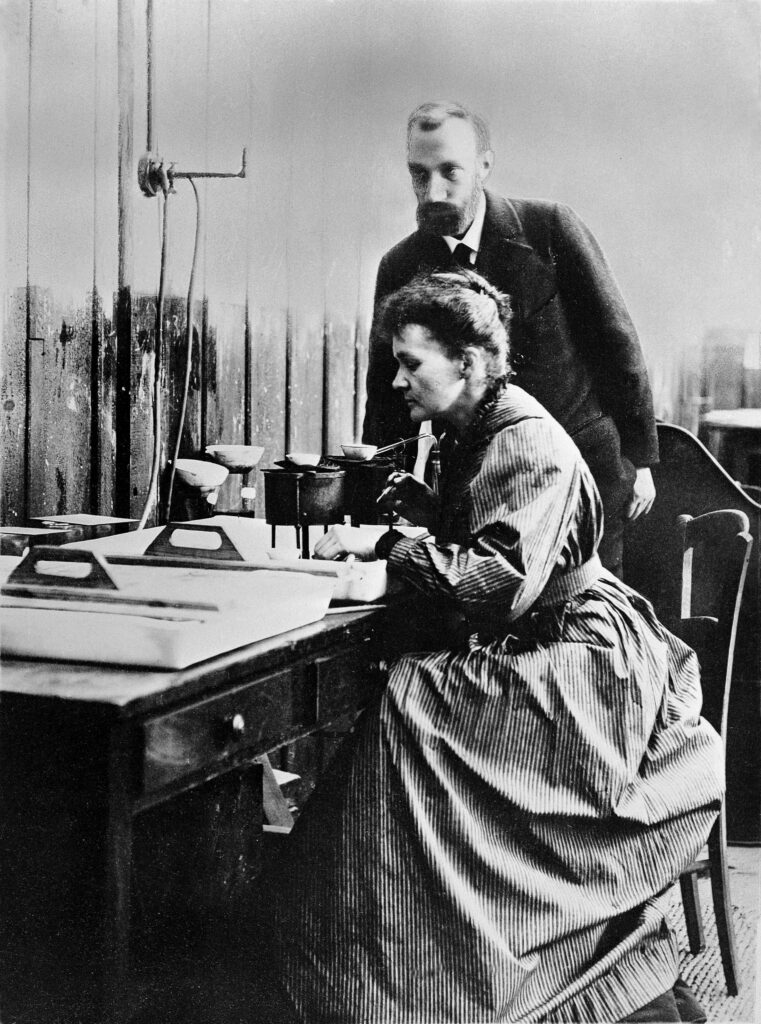
Pierre and Marie Curie at work in laboratory Credit: Wellcome Library, London. CC BY 4.0 http://creativecommons.org/licenses/by/4.0/
This morning, as I was thinking about this in the course of my never-ending struggle with running the multiple tracks of my life, I came up with a phrase to describe this idea: the Parallel Lives Fallacy. It’s the idea that if you only work hard enough, you can, in fact, excel at multiple different roles—you can lead Parallel Lives. Like Marie Curie, who so admirably regulated the flames of her role of housewife and mother and Nobel-Prize-winning scientist.
Parallel Lives: in one life, you’re a full-time award-winning scientist; in another, you’re an excellent housewife and devoted mother (also full-time). Maybe you even add a third one, where you’re a dedicated volunteer and full-time caregiver to your ailing parents. Or, wait, you could be an artist, as well! Write novels, or make pottery to sell at the market, or paint pictures to go in exhibitions!
Full-time jobs, all of them. Several full-time jobs. Wait—full-time. Several full-times. Nothing wrong with that concept, is there? It’s just like, when your plate is full, you can obviously go back to the buffet with it and start loading it up with another plateful’s worth of food, right? Several platefuls.
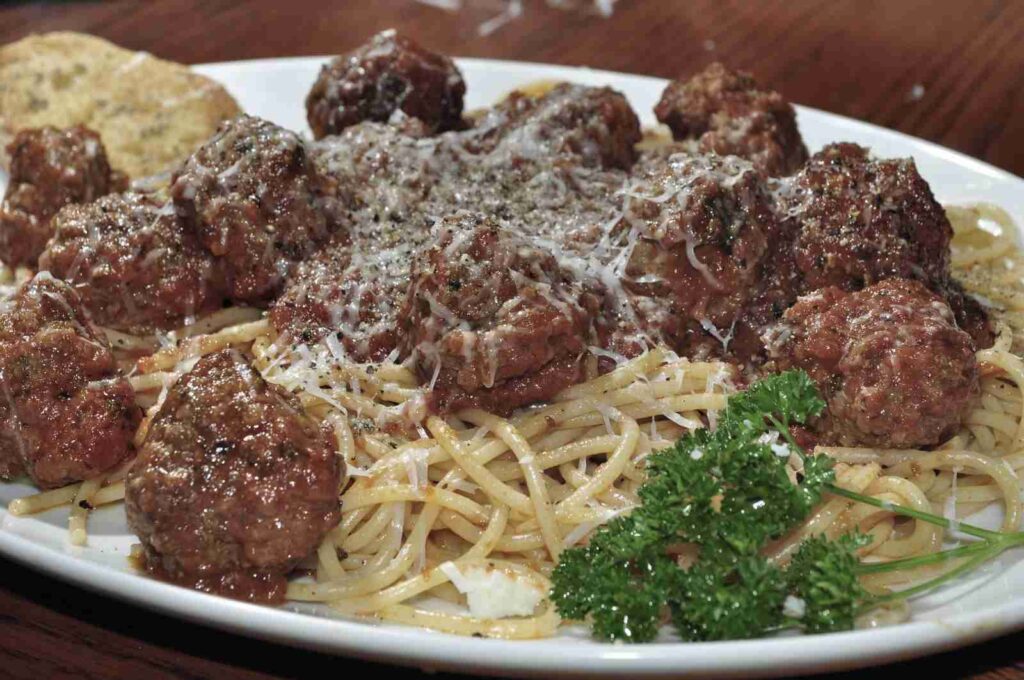
Yes, I know the image that brings up. “On top of spaghetti / all covered in cheese, / I lost my poor meatball / when somebody sneezed. / It rolled off the table, / it rolled on the floor, / and then my poor meatball / rolled out of the door…”
Marie Curie was amazing. She pulled off the Parallel Lives stunt to admiration, without losing a single meatball, from what I can tell. However, her work eventually killed her, because she didn’t know to protect herself from the fascinating stuff she had discovered. It also killed her daughter, Irène (another Nobel Prize winning scientist working with radiation). Apparently (according to Wikipedia), Marie Curie’s papers—including her cookbooks!—even more than a hundred years later have such a high level of radioactive contamination that they’re kept in lead-lined boxes and are considered too hazardous to handle without protective equipment.
I can’t help but wonder about the state of that stew on the carefully regulated burner—was that contaminated, too?
The Parallel Lives Fallacy is a fallacy. Because unless you’re Marie Curie (and I sure am not), you just can’t pull it off without losing at least one or two of your meatballs off that plate. Which is a patent waste of good meatballs (I have a recipe, if you’re interested). You get one plate, and it only holds one plateful of food. There is only one day in a day, only twenty-four hours in twenty-four hours, and only space for one full-time job in your full time.
The problem with Marie Curie’s Bunsen burner is not that we admire her for her balancing act of flame-regulation. It’s that we (okay, that I) instantly think that that’s the only way to do it, the only way to be a successful and worthy person. That we succumb to the Parallel Lives Fallacy.
The reality is that one plateful of food is enough. One day in a day, one life in a life. If you try to stack more on top, the meatballs go rolling under a bush, and, contrary to the song lyrics, don’t grow into a meatball tree but just attract maggots and rats. At least in my life they do.
So I’m going to turn my back on that Parallel Lives Fallacy. I’m going to try to choose more carefully what I want on my plate, because I really enjoy meatballs and don’t want them rolling under a bush on me. I also like spaghetti noodles, and tomato sauce, and a lovely green salad, and maybe some cooked carrots or a piece of garlic bread… I want to have room for them all on my one plate, so I can enjoy the whole meal, savour it and get nourishment from it. One plate, one plateful.
Oh, but you know what? A little secret: You get dessert. In a separate little glass dish. You don’t have to pile it onto your plate with the meatballs. Make of that what you will.
Life, the Universe, and Marie Curie’s Bunsen Burner. One life to live is enough.
News from Fairy Tale Land! Eight years ago, when I was researching my final project for my MA, I wrote a post on my research blog, quill and qwerty, on the iconic film Three Hazelnuts for Cinderella. It’s a German-Czech production from 1973 that has achieved near-cult status in Germany, and has influenced more than one “Cinderella” movie since then (including the 1998 Ever After and the wonderful 2015 live-action version). At the time, I was bemoaning the fact that there didn’t seem to be an English version of this so very lovely movie. Well, a couple of years ago a reader commented that an English version did exist; she’d watched it on TV in the 70s – and today, she posted the link to it on Youtube!
The quality of the recording isn’t the greatest, and it’s a slightly abridged version (1 hr as opposed to the 1 1/2 hrs of the original), but that doesn’t matter – it’s Three Nuts for Cinderella in English! So now you, too, can go watch it and know what it was that I’ve been raving about all that time. Thank you, Colleen! (Note, the beginning and end of the film are in the original Czech; the English dub starts at 6:34.)
So if you want to indulge in some shameless fairy tale enjoyment, hie thee to a Youtube channel, kick back and watch Three Nuts for Cinderella. You won’t be sorry.
A post from five years ago. I don’t have any Puy lentils at the moment, but I think I have some brown lentils on hand still. I might have to make this soup again soon.
It was so cold and miserable yesterday, I had to have something hot for lunch. There weren’t any leftovers, and I didn’t feel like having anything from a can. So I made some lentil soup, from Puy (French) lentils I’ve had in the cupboard for, oh, probably three or four years. (Me in bulk food store: “Oh, look at those lovely [lentils, peas, beans, walnuts, hazelnuts, mixed dried vegetables, chunks of chocolate, etc etc]! I’ve been meaning to try making [lentil/pea/bean soup, nut bread, veg soup, real chocolate cake, etc etc.]” Buy food. Sit food in cupboard. Periodically open cupboard and consider food. “Oh, look, I never did get around to making [lentil/pea/bean soup etc etc]. Must do that.” Close cupboard, forget about food. Months later, open cupboard, consider food…)
Anyway, I just sort of randomly threw this soup together. Lentils have the advantage that they’re the instant-food variety of the legume world, i.e. they cook in under an hour, as opposed to dried beans which have to pre-soak and then simmer away most of the day. So lentils lend themselves relatively well to impulse cooking (haha, see what I did there? Im-pulse).
So here’s what I did:
Lentil Soup
3c stock (I used ham stock I had in the freezer, but I think even water would work)
Dump in pot, bring to boil, turn down heat, simmer for about 45 minutes. To serve, I threw in some grated cheese. Very tasty and warming.
I also found out something: for a while now, I had this theory that the words “lentil” and “lent” are related – that perhaps we call lent lent because people used to eat more lentils then; or vice versa. But, alas, I was wrong. “Lentil” comes from Latin lens, meaning, well, “lentil”, while “lent” comes from Old English lencten, meaning “springtime”. I guess eating lentils in lent is just a coincidence. It was a plausible theory though, don’t you think?
Life, the Universe, and Lenten Soup. I think I’ll have the rest of it today.