I just sent out a newsletter (are you subscribed yet? You can do so here), and I told everyone about Gaeli’s G’nomes. And then I thought, hey, I don’t think I’ve ever introduced them on the blog, either. So it’s time to remedy that situation.
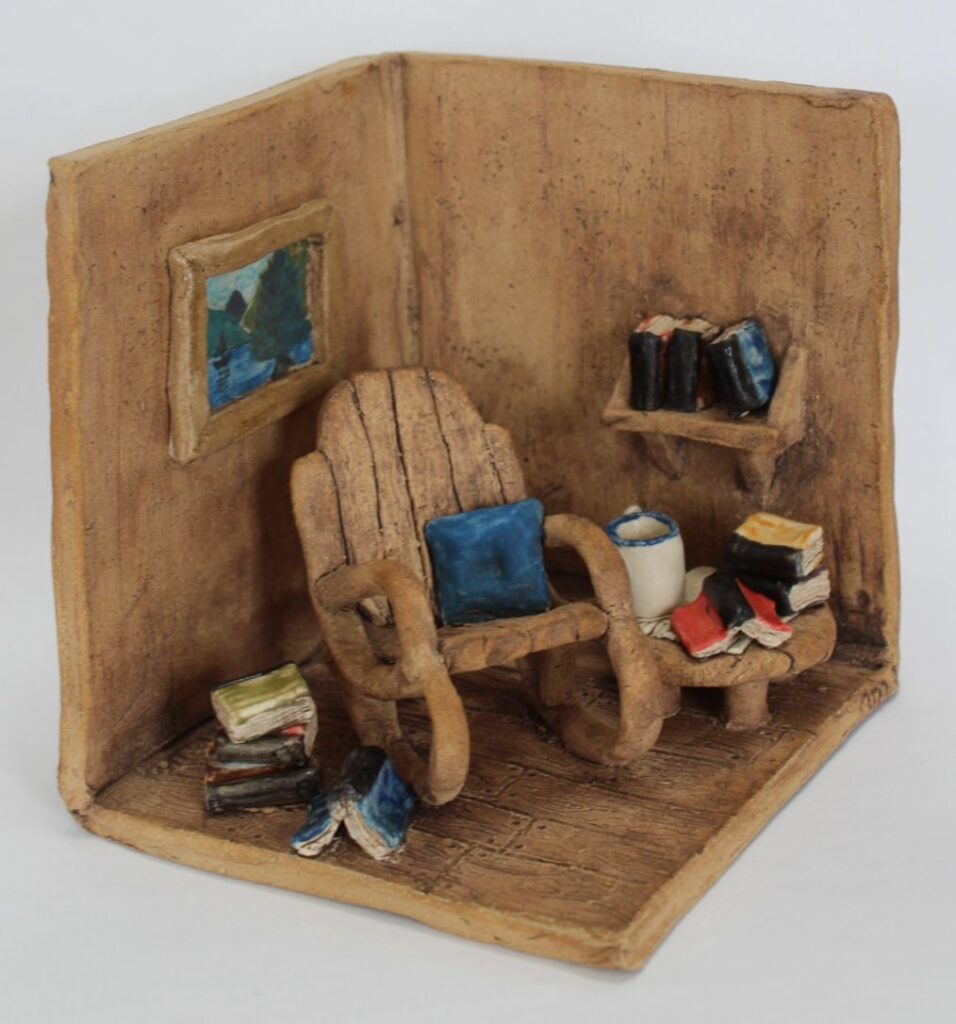
Gaeli’s G’nomes, as I told my newsletter readers, are the family of gnomes who live on my living room cabinet—well, the ones who are still home. Several of them have moved out already, and all of these ones are perfectly willing to do so, too; give me a shout if you’re interested in adopting one. They’re made of stoneware clay, so they’d be happy to live outside in your flowerbed over the summer. Oh, and all of them are about 8″ (20cm) high/long, give or take.
Their family name is spelled the way it is to make sure it’s pronounced with a hard G on both words. Technically they should be “Geli’s Gnomes” (Geli, prounounced “gaily”, was my childhood nickname), but they’re not “Jelly’s Nomes”, as most people would say it if it was spelled that way; hence “Gaeli’s G’nomes”.
Here’s the current family, all hanging out in my living room. I’m not sure what their conversation is about, but as a rule they get along quite well.
Now, if you’d like to meet a few of them, we’ll start with Gordon. He’s a mellow guy, likes to be quiet and just hang out with his bug, who’s gone to sleep on him.
Gabby is a chatty individual who likes to tell stories, and fortunately for her, her bug likes hearing them.
Gabby’s twin brother Garth is a dreamer; he and his bug like to find pictures in the clouds.
And here’s Goldie, who’s the youngest sister. She’s a busy and cheerful kind of person; I think she’s just spotted a butterfly and is quite excited about it. Her bug, on the other hand, isn’t so sure about it; he likes her to pay attention to him, not to some kind of fluttery thing in the air!
We’re hoping that over time, there’ll be more members added to the G’nome family, and will go out into the world and find new homes.
And there you have it, that’s Life, the Universe, and Gaeli’s G’nomes. They’ve enjoyed meeting you all!
Gaeli & G’nome (Self-portrait assignment from Digital Art Class, done in Procreate)
I’ve been having a bit of a hard time lately, for one reason or another. So I went on the internet to ARD Mediathek (Germany’s public broadcasters’ streaming service) and turned on some fairy tale movies. I needed them, needed that reassurance that the world is a place where things will work out and everything is okay in the end. German and Czech fairy tale films are fabulous in that regard—they come across as so real, the tales are so much part of that culture, you can sink into the story and come out happy at the end.
From Cinderella (1919) by Arthur Rackham
But I was left a little dissatisfied that day. I wasn’t sure why at first. The films I watched were lovely fairy tales, with princesses and magic and intrepid heroes and heroines, and bad guys that were defeated, and a happily ever after. One was called “Der Geist im Glas” (“The Spirit in the Bottle”), and “Die verkaufte Prinzessin” (“The Sold Princess”) was the other.
You’ve never heard of them? Neither had I. That’s because they’re not classic fairy tales. The one claims to be loosely adapted from “motifs of a Grimms’ tale”, the other to be “inspired by Bavarian legends”. Whatever—there’s nothing wrong with adapting tales, or even just taking loose inspiration from existing fairy tales and making something of your own with it.
No, that’s not what frustrated me about those films, as I came to realize the next day after I had some time to think about them. What got my goat about both those films is that they shoehorn “issues” into the story. They clobber you over the head with such matters as feminism and inclusivity and “thou shalt believe in magic”. The characters spout off, in a repeat loop, about how princesses can’t be rulers or girls can’t be miners and oh, it’s so unfair and an issue to be solved; or they heavy-handedly draw attention to the fact that there’s MAGIC in this story and oh, that’s so unusual and the science-minded heroine doesn’t believe in it and needs to learn her lesson (even though she accepts without so much as a blink the wicked spirit from the bottle that’s got them all into trouble).
Don’t get me wrong—it’s not the issues I take, well, issue with. Feminism and inclusivity are a no-brainer, as far as I’m concerned. I have no problem with turning the doctor’s apprentice in “The Spirit in the Bottle” from a boy into a girl, or with casting People of Colour in roles that were traditionally “golden-haired”. That’s all great. But what I object to is using a fairy tale as a vehicle for an agenda, instead of letting it speak for itself. That’s using a delicate instrument as a hammer to pound in a nail.
You see, that’s the whole thing about fairy tales: they don’t need to have anyone superimposing a “lesson” on them! Fairy tales teach and empower without anyone getting on a soap box for the purpose. Jack climbing the beanstalk and outwitting the giant makes us feel like giant slayers ourselves; Cinderella going from drudge to princess makes it possible for us to do the same—without someone preaching at us about having self-confidence, or about the evils of step-sibling exploitation. The stories make their point without spelling it out (“spelling”, haha. See what I did there?). They show what they’re saying, they don’t need to tell.
For several years now I had a quotation on the top of my list of notes: “Ich glaube mehr an Märchen als an Zeitungen.”—”I believe in fairy tales more than in newspapers.” The person who said that was Lotte Reiniger, the first creator of animated film. That’s right, years before Disney’s Snow White, Lotte Reiniger made stop-motion films from silhouette cutouts (Scherenschnitt, scissor cut, in German), including the 1926(!) feature-length “Adventures of Prince Achmed”. She created many amazing fairy tale films, and she knew what she was talking about when it comes to fairy tales.
From Adventures of Prince Achmend (1926), by Lotte Reiniger/Primrose Productions – Christel Strobel/Primrose Productions (copyright holder), CC BY-SA 4.0, https://commons.wikimedia.org/w/index.php?curid=68075134
I believe in fairy tales more than in newspapers. What’s that supposed to mean? It means that what fairy tales* have to tell us has more validity, more truth to it than the ever-changing, deceptive clamour of the news industry.
Using a fairy tale as a vehicle to preach about whatever current “issue” you feel people (in this context, that invariably means “children”) need to be instructed onis to not take fairy tales seriously.
Part of what I love about European fairy tale films is that the tales seem normal there. The film makers find the most likely local castle, put the actors in historic-ish costumes, and start shooting. And because the settings aren’t artificial stage sets, but real places that have weeds growing between the cobbles and lichen on the old wall bricks, the stories themselves seem that much more real – magic and all. We believe the weeds in the cobbles, we believe the magic, and we believe the power of the characters to overcome their problems.
But having the un-real-ness of the story shoved in our faces, be it by one of the characters doubting the existence of magic like any modern product of the enlightenment or by having the actors monologuing about how women should have the same rights as men, breaks the illusion. It breaks the setting, almost like breaking the fourth wall. And the silly thing is that it’s totally unnecessary.
Anything is possible in a fairy tale. If you want to send the message in your fairy tale adaptation that women should have the same rights as men (as they should, of course), and that “a beautiful princess” can just as easily be brown-skinned and black-haired as blonde and blue-eyed (which goes without saying), then just show them having those rights or those looks, and your audience will accept it. You’ve made it normal.
But those issues are not the point of a fairy tale. The point is that the doctor’s apprentice (whether boy or girl) saves the day by outwitting the wicked genie in the bottle; or that the beautiful young ruler (whether fair- or dark-skinned) wins the struggle for the throne against their evil uncle with the help of the young miner who is in league with the spirit of the mountain. And we, the audience, save the day and win the throne right along with them—that is why we love fairy tales and keep coming back to them again and again. If we quietly absorb some new ideas in the process, get some new images planted in our imaginations, so much the better, but for the love of Grimms, keep your didactic bulls out of the china shop.
Take fairy tales seriously, believe in them for the time you’re hearing them, reading them, watching them, and you unlock their power. Relegate them to children’s stories that need to be made more “modern” and “relevant” by preaching on the issue du jour, and you’ve spoiled it.
I believe in fairy tales more than in newspapers: I do, I take my fairy tales seriously.
And they lived happily ever after.
From Cinderella (1919), by Arthur Rackham
*The term “fairy tales” could just as easily be replaced with a generic “stories” here. Fairy tales are a distillation of Story, are “Story Pure”, as it were; it’s not about magic and princes, but about the power of Story. However, that’s a topic we’ll have to save that for another day.
The world has become a bad place in the last few years. So many things are going wrong, so much strife, so much floods and fires and earthquakes and wars and rumours of wars.
But Story can set a counterpoint. Story allows us to escape the trap of perceived reality.
And that’s the key, isn’t it—perceived reality.
Story allows us to perceive a different reality. It lets us experience a different world, one in which plots resolve, problems come to a conclusion. Unlike the so-called real world, where everything is just a muddle, Story brings order to the world. As renowned folklorist Max Lüthi says*, the story world shows us not what could be, but what is.
Why do I tell Story? In order to create worlds and places for people to enter into, worlds of truth. Worlds of justice and joy. Worlds not without problems, but worlds where those problems can and will be resolved.
Story is not escapist in the sense of letting us run away from our problems. But is is escapist in the sense of setting us free from the confines of our perceived reality. It allows us to see the bigger picture, opens our eyes to what is actually there. Even when it is Story about ostensibly “unreal” things, about elves and fairies and little dwarfs under the mountain. Maybe especially then.
We need Story—the World needs Story. The world needs Story to make sense of itself, to keep from sinking into a morass of muddle and chaos.
And that is why I tell Story. Unabashedly and unapologetically, I tell stories of joy and pleasure and home and warmth and family, where tiny people live in tiny homes and big ones get whirled away into other worlds where they find belonging.
Because in entering into these worlds, entering into Story, we can step out of the bondage of perceived reality, and we can find what is really real.
The world needs Story. That is why.
[*Lüthi, The European Folktale: Form and Nature (Philadelphia: ISHI, 1982), p.89. I quoted the full piece in a post on my research blog some ten years ago, here.]
I almost didn’t go to that Writers’ Social. I was tired, and it was quite a long drive into town. But I knew I’d enjoy it – hanging out with other writers is always a boost – and so I made myself go.
Should I do the Open Mic?, I wondered as I was driving down the highway through the twilight (I hate driving in twilight, it’s so confusing). I hadn’t prepared for it at all, just had a story in mind that I thought might work – it’s short enough.
And then a line popped into my head, I don’t remember where I heard it or who said it: “Never pass up the opportunity to read from your work.”
Okay then, I thought. What have I got to lose? So when I got there, I asked if there were any Open Mic spots left. I wasn’t really sure whether I wanted to read, I said, so just put me on the “maybe” list.
There were two others ahead of me – two lovely young Creative Writing students from the uni – and as it turned out, nobody else signed up. I was up!
And so I did my first reading at an Open Mic, at a Writer’s Gathering, among six other amazing writers. I pulled up the story on my phone, on Fairytale Magazine‘s old website, and read “Hitting the Wall” – the story of what happens when you stake everything on one particular version of a fairy tale.
It was fun! I really enjoyed reading, and I think the audience enjoyed it too. I even got a laugh or two. And even though my lighthearted, fun little story was rather different from all the serious work that came before and after, I felt okay about that. I’m unapologetic about writing fairy tales – they have things to say.
And here are two more exciting announcements about this week’s literary releases! (Must be the season…) Neither of them are my own publications, but I had a part in both of them.
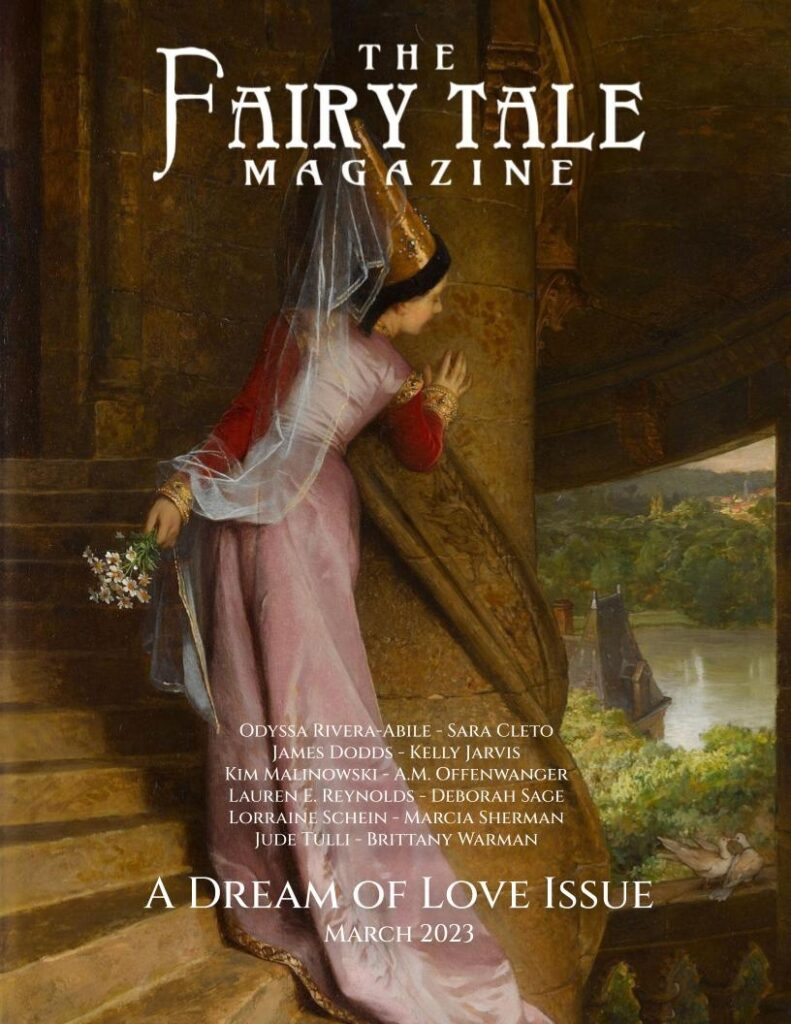
#1: The March issue of The Fairy Tale Magazine with a story by Yours Truly
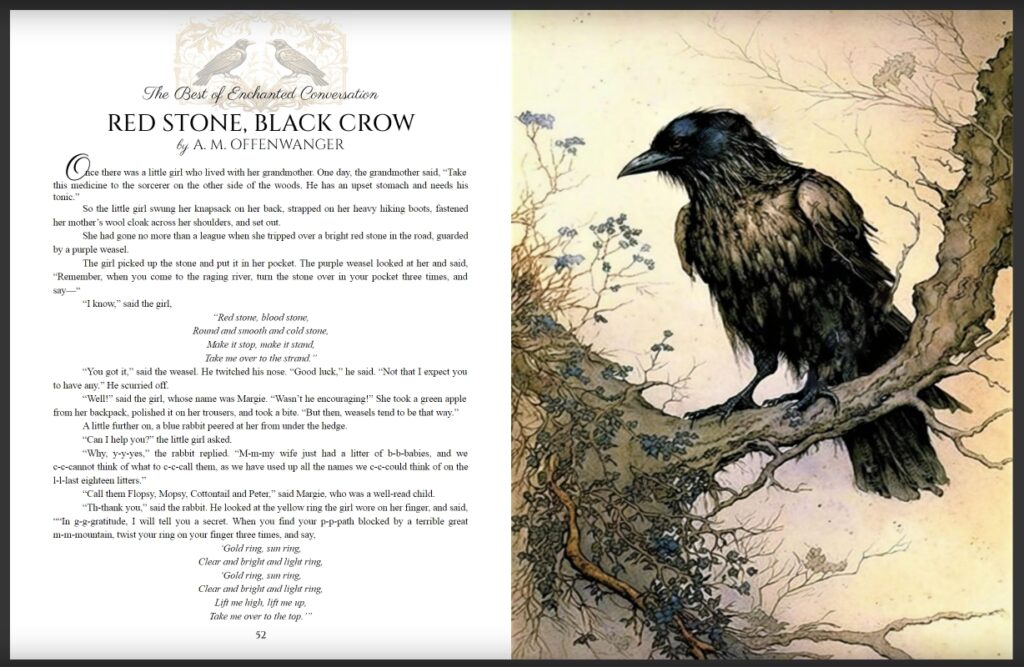
Enchanted Conversation magazine has recently been reborn in a new and utterly gorgeous format as a web magazine under the nameThe Fairy Tale Magazine. I was honoured by having one of my stories that EC had published in 2018 included in the “Best of Enchanted Conversation” section in the March edition, which is now out. So “Red Stone, Black Crow” is now available to read in the illustrious company of 70(!) pages worth of original fairy tale stories, with stunning illustrations that Amanda Bergloff created from public domain art (mine got an Arthur Rackham image! I mean, Arthur Rackham!). Check it out – it’s well worth the price of US$5.99 for the issue, or even better, $16 for the whole year (4 issues). (Also, the mag features an ad for Martin Millerson – how cool is that, an ad for my book in a real magazine!)
The screenshot of my story. If you want to see the rest, get the magazine!
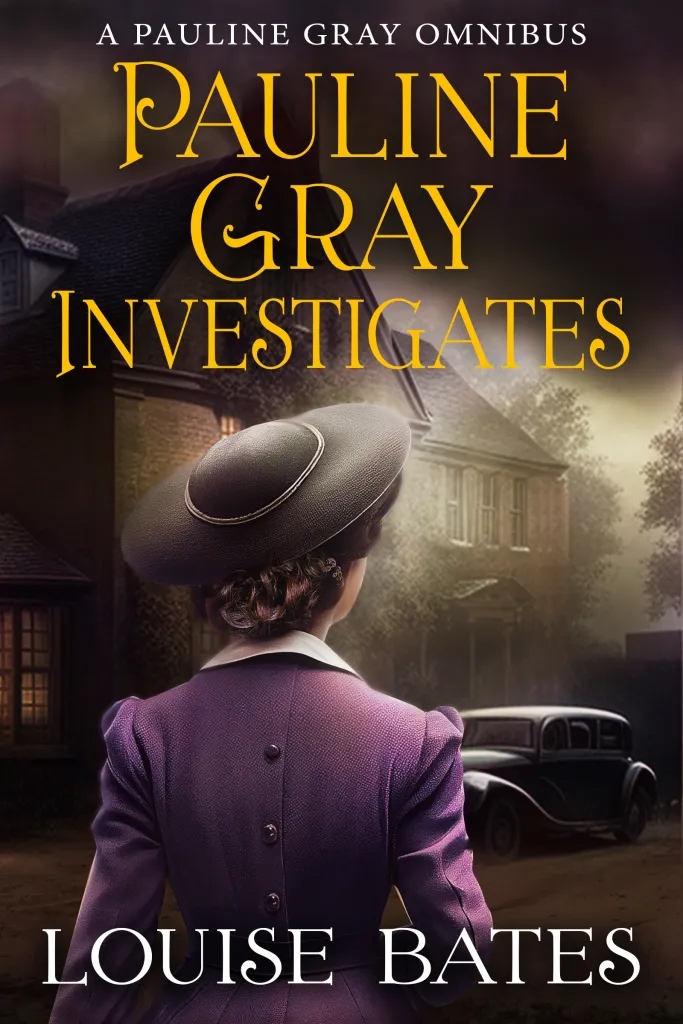
Welcome to Canton, NY, a small farming town nestled in the northern foothills of the Adirondack mountains. It’s the 1930s, and to an outsider’s eye, this looks like an idyllic village mostly untouched by the Great Depression that is ravaging so much of the nation. But even the most idyllic towns and villages have their dark sides. When trouble comes to Canton, the folk there rely on each other to help out. And that includes one young woman in particular …
Meet Pauline Gray. A graduate of the prestigious St. Lawrence University, she fell in love with the town while in college and has never left. A journalist by day and a secret novelist by night, Pauline’s compassion and drive for justice pull her into mysteries that are too small or too peculiar for the police. She would really prefer a quieter life, but when people need her help, she can’t turn them away.
Canton, NY, is, of course, Louise’s own home town, so the historic and geographic details in this series are absolutely spot-on. But more to the point, Pauline Gray and the people she meets are drawn with a deftness and sensitivity that makes the stories a delight to read. Go get a copy of the books – either the omnibus or the individual novellas – you won’t regret it!
And that’s Life, the Universe, and TWO new releases this week! Get yourself some good new reads!
News from Fairy Tale Land! Eight years ago, when I was researching my final project for my MA, I wrote a post on my research blog, quill and qwerty, on the iconic film Three Hazelnuts for Cinderella. It’s a German-Czech production from 1973 that has achieved near-cult status in Germany, and has influenced more than one “Cinderella” movie since then (including the 1998 Ever After and the wonderful 2015 live-action version). At the time, I was bemoaning the fact that there didn’t seem to be an English version of this so very lovely movie. Well, a couple of years ago a reader commented that an English version did exist; she’d watched it on TV in the 70s – and today, she posted the link to it on Youtube!
The quality of the recording isn’t the greatest, and it’s a slightly abridged version (1 hr as opposed to the 1 1/2 hrs of the original), but that doesn’t matter – it’s Three Nuts for Cinderella in English! So now you, too, can go watch it and know what it was that I’ve been raving about all that time. Thank you, Colleen! (Note, the beginning and end of the film are in the original Czech; the English dub starts at 6:34.)
So if you want to indulge in some shameless fairy tale enjoyment, hie thee to a Youtube channel, kick back and watch Three Nuts for Cinderella. You won’t be sorry.
The problem with maintaining a blog is that one really ought to post something on said blog. Well, I haven’t been able to think of anything to say. Yes, I know it’s Wednesday and that calls for a Wordless Wednesday post, but I don’t have any particular picture I wanted to post today, either.
But then, it’s been two years, really, since I’ve been doing much of any posting, quite aside from the year I “officially” took off. And in those two years I’ve accumulated a lot of pictures. So, how about, for the next while you’ll get some retro-pieces? Retro-thoughts, retro-pictures. And the thing is, when I first started blogging, more than ten years ago now, I did warn my esteemed readership that this wasn’t going to be a blog “about” anything in particular. Hence the tag line: “Life, the Universe, and a Few-Odd Other Things”.
It’s been two years… And we all know what those two years entailed. It’s sapped so much of my energy, of my ability to think and to create.
As you’ll know, if you’ve followed this blog for a while (or know me in real life), “Sleeping Beauty” is one of my favourite fairy tales. I keep thinking about why that is, and why this story holds such fascination for us as a society that it’s one of the perennial favourites. I mean, it’s kind of boring, isn’t it? It’s literally about a girl who… sleeps. But I don’t find it boring, and neither do any of the other millions of people who keep enjoying this story.
Just to get something out of the way, no, it’s not because the story is about the prince’s heroic journey to rescue the girl. That’s a Disney addition. In the Grimms’ version, which is the one I love, the prince does nothing more exciting than walk up to the thorn-covered castle, which lets him in because he unwittingly happened to show up at the right time. No dragons, no sword fights, no baddies to battle. Only sleep, so powerful it even knocks out the flies on the wall and the cook in the middle of smacking the scullery boy.
It’s the sleep that’s the real antagonist in this tale – and its solution, the way it is defeated, is to let it run its course. Once the hundred years are up, a prince shows up and the princess wakes. The prince is nothing special (apart from being a prince, but in fairy tales, those are a dime a dozen); he’s not “the chosen one”, he’s not “destined to fall in love with the princess”, let alone her previous lover who actively seeks her out to rescue her (most film versions of the story go with the latter, but, sorry, that’s not actually in the folktale). The only thing he does, and does right, is to listen to the story an old man tells him about the enchanted princess in the thorn-covered castle that nobody can get to, and let his curiosity get the better of him.
And suddenly there are roses on the thorns, and they part to let the prince in just in time for the princess to wake up.
Maybe that’s what we need to hear today: The sleep will run its course. There is nothing to do but wait it out, but once it’s done, there are roses and kisses and, unfortunately for the scullery boy, a smack upside the head.
Perhaps I had something to say today, after all.
Life, the Universe, and Sleeping Beauty. The sleep ends when it’s run its course.
An article by Yours Truly just went up on Enchanted Conversation Magazine. Those of you who’ve been reading my ramblings for a while might recognize it: I wrote it in the course of my grad school research and posted it on Quillandqwerty; now EC has kindly republished it.
THE CASE OF THE MISSING KISS
I’ve been studying Frog Prince tales. You know the ones: princess meets frog, he does her a service, in return he asks for a kiss, she kisses him, and hey presto, he’s turned into a handsome prince. Right? Wrong. If you look at the Grimms’ version—tale #1 in the CHILDREN’S AND HOUSEHOLD TALES—you’re doing okay until you get to the kissing part. It’s not there. It quite simply doesn’t exist. The act that gets the prince unfroggified is one of gross violence: the princess chucks the frog against her bedroom wall (in the 1812 version, with a lovely onomatopoeic “Splat!”). That’s right, attempted murder. When he falls down from the wall—I’ve always had trouble visualising that bit—he’s a handsome prince with “friendly eyes,” and the princess happily goes to bed with him.
That’s fine, you say. There are other versions of that story that have the kiss in it, aren’t there? Well, not that I can find, at least in the old tales…
I recently let off a rant about spinning wheels and one of my pet peeves, and Kate on Enchanted Conversation Magazinekindly consented to publish it. Here you go:
Enchanted Conversation recently republished an older post by Elizabeth Creith, a highly informative article on flax that is aptly entitled “STRAW INTO GOLD.” As a fairly new convert to spinning, it caught my interest—and it reminded me of one of my pet peeves where “spinning and fairy tales” is concerned.
Full disclosure: I let my fascination with “Sleeping Beauty”—my favorite fairy tale—led me down the garden path into learning to spin. First it was a drop spindle, then a little castle wheel, and now I own an old Ashford Traditional, which is one of those really classic items that look exactly like what you’d expect to see when you hear “spinning wheel.” You know, a big flywheel; a treadle; a thing that whizzes around; sharp pointy bits sticking out at every angle for unwary princesses to prick their fingers on and fall into hundred-year sleeps…
Actually, no. My spinning wheel, which is one of the earliest iterations of this model of wheel, has no pointy bits on it anywhere. None. Zero. Nada. It does have the flywheel and the treadle and the thing that whizzes around, though. The latter item is called the flyer, and it contains, right in its center, the spindle. Which, on this kind of wheel, is a hollow tube. Did I mention “no pointy bits”?
So what, then, did the princess prick her finger on?