
#WordlessWednesday: Meeting Myself Coming and Going
life, the universe, and a few-odd other things

7:45 on an almost-spring morning in a small town in Southern Germany. It’s still chilly enough that I need my fingerless gloves, but the sun is rising in a clear sky, setting the golden stucco of the old bakery at the street corner aglow with the promise of a beautiful day. The upper two stories of the old building look hardly different from how they’ve been for the last century or so, the window shutters beneath the half-hipped red tile roof folded back against the wall to show net-curtain-shrouded windows behind which the inhabitants are starting their day.
But the ground-floor shop windows are as modern as they come. I step through the automatic sliding glass doors into the warm scent of the fresh-baked breads and rolls and pastries that are piled on the shelves against the back wall and displayed behind the glass counter that runs the whole length of the shop.
On the far left, at a small café table a couple of men in business suits down a quick cup of coffee and a roll on their way to catch the train for work. The baker emerges from the back room with an enormous tray piled with fresh pretzels, which he unceremoniously dumps on the counter. Good! Those are just what I’m after. This is Swabia, the original birthplace of the pretzel, and nowhere else are they as good as here. A few salt kernels – not too many – speckle the deep, glossy, mahagony brown of the fat part with the deep slash exposing its creamy interior; the two little twisted arms are thin and crispy. Legend has it they are modelled on the first pretzel baker’s wife’s crossed arms as she watched him bake.
When I turn back to the counter to place my order, I find that two small girls are in line ahead of me, buying a sausage roll, a bread roll, and a couple of pastries for their breaktime snack at school – they’re probably in Grade 1 or 2, no more. “That’ll be €3.40,” the sales lady says as she hands over the paper bag with their goodies, and one of the girls stretches as high as she can to lay her coins on the little wooden tray that sits on top of the glass counter for the purpose. She can barely reach, but she pushes the coins across, grabs her bag, and with a cheerful “Tschüss!” she and her friend skip away. They should still make it in time for school to start at 8:00.
It’s my turn. I can’t be bothered to make a lot of decisions today, choosing from the dozen or more varieties of fresh, crispy bread rolls – white, brown, rye, plain, seeded, sunflower and pumpkin, long or plump or round – so I just ask for three of my favourites, Dinkelbrötchen or spelt rolls: a crispy crust covered in oat flakes, a tender interior with soft chewy spelt kernels throughout. Perfect for a spread of Quark, soft white cheese, topped with strawberry jam. And I ask for two Brezeln, of course.
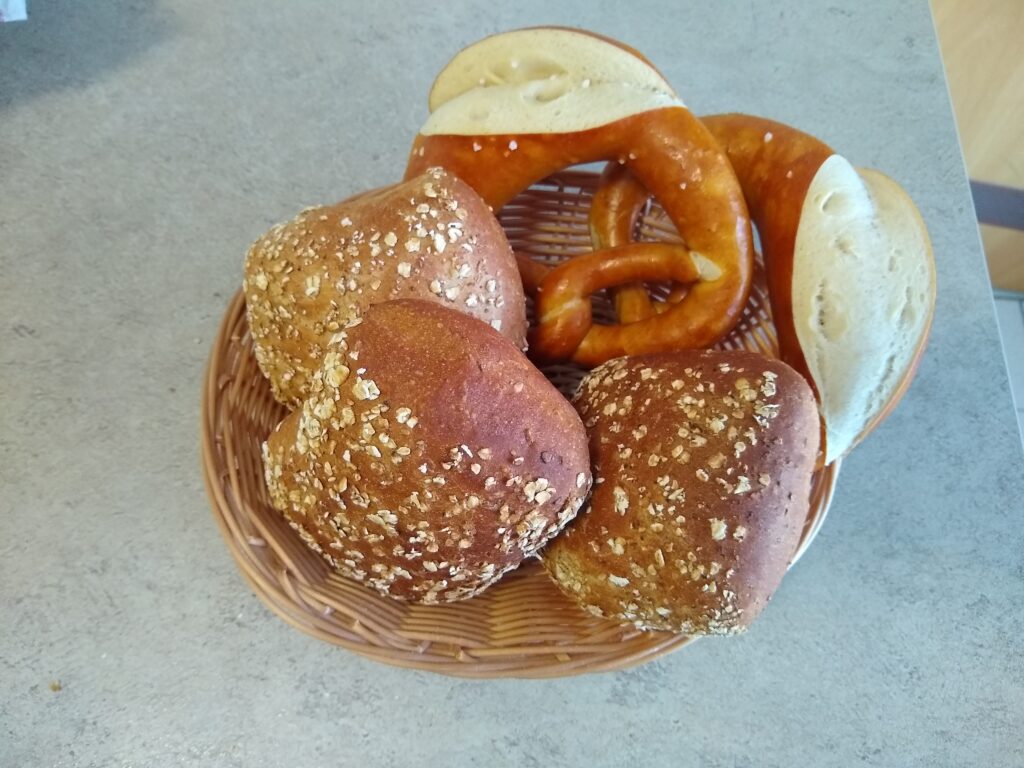
Their warmth is seeping through the paper bag as I step back out into the street. I’m tempted to hug it to myself to warm my hands, but in true European fashion I tuck it into my backpack to carry it the two blocks to where I’m going. The golden hands of the clock tower show five minutes to eight as the drugstore around the corner and the supermarket down the street are getting ready to open their doors to customers. A new day is beginning in this small town.

The bakery has been operating in that building for more than four generations. For over a hundred years, children have been stretching to put their coins on the counter to buy a bread roll for recess, then run off to get to school before the bell rings at 8:00; working people bought their coffee and pastry and headed for the train; and folks like myself today with a little time to spare bought fresh, still-warm-from-oven rolls and pretzels to take home for a leisurely breakfast of coffee and bread and cheese and jam. The baker has been up since 3:00am to make it all happen, as did his father and grandfather and great-grandfather before him, and perhaps his daughter and granddaughter will do after him. For all the automatic sliding doors and gleaming plate glass display windows, there is a thread of continuity that runs through the fabric of existence here.
I find my soul being nourished by the warmth that gently seeps out of my bag of Brötchen und Brezeln, and I revel in that sense of being tied into a web of culture that has been in place for generations and will continue for generations to come. It’s unlikely that any children and grandchildren of mine will buy breads and cakes in this place where my grandparents and great-grandparents got theirs, but someone’s children will. The thought is as warm as the rolls and pretzels in my bag.
Life, the Universe, and a visit to the German bakery. I’m bringing breakfast today.

Today is a cross-quarter day, one of the four days of the year that fall between the quarter days. The quarter days, of course, were (or still are, really) festivals roughly equating to the solstices and equinoxes: Lady Day on March 25, St. John’s on June 24th, Michaelmas on Sept. 29, and Christmas on Dec. 25th. Smack-dab in between those days, there are the cross-quarter days, the old Celtic quarter days: Imbolc, Beltaine, Lughnasadh, and Samhain, on February, May, August, and November 1st, respectively. Notice something? Right close to several of those days are festivals we still know of today: May Day on May 1st; Halloween or “All Hallows E’en”, the evening before All Saint’s Day on Nov.1st; and then here we have Candlemas, also known as Groundhog Day or St. Brigid’s Day, on February 2nd.
In the old European traditions, Candlemas was an important day. It was the start of the agricultural year, the time when maids and farm labourers were hired or re-hired and got their yearly wages. In the Alpine regions, it was and still is also the last day of Christmastide. The Christmas tree, which is put up and decorated on Christmas Eve (not in early December like in America) stays up until Candlemas. Of course, by then a very small sneeze in its general vicinity will cause an avalanche of dry pine needles to shower to the ground, leaving a prickly pole with some sadly denuded sticks protruding from it that are valiantly attempting to hold up the decorations. Time to pack them away until next winter.
Because this winter, I’m glad to say, is more than half over now. If the quarter day of winter solstice means the turning point in the light, where we celebrate the changeover from the days getting shorter and shorter to the long ascend towards summer solstice (when I’ll be moaning about there being too much light, especially at 4am when the birds are yelling outside my window), the cross-quarter day of Candlemas means that we can actually see the days getting longer. By now, we have a reasonable chance of having our breakfast and maybe even cooking our supper in daylight, and back in the days when the only artificial light people had were candles, from Candlemas on they might be able to do their spinning without them.
Candlemas is called Candlemas because it was the day when the yearly supply of candles for both church and home was blessed. I only just learned that among the domestic candles people took to be blessed was a black “weather candle”, which was lit by way of a prayer for safety when there was a thunderstorm or other dangerous weather threatening. The black colour originally came from the weather candles being made of the sooty wax drippings of a church’s votive candles. People back in the day knew how to recycle.

When I thought about what other names February 2nd has, I remembered that way back when I first started blogging, I’d already written a post about it. I looked it up, and it’s actually quite funny (even if I say so myself). I’m pretty sure the photo of the groundhog (or gopher, rather) was one I took myself on a camping trip, but I can’t remember exactly what year or where.
The fact that in today’s English-speaking world most people know the term “Groundhog Day” is also funny. Because what they know, or associate with it, isn’t necessarily February 2nd. I mean, when you saw the title of this post, did you immediately think I was going to talk about a day that repeats itself over and over in an endless loop? If you did, you can thank the Bill Murray movie. I like it when a piece of fiction that was created simply for entertainment brings a whole new understanding of a concept to our culture, and becomes so firmly embedded in our ideas that it changes the very definition of a word.
That’s what culture is: transmission of ideas from one person to another. Celtic Imbolc, black weather candles in the Alps, the Groundhog Day movie. It ties us to the people around us and to those who came before.
Life, the Universe, and Groundhog Day (and Groundhog Day, and Groundhog Day, and Groundhog… Never mind). Happy Candlemas!

It’s a new year. Time for some new habits. As Michelle Lloyd of United Art Space says, time to decide what to shelf and what to delve (deeper into).
So, one of the things I decided it’s time to shelf is some of my online subscriptions. Not so long ago, I was subscribed to four different streaming services – count ‘em, four! Three of them movies, one audiobooks. Britbox, Netflix, Amazon Prime, and Audible.
Now, I don’t know about you, but most of those I subscribed to “just for a while,” in order to watch a particular series or get a set of particular books. And then, I was going to cancel as soon as I had watched/purchased/got that thing I came for.
Right. I watched the new “Why Didn’t They Ask Evans” on Britbox, the one with Will Coulter and Lucy Boynton. I highly recommend it, you really should… No, you shouldn’t. Because if you’re like me, you get a Britbox subscription in spring of 2022 when the series comes out, and in summer of 2023 you’re still paying for it, even though you hardly watch the channel.
And then there’s the Audible subscription. I signed up for long enough to get all six Austen novels as narrated by Juliet Stevenson, because they’re just So. Dang. Good. Now, I’ll grant you: you sign up, you pay your $15 a month ($16.74 with tax), and you get a free audiobook for that, which, if you buy it outright, would cost anywhere from $25 to $40. And you get to keep that book even after you cancel the subscription. So that’s a good deal. However. I signed up. I got my first few books. Then they offered me a deal on buying more credits, which brought each credit (i.e. each audiobook) down to about $13. Even better, right? So I got the rest of the Austens. And the whole Narnia collection (all of them for one credit!), and a few Heyers. I got what I came for! And then some! But did I pack up and leave?
Spoiler alert: No. At least not without some pretty serious struggles.
I decided to cancel my Britbox last summer. They popped up a message to the tune of “Are you really, absolutely, totally sure you want to leave? Why? WHY???” When I clicked the little button that said I was leaving because I was “trying to save money,” they offered me one month free. Heck, yeah, I’m not one to pass up a freebie! At the end of that month I went to cancel again. This time they offered me a couple of months at half price. I mean, sure, why not?
Stuck again.
I kept making myself calendar reminders, in plenty of time before the next billing due date: “Cancel Britbox.” “Cancel Audible.” “Cancel Prime.” Then the day would come around, the reminder pop up on my phone, and I’d go “Ummm, I’ll do it tomorrow…” Tomorrow came, and the reminder got postponed for another few days yet. Eventually, the billing period rolled around, and here I was, with another month of streaming services paid for that I hardly made use of.
But finally, I decided to bite the bullet and do that thing. Pull the plug, get out. But, but, but – all those benefits I’d be missing out on! I wouldn’t be able to watch Poirot whenever I felt like it, or one of the old BBC Shakespeares, like the Romeo and Juliet from 1978 that has a young Alan Rickman with floppy dark hair playing Tybalt…. Did I ever watch that Romeo and Juliet in the last two years? No. But I could have! And if I cancel, I definitely won’t be able to!
FOMO, the Fear Of Missing Out, strikes full force. It’s astonishing how powerful that force is. And the streaming services, aka the people whose sole purpose for existence is to answer the question “How can I get your money into my pocket?”, play it up to the hilt. Quite literally. Trying to cancel Amazon Prime, you have to click through at least three windows that shout at you over and over “LOOK AT WHAT YOU’LL BE MISSING!” And even though most of what they’re telling me I’ll be missing is services I have no interest in (such as Amazon Music, or Amazon Photos), that phrase still has the power to make me pause, and cringe a little, and stop to consider – do I really want to cancel… really really…?
I found myself quite surprised at just how difficult it was to click those buttons to cancel. I mean, it’s not like I couldn’t sign up again anytime I want. If I get an irresistible craving some Saturday evening to watch David Suchet put “ze little grey cells” of Hercule Poirot to work, all it takes is a few more clicks of the mouse, and my Britbox subscription is reactivated. As for the Prime benefits beyond the streaming video, I can still order things from Amazon; it just takes a few days longer for the stuff to get here. If I’m really desperate for 2-day shipping on an order, I could – gasp! – pay for shipping, which would probably still cost less than $10/month…
Because that’s the thing: it’s not like they’re giving us all these wonderful services for FREE. Sure, once you’ve signed up, your forget the chunk of money that drops out of your credit card every month. The pain comes in when you first hit that button, when you perform the action of paying the money. But once the action is completed, you forget it. The pain comes in making a change. That’s what they’re relying on with their marketing strategies: once they’ve got you to take the action and make a change, i.e. subscribe to their service, it’s easier for you to not make another change, and you very quickly get to feeling that you actually deserve whatever they’re giving you, that you’re getting it without cost, “as a membership benefit.”
But there is a cost. A not insubstantial one, at that. I just (gulp!) pulled the plug on Prime and Audible. And when I did the math, I realized that with tax, that’s $27.93 that won’t be coming out of my credit card every month. I cancelled Britbox at the end of December; another $11.19 per month. That’s nearly $40 every month that I’m saving. Genuinely saving, not the fake “Save with our discounted products!” that marketing strategies like to sucker you in with.
Now, don’t get me wrong. I’m not trying to say that streaming services are bad, that you should cancel your streaming subscriptions, that cancelling is more righteous than keeping your services, that I’ll never sign up to another streaming service again, or any such nonsense.
My point is that I noticed just how difficult it is to make the choice to discontinue, even if I don’t really get my money’s worth out of it anymore. Even if I have plenty of alternatives: I have hundreds of DVDs on my shelf, and probably thousands I can get from my local library. Public service broadcasters – around here that’s Knowledge and CBC – have free movie streaming available. Librivox has thousands of public domain audiobooks, and the library has thousands more. I’m not exaggerating – thousands. And all of that genuinely, truly FREE.
Yet I found it hard to click that “cancel” button.
With all the shouting that the stream-for-money services are doing to trigger my FOMO, I’ve almost forgotten about all the resources I have available to me. I’ve let myself be sucked into the stream, into the idea that I need to keep those services because else I’ll… I’ll… I don’t know, I’ll be bored on a Saturday evening when I don’t have a movie to watch? I know. It’s ridiculous.
So I clicked the button, wincing just a little. And now I have a week to watch the last few Prime Video episodes I can’t do without (but kept putting off), and listen to the last few chapters of the free Audible book I’ve got on the go, and then I will try life without those services. But truth be told, it already feels good to know that there will be $28 less coming out of my account each month. Think of what I could do with that…
Life, the Universe, and Getting Out of the Stream. The Joy Of Missing Out.
Happy New Year, Gentle Reader. I just put together the January edition of Clay and Words News, my newsletter (are you subscribed yet? You can do so over here: https://amovitam.ca/newsletter/).

It’s very January-ish around here right now, dark and cold. Although it hasn’t been nearly as cold as is normal for this time of year, the lack of snow makes things seem even darker than usual. We still need the electric lights on at 8AM, and of course turn them back on by at least 4PM. Good thing we’re past solstice, and it’ll only get brighter from here on.
Every January I wonder how our ancestors lived through that dark season, with nothing but candles to illuminate their houses, and poor quality candles at that. Beeswax was expensive even then, reserved for the church and rich people (Jane Austen, Emma: “Wax-candles in the schoolroom! You may imagine how desirable!”), and from what I understand, tallow candles, which ordinary people used, don’t give a very clear light. Never mind rush lights, which are about the equivalent of a tiny flashlight with the battery in its death throes.
I was reminded of a post I wrote a few years ago right around this time, when I realized that January is, in fact, the Midnight of the Year. The tiredness so many of us in the more Northern latitudes feel right now, and the urge to just curl up with a blanket and a good book and not move until spring, might well have a good reason, and perhaps instead of fighting them it would be worth humouring our desires. It’s probably healthier for body and soul.

As per usual, the cat has the right idea. I think I’ll go follow his example.
Life, the Universe, and the Midnight of the Year. Stay warm and carry on.
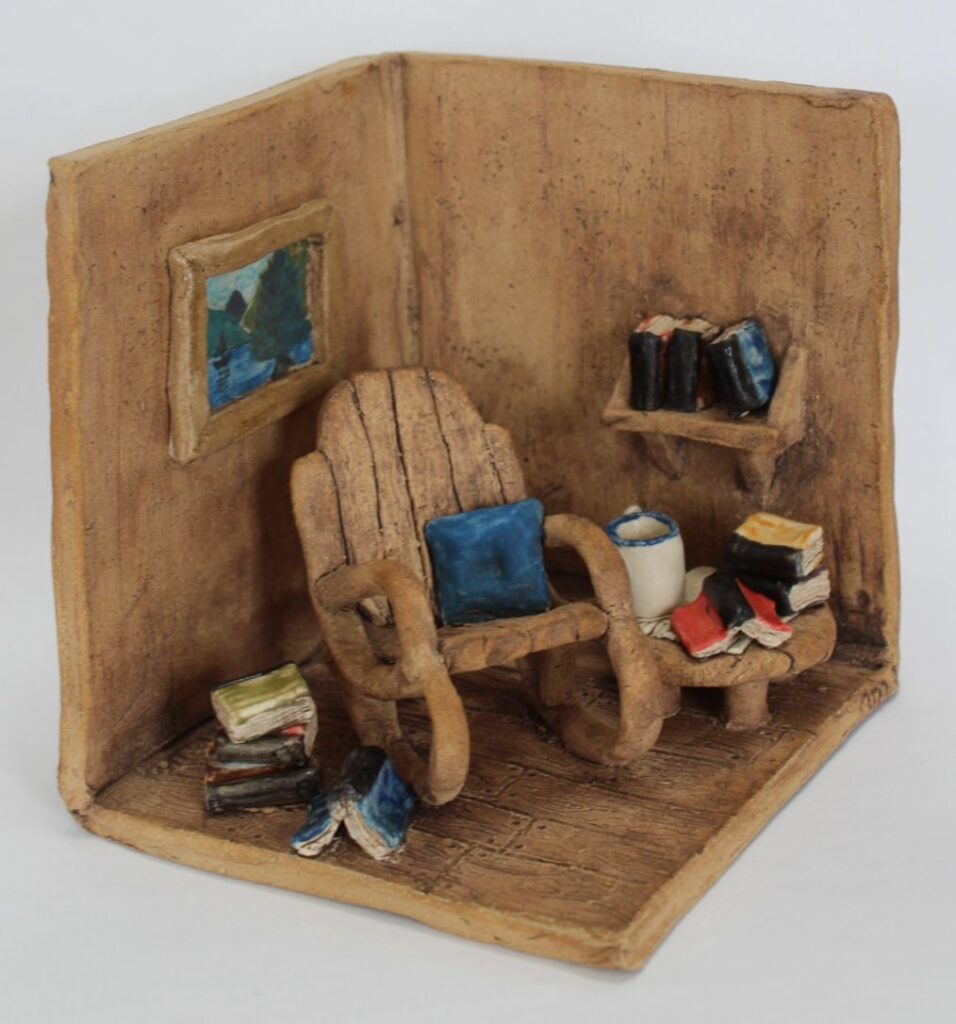
The world has become a bad place in the last few years. So many things are going wrong, so much strife, so much floods and fires and earthquakes and wars and rumours of wars.
But Story can set a counterpoint. Story allows us to escape the trap of perceived reality.
And that’s the key, isn’t it—perceived reality.
Story allows us to perceive a different reality. It lets us experience a different world, one in which plots resolve, problems come to a conclusion. Unlike the so-called real world, where everything is just a muddle, Story brings order to the world. As renowned folklorist Max Lüthi says*, the story world shows us not what could be, but what is.
Why do I tell Story? In order to create worlds and places for people to enter into, worlds of truth. Worlds of justice and joy. Worlds not without problems, but worlds where those problems can and will be resolved.
Story is not escapist in the sense of letting us run away from our problems. But is is escapist in the sense of setting us free from the confines of our perceived reality. It allows us to see the bigger picture, opens our eyes to what is actually there. Even when it is Story about ostensibly “unreal” things, about elves and fairies and little dwarfs under the mountain. Maybe especially then.
We need Story—the World needs Story. The world needs Story to make sense of itself, to keep from sinking into a morass of muddle and chaos.
And that is why I tell Story. Unabashedly and unapologetically, I tell stories of joy and pleasure and home and warmth and family, where tiny people live in tiny homes and big ones get whirled away into other worlds where they find belonging.
Because in entering into these worlds, entering into Story, we can step out of the bondage of perceived reality, and we can find what is really real.
The world needs Story. That is why.
[*Lüthi, The European Folktale: Form and Nature (Philadelphia: ISHI, 1982), p.89. I quoted the full piece in a post on my research blog some ten years ago, here.]



I just spent almost six weeks away from home. Six weeks, eight different places. Vancouver Island, Munich, Hesse, Stuttgart, London, Toronto… Visiting family, spending time with friends, going on errands and sightseeing trips and appointments with said family and friends, talking about their affairs and my affairs and the world’s affairs, experiences piled on impressions and filtered through yet more experiences. It was a wonderful time, a strenuous time, a time to be remembered.
And through it all, over and over, I was struck by just how pervasive Uppercross Syndrome is.
In case you don’t know about Uppercross, in Jane Austen’s Persuasion her heroine, Anne Elliot, has to watch her family move out of their mansion, Kellynch Hall, in a huge upheaval that is necessitated by her father’s imprudent spending habits. Once her father and sister are gone to Bath, where they intend to settle into a new life while Kellynch is rented out to pay their debts, Anne goes to her other sister’s home in the village of Uppercross and for a time becomes completely absorbed in the affairs of the Musgrove family.
“Anne had not wanted this visit to Uppercross, to learn that a removal from one set of people to another, though at a distance of only three miles, will often include a total change of conversation, opinion, and idea. She had never been staying there before, without being struck by … how unknown, or unconsidered there, were the affairs which at Kellynch Hall were treated as of such general publicity and pervading interest… [C]oming as she did, with a heart full of the subject which had been completely occupying both houses in Kellynch for many weeks, she had expected rather more curiosity and sympathy than she found in the separate but very similar remark of Mr and Mrs Musgrove: ‘So, Miss Anne, Sir Walter and your sister are gone; and what part of Bath do you think they will settle in?’ and this, without much waiting for an answer; or in the young ladies’ addition of, ‘I hope we shall be in Bath in the winter; but remember, papa, if we do go, we must be in a good situation: none of your Queen Squares for us!’ or in the anxious supplement from Mary, of—‘Upon my word, I shall be pretty well off, when you are all gone away to be happy at Bath!’”
(Jane Austen, Persuasion, Chapter 6)
In Uppercross and the neighbouring Lyme Regis, Anne and the Musgroves go through lifechanging events, but when it is time for Anne to join her father and sister in Bath, once again she experiences the total disconnect in mental states that a change in location and environment will bring about. Just as the Musgroves were more or less uninterested in the Elliots’ burning concern about their move, now the Elliots in Bath neither know nor care that the Musgroves nearly lost one of their daughters in a freak accident and that Anne was deeply involved in the matter. All they think of is showing off the size of their drawing room and discussing the arrival of a handsome cousin, and it is left to Anne to once again switch tracks from one of her deep concerns to the other.
But it doesn’t take a pair of self-absorbed aristocrats like Sir Walter and Elizabeth Elliot for Uppercross Syndrome to kick in. Like the kind and caring Musgroves, most of us are focused on the here and now, on the circle of friends and surroundings we find ourselves in today. What completely took up my attention in Vancouver faded into the background once we touched down in Germany; what mattered in Munich was left behind on the way to Frankfurt; in Stuttgart, I was so mentally occupied with what was happening there that I barely managed to send the few texts I needed to plan our time in Toronto. Now that I’m home, after I told everyone a bit about Niagara Falls and the family matters in Germany, we talked about the antics the cats got up to in my absence; and now thoughts of the garden and household and pottery and all the other work waiting for me here are swiftly taking over most of my available mental channels.
Uppercross Syndrome: the phenomenon that “a removal from one set of people to another … will often include a total change of conversation, opinion, and idea.”
There is nothing particularly wrong with it. Austen neatly contrasts the self-centred Elliots who care only about their position and appearance with the kindly Musgroves whose life is focused on their home and their children, but neither of them have much thought to spare for the other. I think it’s a human reality that our present environment takes most of our attention, with not much left for what is out of sight and hearing. Perhaps that’s just as well. It’s good to focus on how we live that here-and-now life—far better to be a Mrs Musgrove, concerned about her children, than a Sir Walter Elliot, obsessed with his looks.
But then, like Anne, we can learn “the art of knowing our own nothingness beyond our own circle”. We can live in the humble awareness that what is all-absorbing to us today, in this place, is of little concern or interest to most of the rest of the world—and that even for us, perhaps it’s not such a big deal after all. We can enjoy the joys, but need not hang on to the pain. It puts things in perspective.
Life, the Universe, and Uppercross Syndrome. Another place, another view.


As you might know, I’m fluently bilingual. English or German, I can make my desires know: “Excuse me, where do you keep curtain hardware?” or “Wo ist die Zahnpasta, bitte?” It’s not a problem—I jump from one track to the other, and operate in either system without having to think about it.
And then I went to France. For the first time in my life, I was confronted with being struck deaf and mute. The extent of my French is, pretty much, Bonjour, Au revoir, and merci beaucoup*. In Paris, I understand nothing, and can communicate nothing. And let me tell you, it is astonishingly disconcerting. You don’t realize how much you rely on your verbal prowess until it’s taken away from you. So, I decided it was time I did something about it, and I set out to learn at least a little bit of French. You’ll be glad to know that as of this morning, I have learned to say “Un café au lait avec du sucre, s’il vous plaît, et deux croissants.” You know, the necessities of life. I do not yet know how to ask where the bathroom is, but as I most likely wouldn’t understand the answer, that’s just as well.
But this whole process got me thinking about how to learn languages. It’s really not that hard, we’ve all done it! Yes, you have too—you’re reading this, aren’t you? You learned at least one language completely fluently, effortlessly, grammatically correct, with flawless pronunciation. So, all it should take is to repeat that process with another language, and you’re golden. I’m by no means the first person to come up with that idea; I don’t know how many times I’ve seen language learning programs advertised as being “completely natural” and “just like learning your first language.” It should work, shouldn’t it? No problem.

Now, as luck would have it, a couple of weeks ago I had a front seat to watching the process in action, courtesy of a visit of a young relative. This young gentleman, who recently obtained his first birthday, is a remarkably intelligent individual (of course he is, he’s related to me), who is very interested in language and in the world around him, particularly the four-footed variety. I observed him closely, and I’m now in a position to tell you exactly how this language learning thing is done. Here you are:
LEARNING A LANGUAGE THE NATURAL WAY, IN EASY-TO-FOLLOW STEPS
Step 1.) (Optional, but helpful) Be as cute as you can possibly be.
Step 2.) Surround yourself with as many individuals as you can who adore you and are willing to repeat words to you on a continuous feedback loop.
Step 3.) Point to an object of your interest and make gurgling noises (example: the cat).
Step 4.) Wait for your adoring audience to supply the word in the language of their choice (“Die Katze!”).
Step 5.) Copy the word to the best of your ability (“Tz-tz!”).
Step 6.) Let your audience correct your pronunciation and try again. (“T-tz!”)
Step 7.) Repeat steps 3.-6. approximately twenty times per hour during all your waking hours, every day, for the next two to three years. Vary the objects labelled as required and improve your pronunciation as needed.By the end of four or five years, you should be completely fluent in your new language and will be able to move on to instructing others.
There you have it: the one, the only, the infallible completely natural method to learning languages. It really works.
Now if I could only find someone to repeat le chat to me, over and over and over and…
Life, the Universe, and Natural Language Acquisition. It’s the only proven method.
*being Canadian, I can also read some French food labels: I know that fraise is strawberry, framboise is raspberry, and bleuet is blueberry. I know my yogurt flavours. But they’re of limited usefulness in navigating the Paris metro system or buying museum tickets.
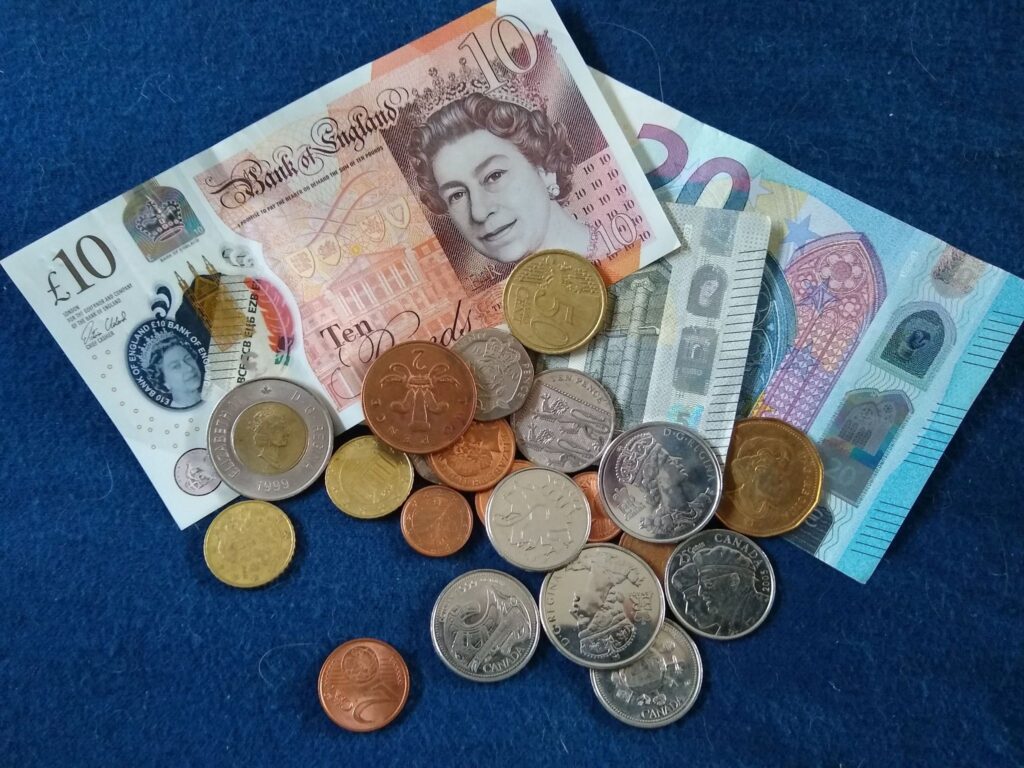
Your attention is one of the most valuable things you possess, which is why everyone wants to steal it from you. First you must protect it, and then you must point it in the right direction.
As they say in the movies, ‘Careful where you point that thing!’
What you choose to pay attention to is the stuff your life and work will be made of.Austin Kleon, Keep Going
I ran across that quote from Austin Kleon the other day, and it really struck me. The man knows what he’s talking about. (He really does. Go buy his books.)
In our world today, it’s become more and more important to point our attention in the right direction. If we don’t intentionally point it at what we want to pay attention to, it’ll be pointed for us, by an attention economy that is extremely expert at making us look where it wants us to look.
And what we pay attention to will fill our whole vision. If all, or most, of what we pay attention to is what’s bad in the world or in our life, pretty soon that becomes our life. It’ll be all we see. The world is a bad place to be, “they” are out to get people like “us”, everything is awful, and we spend our time wallowing in misery.
It’s not that there’s not plenty of bad stuff out there—there is. Or that there aren’t undesirable things happening in our lives—there are.
But listen to the language: paying attention. Spending time.
Because that’s exactly what it is. I have a finite amount of attention and time available. If I use up that attention and time on negativity, on things I dislike and disagree with, on matters that are bad and I can’t do anything about, that time and attention is gone. Poof. Kaputt. I no longer have it available to spend on the things that really matter.
What do I really want to spend the precious coin of my time on? What do I want to pay attention to?
“Do you want to be happy? Be grateful!” says Brother David Steindl-Rast of grateful.org. He’s not talking about “looking on the bright side”, or “trying to find the silver lining in the cloud”, let alone “shutting our eyes to what is painful and ugly and evil”. No, this is about attention: the attention to the surprise and wonder that surround us, every day, no matter where we are.
And I, for one, want to cultivate that kind of grateful attention. I don’t want to be miserable, thank you very much. Over and over I make the choice (at some times more successfully than at others) to spend my attention on the things that really matter, that matter to me. And once I’ve paid that attention, I find I have none left to spend on those other things, the ones that “they” want me to pay out my attention for and that make me upset and angry and depressed. Those things are still there, but I don’t have time for them; I already spent it all.
And that’s just fine with me.
“What you choose to pay attention to is the stuff your life and work will be made of.”
Life, the Universe, and Paying Attention. I want to choose my spending wisely.