Apple Bowl Cottage, or: The Comfort of Story

It is a dark and gloomy day… inside and out. The news is bad, friends are going through tough times, the weather is screwed up, and everything is playing merry hell with my moods. As is usual for late January, there is a cloud over the Valley that feels like a giant hand clapped a lid on and is pressing down tight.

I come downstairs in the dark, and I light a candle on the coffee table. Then I light another one—the little tea light that’s inside the fairy house sitting next to the candle. “Apple Bowl Cottage” has been to a couple of art shows this winter, but it didn’t find a new home yet. Maybe that’s just as well; I needed it today.

I sip my coffee, enjoying the soft glow of the candlelight, then I turn on the big light and write in my journal for a while. By now, there is daylight outside, such as it is. Not much of it (did I mention Lid-on-the-Valley weather?). But it’s time for breakfast, so I blow out the candle.

And in those two seconds that I watch the smoke curl out of the chimney of the fairy house, I have a sudden flash of Story.

The fairies turned off their lights, I think, and they’re off to work. No, actually, they don’t go to work outside of home; the fairy that lives in this house is getting ready for her day of cooking and washing and making apple pies. She turned off the light because it’s bright enough outside now she doesn’t need the lamp. I wonder what she’s going to do today? I think after she’s turned the apples in the bowl into a pie, she might be looking forward to reading her book; she just got to the best part yesterday.

And just like that, the world has become brighter. Warmer. Safer.

I don’t know her name, the little fairy that lives in the tiny ceramic cottage on my coffee table today. But the light shining from her little home, and the warm smoke curling from the chimney, has cheered my day. There is still a Lid on the Valley and bad things in the news, but I’ve been reminded of joy and warmth and comfort and whimsy and brightness.

And those are as real as anything else.

Life, the Universe, and Apple Bowl Cottage. The comfort of Story.

(Apple Bowl Cottage with a quarter to show scale. Also, that’d be a heck of a lot of money, by comparison! A coin as big as your table top…)

PS: Yes, Apple Bowl Cottage is for sale, and I think the fairy would be very happy to move to your house (and I’d be happy to share her)! If you’re interested send me a message, here.

Gaeli’s G’nomes

I just sent out a newsletter (are you subscribed yet? You can do so here), and I told everyone about Gaeli’s G’nomes. And then I thought, hey, I don’t think I’ve ever introduced them on the blog, either. So it’s time to remedy that situation.

Gaeli’s G’nomes, as I told my newsletter readers, are the family of gnomes who live on my living room cabinet—well, the ones who are still home. Several of them have moved out already, and all of these ones are perfectly willing to do so, too; give me a shout if you’re interested in adopting one. They’re made of stoneware clay, so they’d be happy to live outside in your flowerbed over the summer. Oh, and all of them are about 8″ (20cm) high/long, give or take.

Their family name is spelled the way it is to make sure it’s pronounced with a hard G on both words. Technically they should be “Geli’s Gnomes” (Geli, prounounced “gaily”, was my childhood nickname), but they’re not “Jelly’s Nomes”, as most people would say it if it was spelled that way; hence “Gaeli’s G’nomes”.

Here’s the current family, all hanging out in my living room. I’m not sure what their conversation is about, but as a rule they get along quite well.

Now, if you’d like to meet a few of them, we’ll start with Gordon. He’s a mellow guy, likes to be quiet and just hang out with his bug, who’s gone to sleep on him.

Gabby is a chatty individual who likes to tell stories, and fortunately for her, her bug likes hearing them.

Gabby’s twin brother Garth is a dreamer; he and his bug like to find pictures in the clouds.

And here’s Goldie, who’s the youngest sister. She’s a busy and cheerful kind of person; I think she’s just spotted a butterfly and is quite excited about it. Her bug, on the other hand, isn’t so sure about it; he likes her to pay attention to him, not to some kind of fluttery thing in the air!

We’re hoping that over time, there’ll be more members added to the G’nome family, and will go out into the world and find new homes.

And there you have it, that’s Life, the Universe, and Gaeli’s G’nomes. They’ve enjoyed meeting you all!

Gaeli & G’nome (Self-portrait assignment from Digital Art Class, done in Procreate)

Why Story?

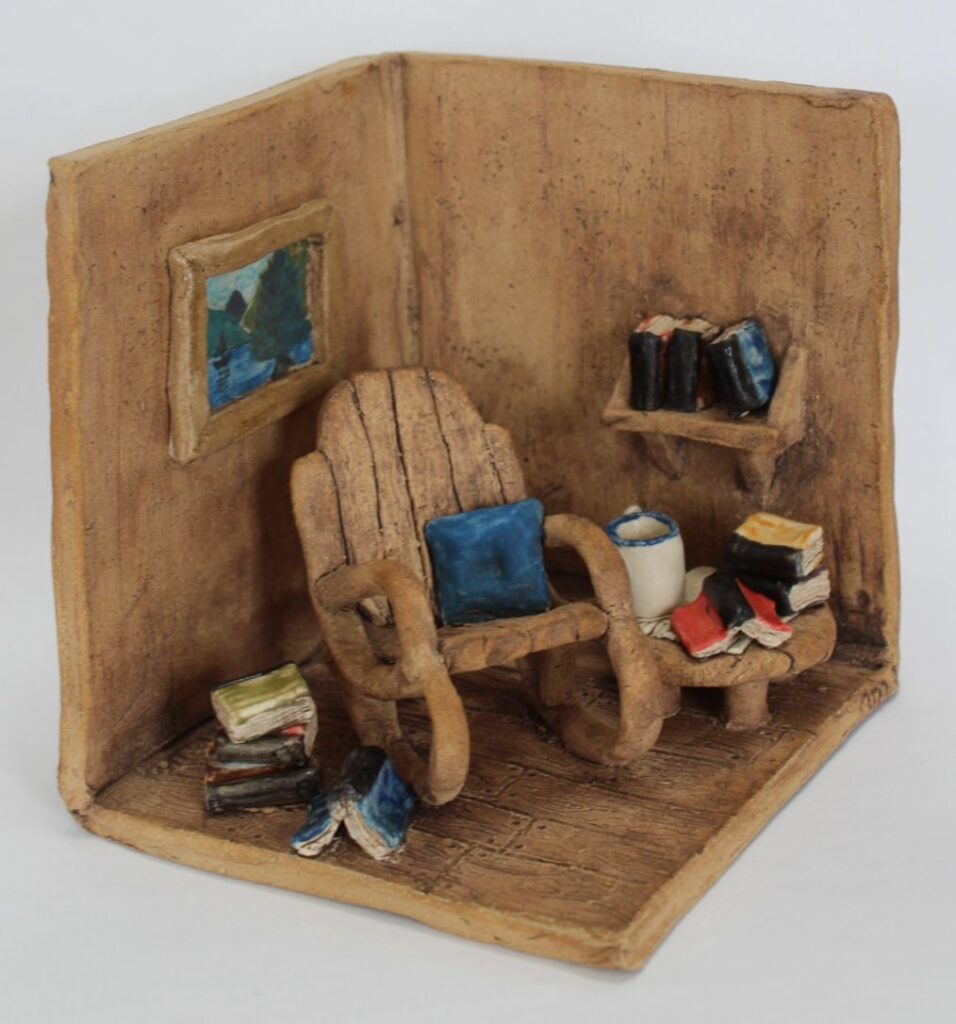
Reading Nook, 2022. Stoneware, 5x5x5″ (SOLD)

The world has become a bad place in the last few years. So many things are going wrong, so much strife, so much floods and fires and earthquakes and wars and rumours of wars.

But Story can set a counterpoint. Story allows us to escape the trap of perceived reality.

And that’s the key, isn’t it—perceived reality.

Story allows us to perceive a different reality. It lets us experience a different world, one in which plots resolve, problems come to a conclusion. Unlike the so-called real world, where everything is just a muddle, Story brings order to the world. As renowned folklorist Max Lüthi says*, the story world shows us not what could be, but what is.

Why do I tell Story? In order to create worlds and places for people to enter into, worlds of truth. Worlds of justice and joy. Worlds not without problems, but worlds where those problems can and will be resolved.

Story is not escapist in the sense of letting us run away from our problems. But is is escapist in the sense of setting us free from the confines of our perceived reality. It allows us to see the bigger picture, opens our eyes to what is actually there. Even when it is Story about ostensibly “unreal” things, about elves and fairies and little dwarfs under the mountain. Maybe especially then.

We need Story—the World needs Story. The world needs Story to make sense of itself, to keep from sinking into a morass of muddle and chaos.

And that is why I tell Story. Unabashedly and unapologetically, I tell stories of joy and pleasure and home and warmth and family, where tiny people live in tiny homes and big ones get whirled away into other worlds where they find belonging.

Because in entering into these worlds, entering into Story, we can step out of the bondage of perceived reality, and we can find what is really real.

The world needs Story. That is why.

[*Lüthi, The European Folktale: Form and Nature (Philadelphia: ISHI, 1982), p.89. I quoted the full piece in a post on my research blog some ten years ago, here.]

Magic Listening Machines, or: Why I Love Fairy Tales

Today on Enchanted Conversations by Yours Truly:
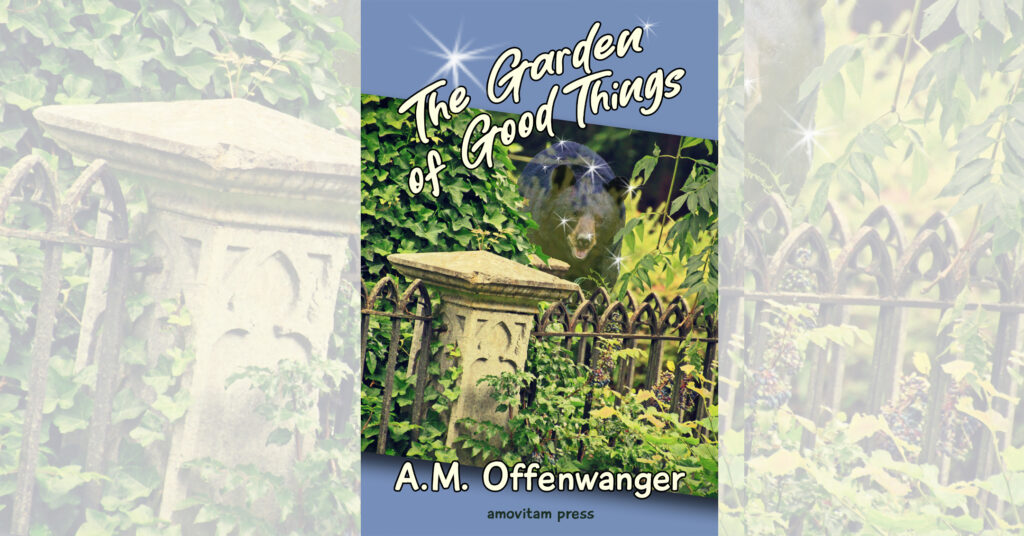
MagicListeningMachines-OFFENWANGER-CoverABergloff

Magic Listening Machines or WHY I LOVE FAIRY TALES

I did not hear my first fairy tales at the knee of my grandmother. Nor did someone read them to me as bedtime stories out of a venerable fat hardcover copy of Grimms’ Children’s and Household Tales. No—I got my introduction to the Land of Faerie through the record player. That’s right, children: Once upon a time, in a world far away from that of today, stories were told by a magic machine. Flat black discs with thin grooves engraved on them were placed upon a platter, a magic wand was laid on top, an enchanted lever was pressed, and suddenly the strains of music and the voice of a storyteller filled the room—though of the musicians and the tale teller there was no sight to be seen.

img_20170809_075551981_hdr.jpg
Oh, we did of course have paper books of the stories, as well. I still have on my bookshelf our first copies of Andersen, Hauff, and the Arabian Nights, all of which I enjoyed reading. But some of my favorites were, and still are, the Grimms’ tales I got from those vinyl records: “Snow White and Rose Red,” “The Wolf and the Seven Little Goats,” “Puss in Boots”…

The other day, I was listening to audio versions of fairy tales again. By now, the magic machine I use is so small that it fits in my back pocket, and it can do all sorts of other magical things (such as making phone calls)…

20180119170022_IMG_0305

To keep reading, go here

On Character-Driven Stories, or: It’s About the People

“Don’t tell Angelika,” a friend of ours, an engineer, said to my husband, “but I tried to read her book, and didn’t make it past the first few pages. There are way too many feelings in it!” My husband did tell me, because he knew what my reaction would be: I laughed long and hard.

But also, quite contrary to our friend’s expectations, I took his statement as a compliment. For one, he only tried to read the book because it was mine, i.e. it was an expression of friendship, which I appreciate. But the other thing is that the average engineer is not exactly my target audience. So if I managed to turn one off by dint of having too many feelings in my book, I think I may have succeeded in writing for the other kind of person: the one who wants to hear about emotions, about the inner life of characters, about their relationships to one another.

The point was brought home to me again just the other day in my writers’ group. One of the critiques I got on a piece of mine, the beginning of another novel, was, “Do you really need three different points of view to tell the story?” I was a little taken aback (not to say  hurt, which is, alas, the price of getting all-too-necessary critiques). But once I’d mulled it over for a while, I came to a conclusion: the answer is Yes. Yes, I do need three points of view, because what my stories are about is the characters and their interactions.

SeventhSon_CVR_XSML

One of the Amazon reviews of Seventh Son says: “The character relationships are subtle and involved. In fact, all of the book’s true drama comes from how people relate to each other”. Precisely. I write character-driven stories.

And the reason I write character-driven stories is because that’s what I like to read. Now, I’m fully aware that I’m in somewhat of a minority with that preference. What’s popular, what sells best, are plot-driven stories, stories where things happen, where there is action and external drama. Battles! Kidnappings! Sword-fights! Car chases! Explosions! Murders! Wicked witches poisoning girls with apples and being chased by workaholic dwarves with pickaxes!

Personally, I find action scenes boring. Crash, bang, boom, bash – just tell me who wins already, and get on with the real story, about the people. (Plus, I don’t like the tension and extra adrenaline; I’ve got too much of it coursing through my system already – a side effect of being an HSP; but that’s a post for another day.)

To me, what is interesting in a story is not so much what happens, but what the people make of it, how it affects them. I want to get into their heads. It’s the character of the, well, characters that matters to me, that creates stories. Of course you always need a plot – a beginning, a middle, an end – but to me that plot can be as simple as “girl meets boy, girl has trouble getting together with boy, girl gets boy”.

In fact, the latter is the plot of all six Austen novels; the only thing that changes is the characters. And Austen is still in print after 200 years. It’s also the plot of every romance novel, which are, in fact, as a group the biggest sellers on the fiction market. Character-driven stories roll across the screen in every TV serial like Downton Abbey or Coronation Street which follows a group of people through the years, watching them live their lives and interact with one another; and they shocked movie critics when My Big Fat Greek Wedding and The Best Exotic Marigold Hotel became sleeper hits.

Austen2

Come to think of it, given the popularity of the aforementioned tales, maybe I’m not in such a minority with my preference for character-driven stories, after all. There are a lot of us who prefer people stories, which can be easy to forget when you hear writing gurus go on about “what sells” or castigate the fledgling writer for “not writing tightly enough” or – gasp! – using adverbs, those touchy-feely markers of emotion.

There are a lot of us – but even if there weren’t, I’d still stick with my preference. I like Austen, and L. M. Montgomery, and Georgette Heyer, and even Miss Read. No swords, no car chases, no bad guys and nary a dead body. Just wonderful, fascinating stories about people.

Okay, I’ll grant you that writers of these stories don’t often populate the weekly bestseller lists. But I have a hunch that they are disproportionately represented on the long-sellers list. Which is all to the good, because it means their books are going to be around for a long time for the likes of me to enjoy.

Life, the Universe, and Character-Driven Stories. It’s all about the people.


On Princesses and the Unreality of Realism

For this year’s New Year’s Eve movie marathon, we watched Star Wars, the original three movies (on VHS, no less. Yup, we still have a VCR). I’m not a huge Star Wars aficionado, so I haven’t got these films memorised, verbally or visually; when I watch them, they’re always quite new-ish to me. And what struck me this time through is how utterly pristine Princess Leia’s appearance is.

img_20170105_114024_crop

I mean, the first time Luke Skywalker sees this woman, she’s just been through torture (so we’re told – not shown, thankfully), and now she’s imprisoned in a bare cell without even sheets on the bed – no place to hide a comb, let alone a shower or laundry facilities. Yet here she is, with not a hair in her elaborate coiffure out of place, wearing a spotless, unwrinkled white gown.

I used to have long hair when I was a kid, and I can tell you that with fairly straight hair like Carrie Fisher’s was then, pinned-up styles do not stay tidy long. They slip out of their hairpins very quickly, get straggly and messy (which is why I gave up fairly early on trying to put up my hair – I just can’t be bothered). Yet Princess Leia never, ever has even a single strand hanging loose – not even after she goes tobogganing down the garbage chute. And her gown – good grief, wearing white? With all she goes through, by rights she should look like she’s wearing Dobby the House Elf’s ragged kitchen towel.

But she doesn’t. She never looks like anything but – a princess.

img_20170105_113924363_crop

Leia is a wonderful character. Carrie Fisher’s passing has brought out in countless tributes what a great inspiration and role model Princess Leia was and still is for now several generations of viewers – a woman of strength, of determination, of agency; a larger-than-life hero.

And part of that larger-than-life effect comes from having a hairdo that never sheds a single bobby pin.

Disney’s cartoon princesses don’t have anything on Leia. You see, in cartoons we know not to expect realism – we know it’s just a drawing, “just” a story. But in a live action film, we think that what we’re seeing is real. So when we see Cinderella’s flowing golden locks and the gown that just appears on her body with a wave of the fairy godmother’s wand, that’s one thing – but we never think that Leia’s glossy dark snail shells and her snowy robe come under the same heading, because, obviously, they’re real. We can see them with our own two eyes, can’t we? What we’re not seeing is the army at Leia’s (or rather Carrie’s) command, an army not of rebel soldiers, but of hairdressers, make-up artists and wardrobe staff, as befits a princess. (“Ah, Recruit Skywalker – you’re in wardrobe today. The princess spilt oatmeal on her dress this morning; go do your duty to the cause.” “What?!? What about flying a fighter plane?” “Never mind that, anyone can handle that. Go make your mark where it counts!”)

We need that army to make us believe in Leia the Princess. We need her to have the superpower of never-a-hair-out-of-place and never-a-spot-on-her-dress because she is a princess. And princesses are mythical creatures on the order of dragons, unicorns and superheroes. In cartoons, that’s easy to handle, but in “realistic” fiction, it takes a bit more doing. Yet when it’s done well, as it is in Star Wars, the impact is tremendous. Because we believe with all our hearts, informed by our disbelief-suspended senses, that what we are seeing is real, that it actually happened, we also believe in the power of The Princess to do what she has set out to do, which is to save the world.

And in that, there is hope.

Life, the Universe, and the Power of the Unreality of Realism. And here we thought she just had funny hair.