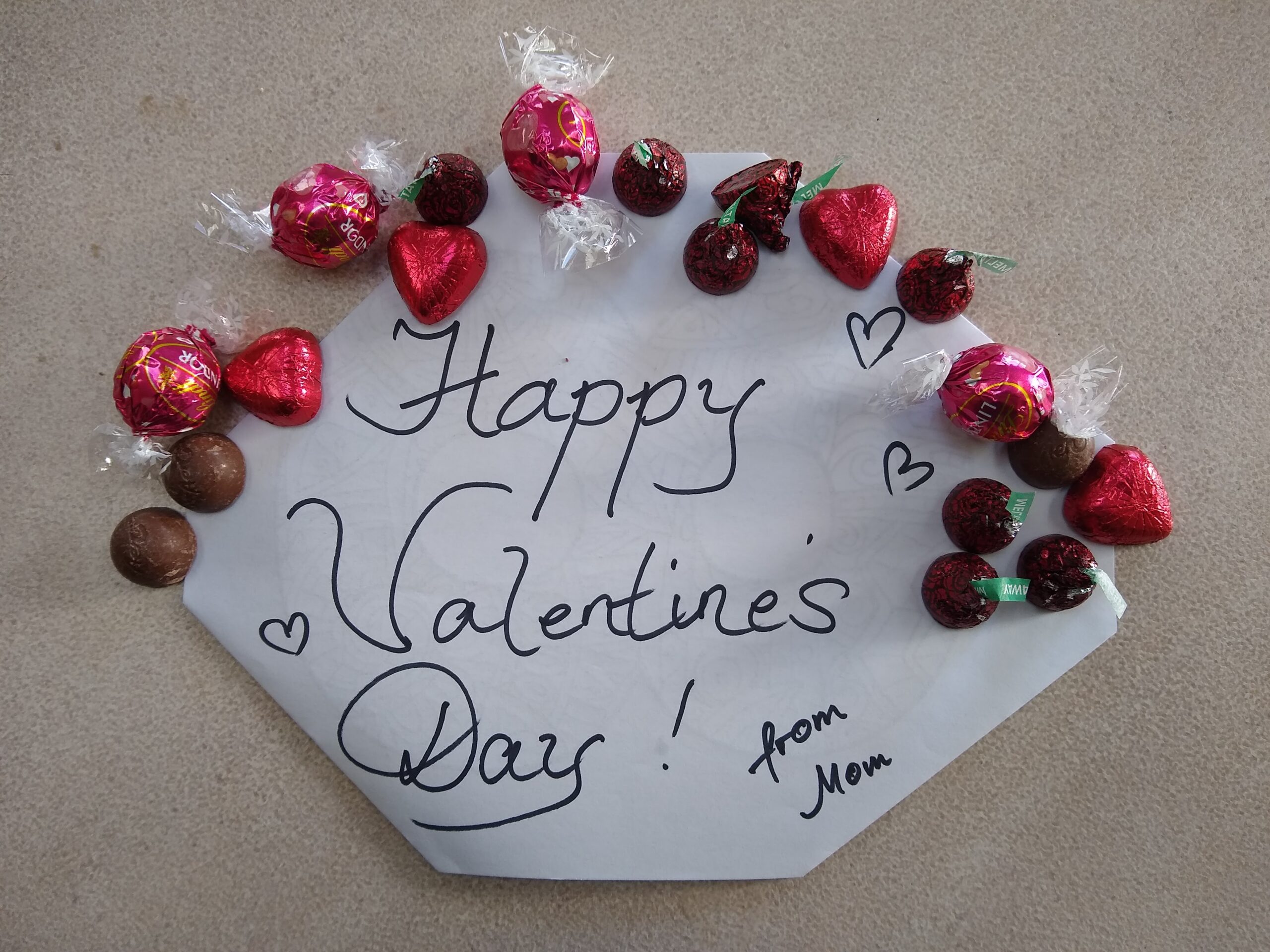
I have to let off a quick rant. It’s Valentine’s Day today. You know, Day of Lurrrrv and Romance and Red Hearts and Pink Flowers. And invariably, there’s going to be a few Bah Humbugs (okay, wrong season – maybe curmudgeons, then?) who call for a boycott of the holiday, and complain about how all this talk of love and romance only makes those of us who don’t have anyone who brings them roses and chocolates feel worse about that fact. So therefore, they say, we should not celebrate it at all. Ban this foolishness! Down with red-foil-wrapped chocolates and cinnamon hearts!
“Bah!” I say to them, “Humbug!” (that does have a nice ring to it, seasonal or not). Yes, all right, I agree that the commercialism of Valentine’s Day is flat-out ridiculous, and that spending money and making empty gestures is not what love is about. (In fact, a few years ago I wrote a blog post about it.) And of course I feel for those for whom the day, like many other holidays, brings up painful memories of lost loved ones, but that’s not what I’m talking about here. The pain of grief is a whole other topic.
The thing is this: just because you don’t have that one romantic partner in your life who neatly conforms to all of society’s extremely limited ideas of what love consists of it doesn’t mean you can’t celebrate a Day of Love, and/or let others celebrate it. Just because I’m not a grandmother doesn’t mean I can’t participate in my friend’s joy at her grandson’s birthday. Being European doesn’t mean I can’t celebrate Chinese New Year’s or enjoy watching the Asian community celebrating it. Not having a romantic-gestures-delivering partner doesn’t mean I can’t embrace Valentine’s Day.
Our world is bleak enough as it is—let’s celebrate all we can. And let’s especially celebrate love in all its manifestations. I just learned the terms “Galentine’s” and “Palentine’s”, celebrating your gal friends and pals—what a great concept. Friends, family, parents, children, uncles, aunts, cousins, second-cousins-by-marriage-once-removed, and yes, husbands, wives, girlfriends, boyfriends, lovers—let’s enjoy each other and the relationships we have. Let’s revel in the joy of love and romance and mushy sentiment, because, let’s face it, it makes us feel good, and it literally makes life happen. How great is that?
Steve says it’s time I gave y’all an update. (Side note: I like that word, “y’all”. It’s quite fascinating how the dialect of the Southern United States has created a new second person plural, which takes the place of what the word “you” used to mean. Back in the day of The Bard and the King James Bible, “thou” meant “you, the single person”, and “you” meant “you, the several people”. Nowadays, regular English only has “you”, as in, “you one” and “you many”. But Southern US English has re-invented a plural, so there you can say “you one” and “y’all many”. I wonder if it’ll ever make it into formal, written language? End of digression.)
So, yes, update. No, I’m not getting sidetracked, why would I? It’s not like I go on guilt trips about how much I have, or haven’t, written in the last while. In fact, I was going to (but didn’t) write a blog post on that: “The Year I Failed NaNoWriMo”.
Because, that did happen last November. I failed NaNo—dismally so. I only got a few thousand words done. But then, I’d set myself up for it. I wanted to see if I could write a novel and do regular work, as well. So I booked several editing jobs during November, as well as having some volunteer work to do (and never mind starting Christmas preparations), plus a trip to the coast for some family stuff in the middle of it. On top of it I was a NaNo ML (Municipal Liaison, i.e. regional leader or cheering squad), which brings a bunch more work with it. I know, I know, laugh all you want.
In fact, setting myself up for failure was a useful experiment. I once knew someone who set himself up to fail a university course: he signed up to the class with the full intention of failing, just to teach himself the lesson that it’s okay to fail. I wouldn’t quite go that far myself; for one, university courses are blinkin’ expensive—there are a lot of cheaper ways of failing. But I started NaNoWriMo 2022 with the idea that I probably wouldn’t finish my 50,000 words. I’d done it ten times in a row before, pushed myself to the finish line, got it done. So I knew what it takes for me to do it. I’ve seen others win NaNoWriMo “on the side”, though, while holding down full-time jobs or looking after young children, and I wondered if there was any chance of me doing so. Answer: No. I didn’t even get a part of a novel written. Which was no surprise, but still stressful.
I did learn a couple of useful things. I’m not a very fast writer, I’ve known that all along. Word sprints and word wars are useless for me. It’s not that I can’t type fast, but I can’t think fast, can’t craft sentences very quickly, so my word count per minute has never been high. Some of my friends can crank out 2000 words an hour without breaking a sweat, and I’ve always wondered how they do it and why I can’t. This time, during one of our online write-ins, I decided to just write stream-of-consciousness drivel, nothing whatever to do with any story I was writing, just to see how fast I could put words on screen. And what do you know, if all I’m doing is typing without trying to make sense, let alone paint a word picture, I can rack up the word count with the best of them! However, it’s a word count that nobody would ever want to read. There were words, even mostly-spelled-correctly words making somewhat-puncuated sentences, but they were utter dross, not a story. And I didn’t enjoy the process. So, it’s not that I’m a failure at writing, it’s that I have a different writing style from the one that cranks ‘em out fast*. I’m a Slow Writer. Which, given the fact that I’m into Slow Culture as a whole (Slow Food, Slow Textiles, etc.), is kind of a good thing. And like other aspects of Slow Anything, it means you (or rather I) have to take time for it, have to set time aside, or it won’t happen.
So! Now you know that I did not write a new novel last November. However. I do have a whole bunch of novels sitting around on my computer in varying states of completion. A few are finished, critiqued, edited, polished. Some are finished, i.e. completed novels, but need rewriting; one needs a whole different ending. And one is only half done, and I need to write the second half and get ‘er done. Also, there are some short stories kicking around that I’ve been submitting to contests, and/or might turn into a story collection, or expand into a novella or even full novel.
All that to say, Writing? Why yes, Steve, I have been writing, thank you very much. You can stop giving me censorious looks. And something might even come out of it, very soon.
That’s Life, the Universe, and News from the Writing Trenches in January** of 2023. I’ll let y’all know when there’s more to tell.
*Footnote: I’m not saying that people who write novels fast write dross; far from it. Just that their brains work differently from mine. I can only write really fast if I write drivel; if I want to write anything worth reading I have to take my time. And that’s okay.
**Edit after posting: I just noticed that it is, in fact, now February, not January. Which tells you where my brain is at. Ah well…
Introducing: Nefertiti, or Neferkitty, as it were. Small, black, cute, annoying to the big orange guy. She came to our house on Tuesday, exactly one year after we said goodbye to our beautiful, elegant feline lady Cleo, and in keeping with tradition, she is named after royalty, another Egyptian queen, in this case.
We love her to bits already.
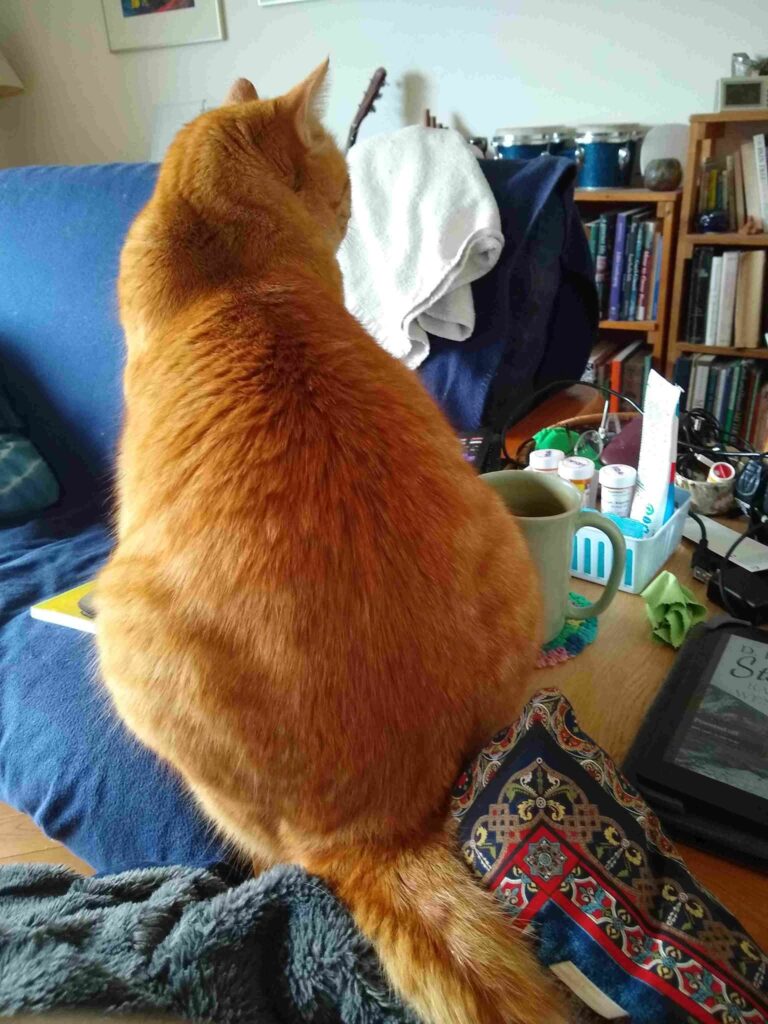
Louis the Large is not so sure about her, but he’s been lonely and bored being an only cat, so Small & Fuzzy should help that situation.
That thing that’s moving back and forth, that’s for playing with, right?Keeping an eye on this fuzzy, bouncy thing. What’d they have to bring *that* into the house for?
So from my house and fur family to yours: Merry Christmas and a Happy New Year!
“The Dead Admonish Us To Peace. 62,000,000 people died worldwide as soldiers and civilians in Word War II. 6,500,000 people were murdered by the Nazi regime. “
“Where do you get all those ideas from?” someone said to me the other day. “You have such an interesting life, you do so many things… You make things, and write books, and go to conferences, and go travelling…”
True. I do all those things. They are pretty special, which is why I write about them in this blog, and I’m very grateful that I can do them and that I can share them with you.
However, looking at the blog this past year, it has been rather full of stuff I do and places I’ve gone, and there hasn’t been very much about what my life really looks like in between all those “highlighty” events. You know, those long periods when I didn’t post anything, not even a “Wordless Wednesday” photo. When the blog was staring at me accusingly from the bottom of the long list of things that I needed to do, and that I, as per usual, didn’t do terribly well.
You see, while there are lots of things I can do, there are also lots of things I’m not very good at. I wish I were, but I guess there’s always a trade-off, isn’t there? You can’t be good at everything.
So in the name of balancing out the record a bit, here are a few things that I’m not good at. Never was, and, most likely, never will be.
–Growing plants. I’ve posted pictures of my garden that make it look quite lovely, but, oh my. Those are very select images. The amount of money I’ve spent at nurseries on seedlings, the number of vegetable varieties I’ve tried to grow, the labour I’ve invested in trying to establish garden beds, all of which just… died… As for indoors, the houseplants I’ve killed are myriad; I only keep plants around that can tolerate the utmost neglect* (“Oh, you poor thing, you look dead! I probably should have watered you a month ago…”).
–Keeping my house clean. On my “About” page I claim to live with, aside from my family and Steve, “a large number of dust bunnies.” That is not a joke. Okay, fine, it is—please laugh at it. But it’s also true. Well, I actually call them dust kitties, because they consist of a considerable proportion of cat hair. It’s not that I don’t see them congregating in the corners, I just don’t get around to dealing with them. And boy, can they ever pile on the guilt trips! For something that doesn’t have any eyes they can sure give you a nasty look every time you walk past them.
–Oven-roasting or barbecuing meat. I make a mean pot roast, but oven-cooked beef or barbecued steaks tend to fall in the neighbourhood of shoe leather, while an oven-roasted chicken is either still half-raw or overcooked, but hardly ever tender and juicy and succulent and cooked all the way through when I want it to be.
–Being consistent with things I ought to or even want to do. Like writing blog posts. Or going for walks. Or flossing my teeth. Or practising drawing or music skills. Or any of the many other good things we all know we should or would like to be doing.
I could go on for some time here, but you get the picture (I won’t post one of the dust kitties. Because, eew).
The chief contributor to the dust kitties in his pear-shaped glory
In a nutshell, what Burkeman points out is that we’re all on limited time here on earth. Four thousand weeks, give or take (which amounts to roughly eighty years), that’s it, that’s all each of us gets. And, as I was saying with my analogy of the plate full of meatballs, you cannot pack more into those four thousand weeks than what fits. If you choose to spend Week #2834 on one particular activity (say, digging a garden bed), you’re not going to spend it on another (writing a blog post, for example). Poof, that week is gone. There is only one week in a week, etc. And what that comes down to, Burkeman says, is that you have to choose. You have to choose what to do well, choose what matters. And choose what to suck at.
I suck at things—and let me tell you, it sucks. When you’re born a perfectionist, it hurts to not be able to do all those things that you’re told by—well, something, somebody, the last novel you read, the ubiquitous “they”—you should be able to do. But the reality is, that’s a hurt we have to live with. That I have to live with. It’s embarrassing to be this way.
But also (and again I’m quoting Burkeman here, in spirit, if not verbatim) to realise your limitations is also immensely freeing. I can’t do everything, and that, as I’m trying to get through my head and into my heart, is okay. Because it’s true for everyone; it is, in fact, to be human.
I’ll never definitively win the battle with the dust kitties. But maybe we can come to a truce. And meanwhile, I’ll admire those of you who have lush, thriving gardens and tidy and serene homes, with a juicy roast in the oven that you return to after your daily run. You are a gifted person, and I salute you.
Life, the Universe, and Things I’m Not Good At. And that’s okay.
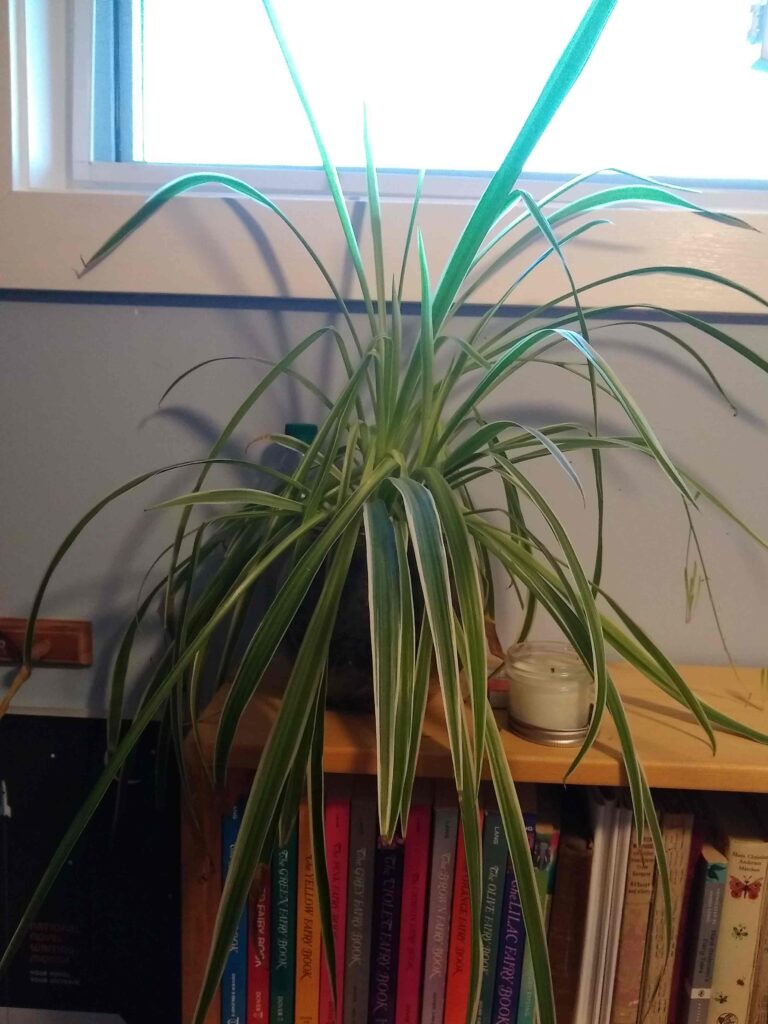
One of the houseplants that has managed to survive the treatment it gets around here
I must have been around nine or ten, reading an article in the yearly Reader’s Digest Youth Anthology about Marie Curie. You know, the famous scientist? First woman to receive a Nobel Prize? First woman to receive multiple Nobel Prizes, in fact? Only person ever to get a Nobel Prize in two different fields? Yeah, her. So inspiring, such a role model.
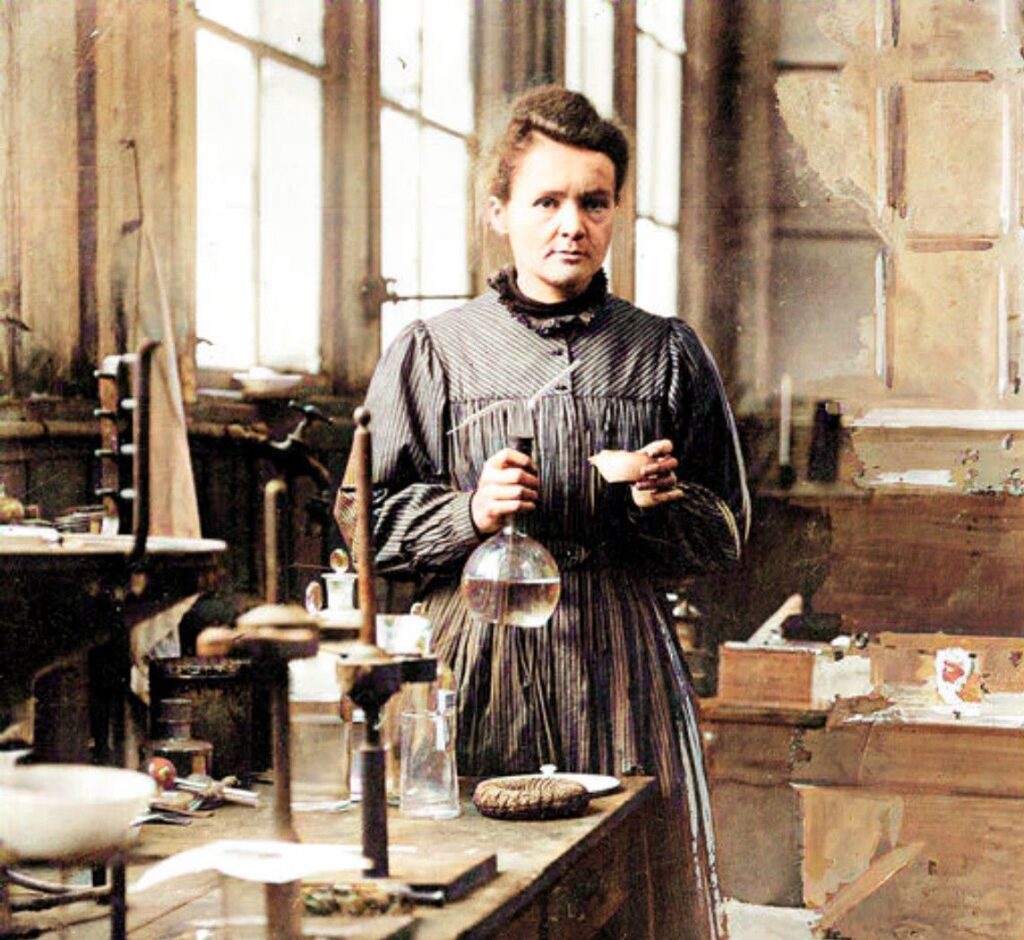
There’s one sentence that stuck out to me so much I still remember it forty-odd years later. The article was talking about Mme Curie’s life, and it described how she would get ready for her day at the research lab, making sure her two little girls were looked after, putting a stew on the back burner for their dinner. A little while later, she would be in the lab, and, so the article said, “adjusted the flame of her Bunsen burner with the same care that she had used for the flame of the stew pot that morning…”
Ah, thought little pig-tailed nine-year-old me, that’s how it’s done. If a girl wants to be a famous scientist and do life-changing work, she has to make sure that the beef stew for her family back in her kitchen is as well-regulated as the flame of the Bunsen burner in her lab.
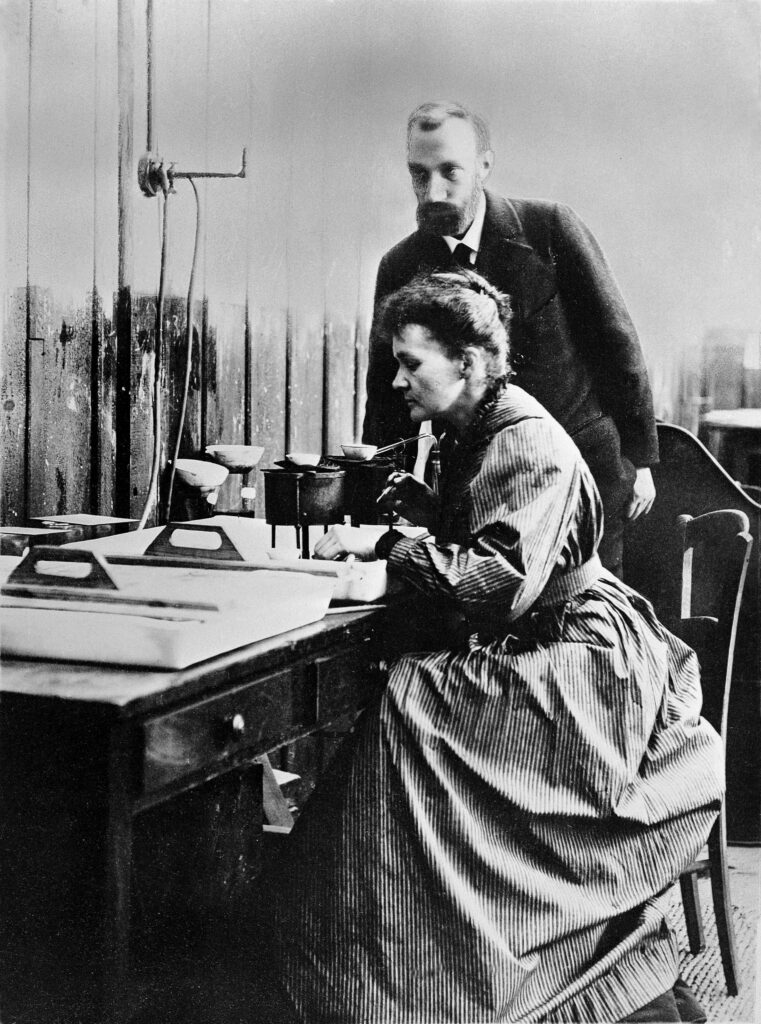
Pierre and Marie Curie at work in laboratory Credit: Wellcome Library, London. CC BY 4.0 http://creativecommons.org/licenses/by/4.0/
This morning, as I was thinking about this in the course of my never-ending struggle with running the multiple tracks of my life, I came up with a phrase to describe this idea: the Parallel Lives Fallacy. It’s the idea that if you only work hard enough, you can, in fact, excel at multiple different roles—you can lead Parallel Lives. Like Marie Curie, who so admirably regulated the flames of her role of housewife and mother and Nobel-Prize-winning scientist.
Parallel Lives: in one life, you’re a full-time award-winning scientist; in another, you’re an excellent housewife and devoted mother (also full-time). Maybe you even add a third one, where you’re a dedicated volunteer and full-time caregiver to your ailing parents. Or, wait, you could be an artist, as well! Write novels, or make pottery to sell at the market, or paint pictures to go in exhibitions!
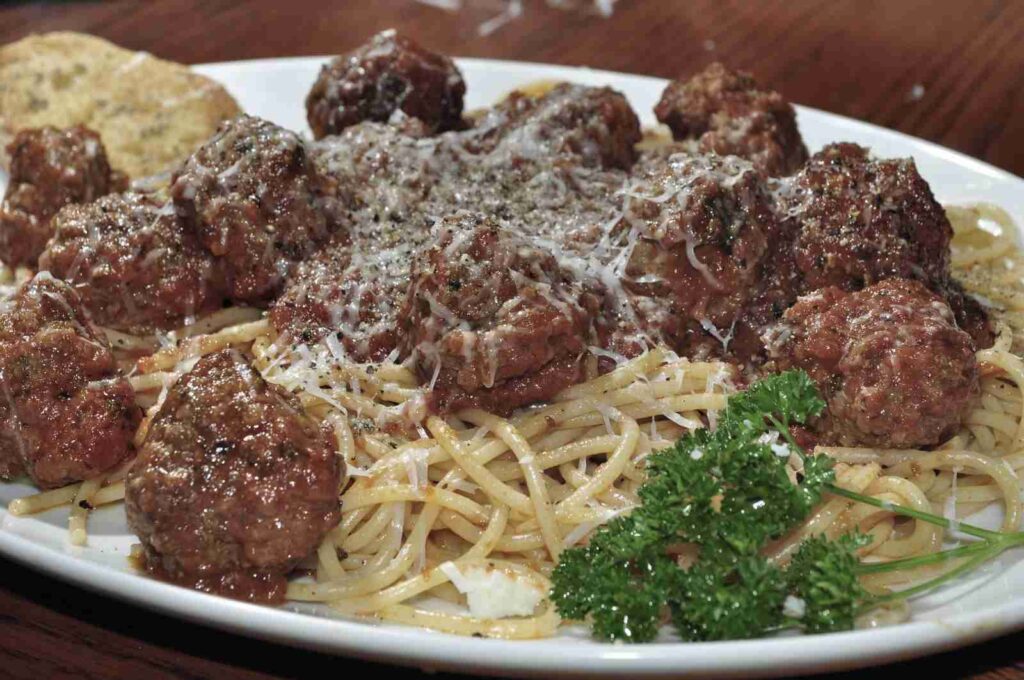
Full-time jobs, all of them. Several full-time jobs. Wait—full-time. Several full-times. Nothing wrong with that concept, is there? It’s just like, when your plate is full, you can obviously go back to the buffet with it and start loading it up with another plateful’s worth of food, right? Several platefuls.
Yes, I know the image that brings up. “On top of spaghetti / all covered in cheese, / I lost my poor meatball / when somebody sneezed. / It rolled off the table, / it rolled on the floor, / and then my poor meatball / rolled out of the door…”
Marie Curie was amazing. She pulled off the Parallel Lives stunt to admiration, without losing a single meatball, from what I can tell. However, her work eventually killed her, because she didn’t know to protect herself from the fascinating stuff she had discovered. It also killed her daughter, Irène (another Nobel Prize winning scientist working with radiation). Apparently (according to Wikipedia), Marie Curie’s papers—including her cookbooks!—even more than a hundred years later have such a high level of radioactive contamination that they’re kept in lead-lined boxes and are considered too hazardous to handle without protective equipment.
I can’t help but wonder about the state of that stew on the carefully regulated burner—was that contaminated, too?
The Parallel Lives Fallacy is a fallacy. Because unless you’re Marie Curie (and I sure am not), you just can’t pull it off without losing at least one or two of your meatballs off that plate. Which is a patent waste of good meatballs (I have a recipe, if you’re interested). You get one plate, and it only holds one plateful of food. There is only one day in a day, only twenty-four hours in twenty-four hours, and only space for one full-time job in your full time.
The problem with Marie Curie’s Bunsen burner is not that we admire her for her balancing act of flame-regulation. It’s that we (okay, that I) instantly think that that’s the only way to do it, the only way to be a successful and worthy person. That we succumb to the Parallel Lives Fallacy.
The reality is that one plateful of food is enough. One day in a day, one life in a life. If you try to stack more on top, the meatballs go rolling under a bush, and, contrary to the song lyrics, don’t grow into a meatball tree but just attract maggots and rats. At least in my life they do.
So I’m going to turn my back on that Parallel Lives Fallacy. I’m going to try to choose more carefully what I want on my plate, because I really enjoy meatballs and don’t want them rolling under a bush on me. I also like spaghetti noodles, and tomato sauce, and a lovely green salad, and maybe some cooked carrots or a piece of garlic bread… I want to have room for them all on my one plate, so I can enjoy the whole meal, savour it and get nourishment from it. One plate, one plateful.
Oh, but you know what? A little secret: You get dessert. In a separate little glass dish. You don’t have to pile it onto your plate with the meatballs. Make of that what you will.
Life, the Universe, and Marie Curie’s Bunsen Burner. One life to live is enough.
In a manner of speaking, this is a #ThrowbackThursday post. Not that it’s been posted before, but I started writing it exactly two years ago, on our last trip out of the country. Somehow, with the lockdown and everything, I never had the heart to finish it, but now, on the second anniversary of the trip, it seemed like a good time to dust it off and put it up. Now that things are opening up again, maybe it’ll be possible to go back there soon?
I was just on another jaunt to the Old Country. As I’ve said before, while living halfway across the globe from your family can be a pain in the neck (literally – those long flights are uncomfortable), a visit also makes for good opportunities to get in some sightseeing.
This time, I got to see the Dickens Museum at 48 Doughty Street in London*. Charles Dickens (whom, courtesy of Roald Dahl and his BFG, I am now always thinking of as Dahl’s Chickens) lived in this house in Bloomsbury from 1837 – 1839, at the very beginning of his writing career. He moved in as an unknown 25-year-old with a wife and one baby, and moved out two years later as a popular writer with two more children and an established name.
Doughty Street (the wrapped house at the edge of the picture is the Dickens house)
Now, I’m not a die-hard Dickens fan – truth be told, I’ve only read about half a dozen of his books so far. But this museum was fascinating in a way that wasn’t even directly about him. The house is a testament to the life of a middle-class family in the very earliest years of Victoria’s reign.
The Dickens family consisted of one young man (Twenty-five! He was just twenty-five!), his wife, her sister, and one-two-three babies. They had: on the ground floor, a dining room and morning room (basically Mrs Dickens’ office or place to hang out); on the first floor a drawing room and Dickens’ study; on the second floor two bedrooms (one for the Dickenses and one for sister-in-law); on the third floor, the nursery and servants’ bedroom; in the basement, the kitchen, scullery, and wash house (laundry room). That’s it.
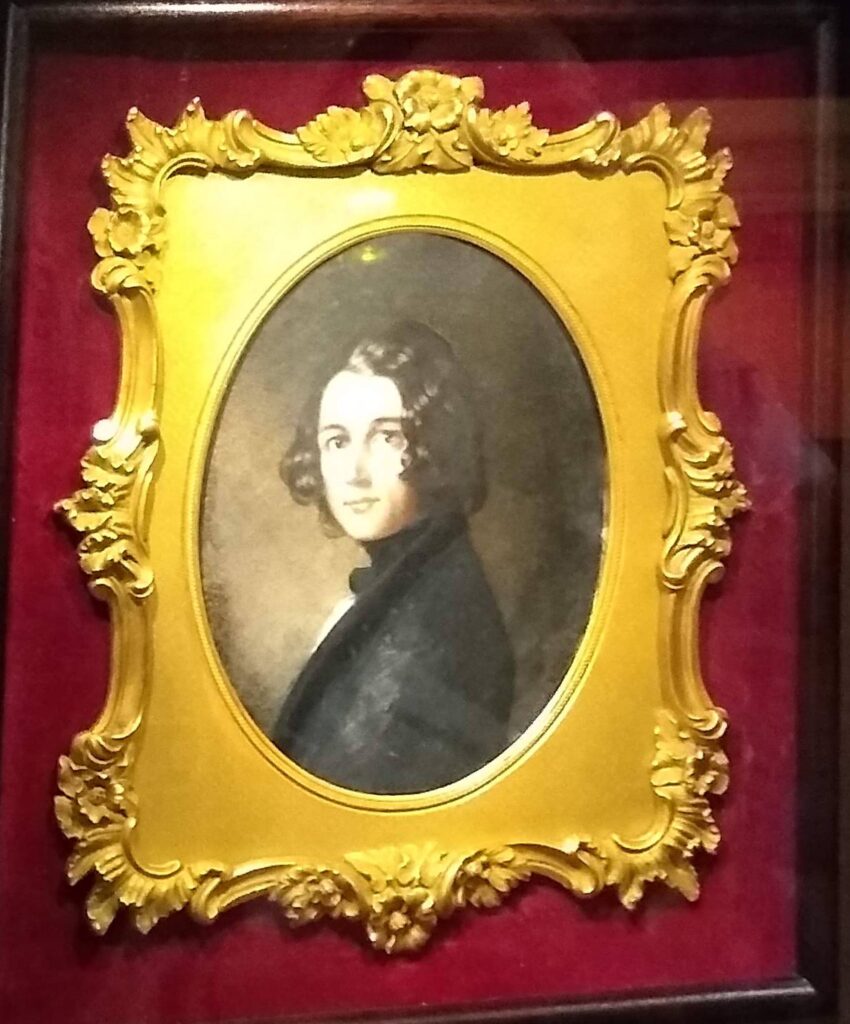
Young Charles Dickens, the “Lost Portrait” (which is no longer lost, but that’s another story)
“Oh, but of course the bathrooms, too,” you say? No. No bathrooms. No toilets**. No sinks, no places to wash hands, except for one stone sink in the basement scullery. So where did they do their, you know, business?
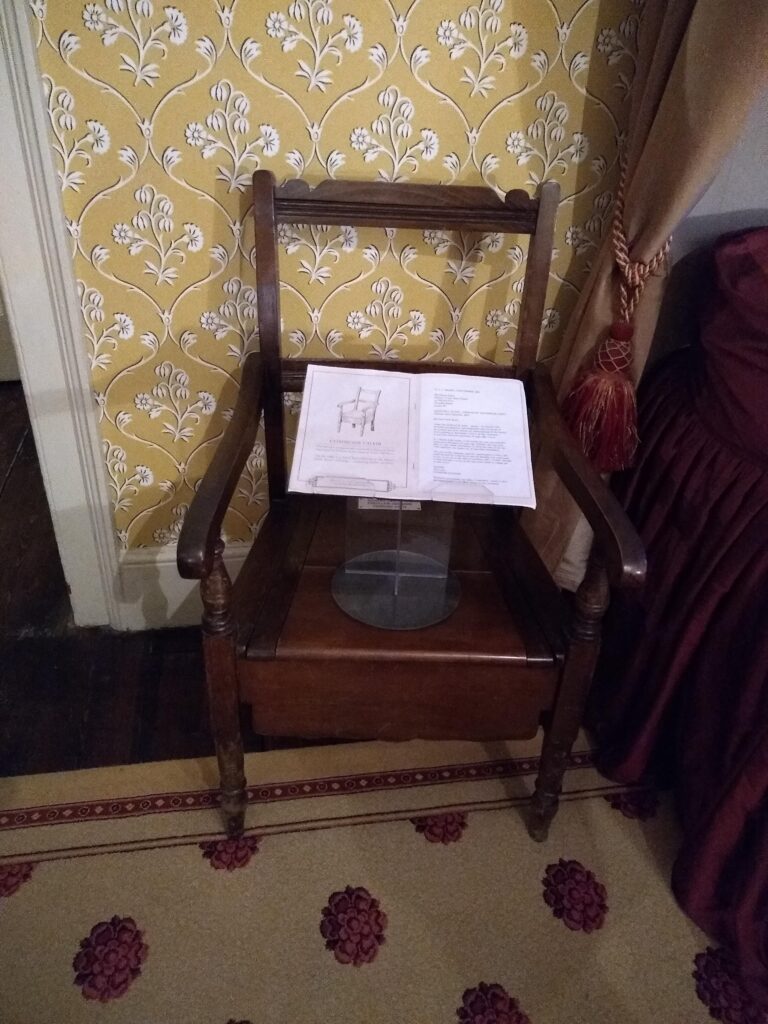
On chamberpots (ceramic bowls large enough to sit on) and commodes, which are basically chairs with a hole in the seat and a potty under it. And you guessed it: somebody had to empty them out. Somebody had to carry porcelain bowls full of smelly, stinky, gross you-know-what down three flights of stairs and dump them.
The commode
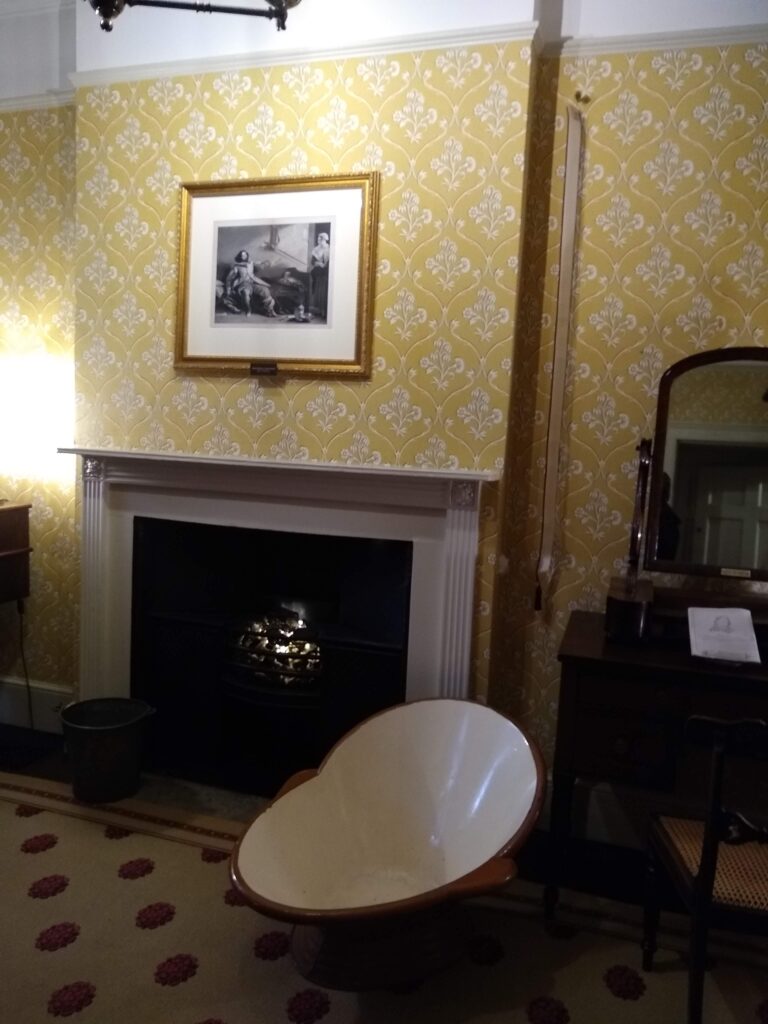
And that same somebody also got to lug pots full of hot water up the stairs every morning so the family could have a wash. In fact, if Mrs Dickens wanted a bath, she had it in front of the fire in her bedroom. The tub on display at the museum is a little hip bath – small enough that it can be carried while full. Let me repeat that: a tub full of water—let’s say, at a minimum five to ten gallons, or twenty to forty litres/kilos—carried down three flights of stairs. With how small people were in those days, that’s probably half the body weight of the person who had to do the carrying.
The hip bath in the bedroom
The maid who had to do the carrying. Because it sure wasn’t Mr Dickens himself, or his wife, or his sister-in-law.
Hence the servants’ bedroom on the third floor. The young Dickens family in that Doughty Street house, an ordinary middle class family whose sole wage earner was at the beginning of his career, consisted not only of Mr, Mrs, Miss, and Babies, but also a cook, a house/parlour maid, and a nanny. And they needed those servants, because without them, things would have been pretty darn uncomfortable. Servants’ wages and room and board were a normal part of the expenses of any middle class household; not having servants, i.e. having to do the work yourself, was the very definition of “working class.”
I had never really thought about that before. Indoor plumbing with hot and cold water at the push of a button is something we take for granted today; central heating and electric stoves and washing machines and vacuum cleaners are something we don’t even think about.
But in Dickens’ time, indoor plumbing was provided by the servants carrying jugs and buckets and tubs full of water and sewage up and down stairs. Heat to keep you warm and to cook with (Every. Single. Cup of tea!) and hot water to wash or bathe in were supplied by the servants lighting and stoking and cleaning out and re-lighting fireplaces. The scrubbing action and spin cycle of the washing machine came from the servants rubbing and plungering and wringing laundry in the cold stone-flagged wash house in the basement, and the vacuuming of carpets was accomplished by the servants lugging them out back and beating the dirt out of them with a carpet beater.
The wash house with the copper in the corner (for Mrs Cratchit to boil the pudding in)
A lot of us (myself included) have this nostalgia for the days of the past, would like to spend our imaginary lives back in the days “when life was simple,” want to hang out with Elizabeth Bennet and Mr Darcy and Ebenezer Scrooge (once he got his head screwed on straight). But life “in those days” actually wasn’t simple—it was quite complex. And it was almost entirely human-powered. We measure a car’s engine in horsepower—maybe we should measure indoor plumbing and electric washing machines in human-power (“This latest model of Maytag has a 5hu-p/day capacity and is able to draw 8hu-p of hot water in less than two minutes…”).
I’m not going to give up mentally living in the past, but visiting the Dickens Museum has given me a whole new appreciation for just how privileged we are today. Next time you flush the toilet in your second-floor bathroom or crank the handle in the tub to instantly have hot water raining on your head, give a thought to that unnamed woman who, 185 years ago, carried enormous buckets full of water and slop up and down the steep stairs of a small London house, so that a gifted young man could sit in his study and write wonderful stories about Oliver Twist and Nicholas Nickleby that are still with us today.
Life, the Universe, and Indoor Plumbing. Charles Dickens would have been nothing without his servants.
*I can highly recommend the website of the Dickens Museum at https://dickensmuseum.com. Lots of interesting information, and you can take a whole virtual tour of the museum, including admiring the hip bath by the bedroom fire! **2022 addition: Apparently, as I just found out, there was actually one “water closet” (toilet) on the ground floor and one in the basement, but firstly, that was a new and unusual thing for the day, and secondly, the servants still had to carry all the wash water and chamberpot waste up and down the stairs to the upper floors.