Here’s a few pieces that are coming to Lake Country ArtWalk with me this weekend:
And then there’s this flock of Tiny G’nomes that materialized in my studio recently:
They haven’t told me their names yet, but they’re a very friendly sort, and they’ve moved into the village of fairy houses and picture pots. But I’m sure they’d be more than happy to come live at your house, too! Maybe with a fairy house or a picture mug, so they’ll feel at home.
I just sent out a newsletter (are you subscribed yet? You can do so here), and I told everyone about Gaeli’s G’nomes. And then I thought, hey, I don’t think I’ve ever introduced them on the blog, either. So it’s time to remedy that situation.
Gaeli’s G’nomes, as I told my newsletter readers, are the family of gnomes who live on my living room cabinet—well, the ones who are still home. Several of them have moved out already, and all of these ones are perfectly willing to do so, too; give me a shout if you’re interested in adopting one. They’re made of stoneware clay, so they’d be happy to live outside in your flowerbed over the summer. Oh, and all of them are about 8″ (20cm) high/long, give or take.
Their family name is spelled the way it is to make sure it’s pronounced with a hard G on both words. Technically they should be “Geli’s Gnomes” (Geli, prounounced “gaily”, was my childhood nickname), but they’re not “Jelly’s Nomes”, as most people would say it if it was spelled that way; hence “Gaeli’s G’nomes”.
Here’s the current family, all hanging out in my living room. I’m not sure what their conversation is about, but as a rule they get along quite well.
Now, if you’d like to meet a few of them, we’ll start with Gordon. He’s a mellow guy, likes to be quiet and just hang out with his bug, who’s gone to sleep on him.
Gabby is a chatty individual who likes to tell stories, and fortunately for her, her bug likes hearing them.
Gabby’s twin brother Garth is a dreamer; he and his bug like to find pictures in the clouds.
And here’s Goldie, who’s the youngest sister. She’s a busy and cheerful kind of person; I think she’s just spotted a butterfly and is quite excited about it. Her bug, on the other hand, isn’t so sure about it; he likes her to pay attention to him, not to some kind of fluttery thing in the air!
We’re hoping that over time, there’ll be more members added to the G’nome family, and will go out into the world and find new homes.
And there you have it, that’s Life, the Universe, and Gaeli’s G’nomes. They’ve enjoyed meeting you all!
Gaeli & G’nome (Self-portrait assignment from Digital Art Class, done in Procreate)
I’ve been having a bit of a hard time lately, for one reason or another. So I went on the internet to ARD Mediathek (Germany’s public broadcasters’ streaming service) and turned on some fairy tale movies. I needed them, needed that reassurance that the world is a place where things will work out and everything is okay in the end. German and Czech fairy tale films are fabulous in that regard—they come across as so real, the tales are so much part of that culture, you can sink into the story and come out happy at the end.
From Cinderella (1919) by Arthur Rackham
But I was left a little dissatisfied that day. I wasn’t sure why at first. The films I watched were lovely fairy tales, with princesses and magic and intrepid heroes and heroines, and bad guys that were defeated, and a happily ever after. One was called “Der Geist im Glas” (“The Spirit in the Bottle”), and “Die verkaufte Prinzessin” (“The Sold Princess”) was the other.
You’ve never heard of them? Neither had I. That’s because they’re not classic fairy tales. The one claims to be loosely adapted from “motifs of a Grimms’ tale”, the other to be “inspired by Bavarian legends”. Whatever—there’s nothing wrong with adapting tales, or even just taking loose inspiration from existing fairy tales and making something of your own with it.
No, that’s not what frustrated me about those films, as I came to realize the next day after I had some time to think about them. What got my goat about both those films is that they shoehorn “issues” into the story. They clobber you over the head with such matters as feminism and inclusivity and “thou shalt believe in magic”. The characters spout off, in a repeat loop, about how princesses can’t be rulers or girls can’t be miners and oh, it’s so unfair and an issue to be solved; or they heavy-handedly draw attention to the fact that there’s MAGIC in this story and oh, that’s so unusual and the science-minded heroine doesn’t believe in it and needs to learn her lesson (even though she accepts without so much as a blink the wicked spirit from the bottle that’s got them all into trouble).
Don’t get me wrong—it’s not the issues I take, well, issue with. Feminism and inclusivity are a no-brainer, as far as I’m concerned. I have no problem with turning the doctor’s apprentice in “The Spirit in the Bottle” from a boy into a girl, or with casting People of Colour in roles that were traditionally “golden-haired”. That’s all great. But what I object to is using a fairy tale as a vehicle for an agenda, instead of letting it speak for itself. That’s using a delicate instrument as a hammer to pound in a nail.
You see, that’s the whole thing about fairy tales: they don’t need to have anyone superimposing a “lesson” on them! Fairy tales teach and empower without anyone getting on a soap box for the purpose. Jack climbing the beanstalk and outwitting the giant makes us feel like giant slayers ourselves; Cinderella going from drudge to princess makes it possible for us to do the same—without someone preaching at us about having self-confidence, or about the evils of step-sibling exploitation. The stories make their point without spelling it out (“spelling”, haha. See what I did there?). They show what they’re saying, they don’t need to tell.
For several years now I had a quotation on the top of my list of notes: “Ich glaube mehr an Märchen als an Zeitungen.”—”I believe in fairy tales more than in newspapers.” The person who said that was Lotte Reiniger, the first creator of animated film. That’s right, years before Disney’s Snow White, Lotte Reiniger made stop-motion films from silhouette cutouts (Scherenschnitt, scissor cut, in German), including the 1926(!) feature-length “Adventures of Prince Achmed”. She created many amazing fairy tale films, and she knew what she was talking about when it comes to fairy tales.
From Adventures of Prince Achmend (1926), by Lotte Reiniger/Primrose Productions – Christel Strobel/Primrose Productions (copyright holder), CC BY-SA 4.0, https://commons.wikimedia.org/w/index.php?curid=68075134
I believe in fairy tales more than in newspapers. What’s that supposed to mean? It means that what fairy tales* have to tell us has more validity, more truth to it than the ever-changing, deceptive clamour of the news industry.
Using a fairy tale as a vehicle to preach about whatever current “issue” you feel people (in this context, that invariably means “children”) need to be instructed onis to not take fairy tales seriously.
Part of what I love about European fairy tale films is that the tales seem normal there. The film makers find the most likely local castle, put the actors in historic-ish costumes, and start shooting. And because the settings aren’t artificial stage sets, but real places that have weeds growing between the cobbles and lichen on the old wall bricks, the stories themselves seem that much more real – magic and all. We believe the weeds in the cobbles, we believe the magic, and we believe the power of the characters to overcome their problems.
But having the un-real-ness of the story shoved in our faces, be it by one of the characters doubting the existence of magic like any modern product of the enlightenment or by having the actors monologuing about how women should have the same rights as men, breaks the illusion. It breaks the setting, almost like breaking the fourth wall. And the silly thing is that it’s totally unnecessary.
Anything is possible in a fairy tale. If you want to send the message in your fairy tale adaptation that women should have the same rights as men (as they should, of course), and that “a beautiful princess” can just as easily be brown-skinned and black-haired as blonde and blue-eyed (which goes without saying), then just show them having those rights or those looks, and your audience will accept it. You’ve made it normal.
But those issues are not the point of a fairy tale. The point is that the doctor’s apprentice (whether boy or girl) saves the day by outwitting the wicked genie in the bottle; or that the beautiful young ruler (whether fair- or dark-skinned) wins the struggle for the throne against their evil uncle with the help of the young miner who is in league with the spirit of the mountain. And we, the audience, save the day and win the throne right along with them—that is why we love fairy tales and keep coming back to them again and again. If we quietly absorb some new ideas in the process, get some new images planted in our imaginations, so much the better, but for the love of Grimms, keep your didactic bulls out of the china shop.
Take fairy tales seriously, believe in them for the time you’re hearing them, reading them, watching them, and you unlock their power. Relegate them to children’s stories that need to be made more “modern” and “relevant” by preaching on the issue du jour, and you’ve spoiled it.
I believe in fairy tales more than in newspapers: I do, I take my fairy tales seriously.
And they lived happily ever after.
From Cinderella (1919), by Arthur Rackham
*The term “fairy tales” could just as easily be replaced with a generic “stories” here. Fairy tales are a distillation of Story, are “Story Pure”, as it were; it’s not about magic and princes, but about the power of Story. However, that’s a topic we’ll have to save that for another day.
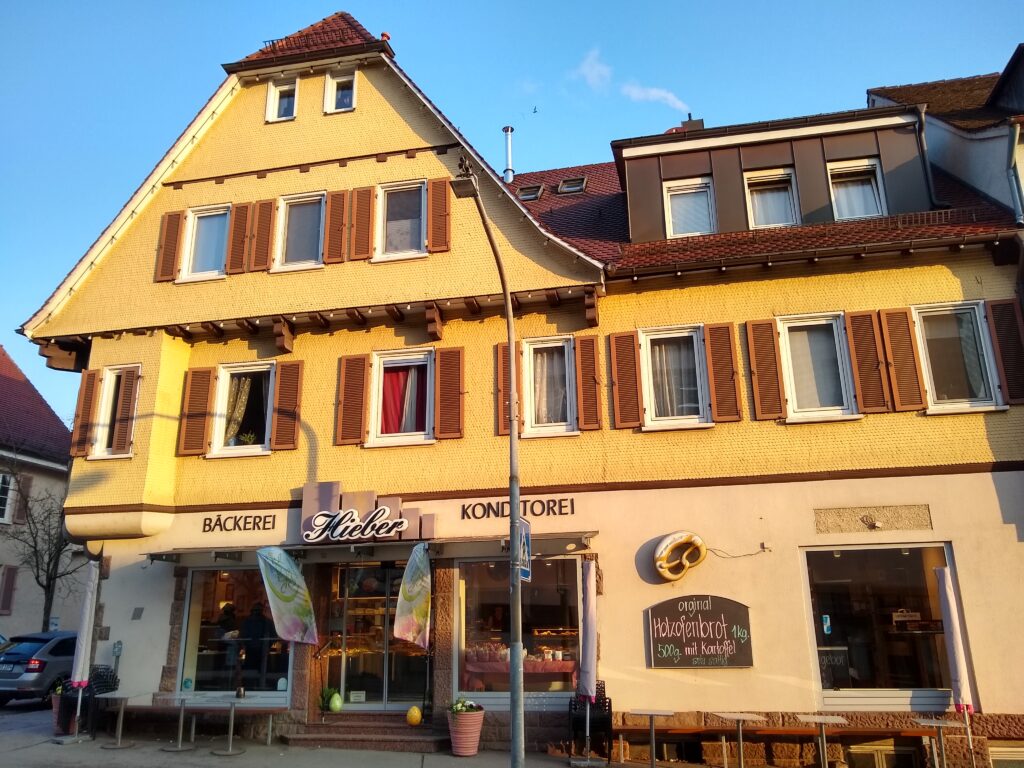
7:45 on an almost-spring morning in a small town in Southern Germany. It’s still chilly enough that I need my fingerless gloves, but the sun is rising in a clear sky, setting the golden stucco of the old bakery at the street corner aglow with the promise of a beautiful day. The upper two stories of the old building look hardly different from how they’ve been for the last century or so, the window shutters beneath the half-hipped red tile roof folded back against the wall to show net-curtain-shrouded windows behind which the inhabitants are starting their day.
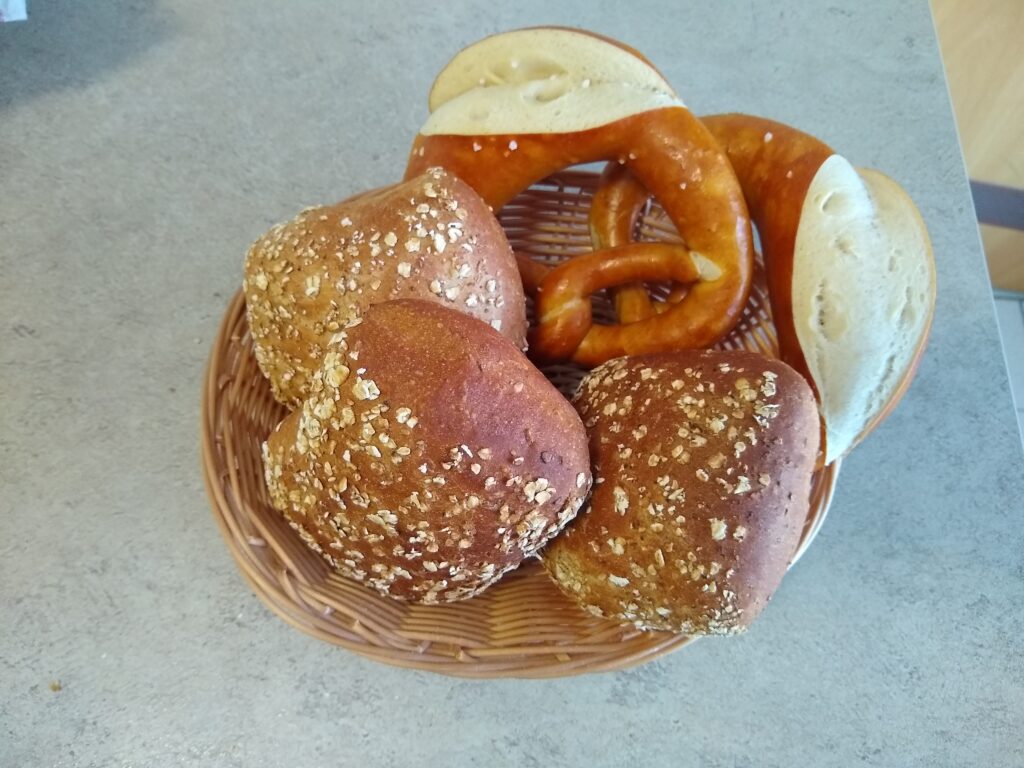
But the ground-floor shop windows are as modern as they come. I step through the automatic sliding glass doors into the warm scent of the fresh-baked breads and rolls and pastries that are piled on the shelves against the back wall and displayed behind the glass counter that runs the whole length of the shop. On the far left, at a small café table a couple of men in business suits down a quick cup of coffee and a roll on their way to catch the train for work. The baker emerges from the back room with an enormous tray piled with fresh pretzels, which he unceremoniously dumps on the counter. Good! Those are just what I’m after. This is Swabia, the original birthplace of the pretzel, and nowhere else are they as good as here. A few salt kernels – not too many – speckle the deep, glossy, mahagony brown of the fat part with the deep slash exposing its creamy interior; the two little twisted arms are thin and crispy. Legend has it they are modelled on the first pretzel baker’s wife’s crossed arms as she watched him bake.
When I turn back to the counter to place my order, I find that two small girls are in line ahead of me, buying a sausage roll, a bread roll, and a couple of pastries for their breaktime snack at school – they’re probably in Grade 1 or 2, no more. “That’ll be €3.40,” the sales lady says as she hands over the paper bag with their goodies, and one of the girls stretches as high as she can to lay her coins on the little wooden tray that sits on top of the glass counter for the purpose. She can barely reach, but she pushes the coins across, grabs her bag, and with a cheerful “Tschüss!” she and her friend skip away. They should still make it in time for school to start at 8:00.
It’s my turn. I can’t be bothered to make a lot of decisions today, choosing from the dozen or more varieties of fresh, crispy bread rolls – white, brown, rye, plain, seeded, sunflower and pumpkin, long or plump or round – so I just ask for three of my favourites, Dinkelbrötchen or spelt rolls: a crispy crust covered in oat flakes, a tender interior with soft chewy spelt kernels throughout. Perfect for a spread of Quark, soft white cheese, topped with strawberry jam. And I ask for two Brezeln, of course.
Their warmth is seeping through the paper bag as I step back out into the street. I’m tempted to hug it to myself to warm my hands, but in true European fashion I tuck it into my backpack to carry it the two blocks to where I’m going. The golden hands of the clock tower show five minutes to eight as the drugstore around the corner and the supermarket down the street are getting ready to open their doors to customers. A new day is beginning in this small town.
The bakery has been operating in that building for more than four generations. For over a hundred years, children have been stretching to put their coins on the counter to buy a bread roll for recess, then run off to get to school before the bell rings at 8:00; working people bought their coffee and pastry and headed for the train; and folks like myself today with a little time to spare bought fresh, still-warm-from-oven rolls and pretzels to take home for a leisurely breakfast of coffee and bread and cheese and jam. The baker has been up since 3:00am to make it all happen, as did his father and grandfather and great-grandfather before him, and perhaps his daughter and granddaughter will do after him. For all the automatic sliding doors and gleaming plate glass display windows, there is a thread of continuity that runs through the fabric of existence here.
I find my soul being nourished by the warmth that gently seeps out of my bag of Brötchen und Brezeln, and I revel in that sense of being tied into a web of culture that has been in place for generations and will continue for generations to come. It’s unlikely that any children and grandchildren of mine will buy breads and cakes in this place where my grandparents and great-grandparents got theirs, but someone’s children will. The thought is as warm as the rolls and pretzels in my bag.
Life, the Universe, and a visit to the German bakery. I’m bringing breakfast today.
And thus it begins – the first trip of the year. A short-notice-planned jaunt to Germany on family business, which on even shorter notice got rebooked for a few days early.
Steve and I got as far as the local airport, twenty minutes from home, where we found the first flight delayed by an hour, and then by another two. It’s fine as we originally had a seven-hour layover to the next leg of the flight, so now it’s four – still plenty of time. However, it also gave me time to have my anxiety spin in circles wondering if I should get one of the Offspring to come down to the airport and bring me my walking shoes instead of the half-boots I’ve got on now that I’m worried will be too warm for Europe, where it’s usually much more spring-like at this time of year then here. Fortunately, I smartened up in time, and thankfully the Offspring has plenty of patience with maternal fussings. Or, as he said, “What are children for if not to have compassion on your poor nerves?” (I pride myself on having raised them on a steady diet of Jane Austen movies, from which I now reap the benefits.)
Anyway. The three-hour delay resulted in us getting a $15 meal voucher from the airline. It was enough for a rice & chicken bowl at Tim Horton’s:
It was tasty, and unexpectedly spicy. I skipped eating the beans that were in it, for reasons we won’t go into here. (You’re welcome.)
So now we’ve progressed through security; Steve says the X-ray machine makes his head buzz. I forgot to take out my little bag of liquids, but they never even asked about it. Maybe they got confused by my question of whether I needed to take out the e-reader.
Another hour to the flight – provided they don’t delay it again. Ah well, the delay was for “unscheduled maintenance”, which I hope means they fixed whatever was wrong so that, for example, the wing doesn’t fall off in mid-flight and we have to make an emergency landing in the Rockies. However, if we do, at least I’m still wearing my boots and not flimsy walking shoes, which would be definitely be unsuited to mountaintop weather.
And that, for now, is Life, the Universe, and The First Trip of the Year. See you on the other side!
slowly the candle flickers in counterpoint to the ticking of the clock the cat breathes in and out and gently from the vents warm air comes shushing out.
Today is a cross-quarter day, one of the four days of the year that fall between the quarter days. The quarter days, of course, were (or still are, really) festivals roughly equating to the solstices and equinoxes: Lady Day on March 25, St. John’s on June 24th, Michaelmas on Sept. 29, and Christmas on Dec. 25th. Smack-dab in between those days, there are the cross-quarter days, the old Celtic quarter days: Imbolc, Beltaine, Lughnasadh, and Samhain, on February, May, August, and November 1st, respectively. Notice something? Right close to several of those days are festivals we still know of today: May Day on May 1st; Halloween or “All Hallows E’en”, the evening before All Saint’s Day on Nov.1st; and then here we have Candlemas, also known as Groundhog Day or St. Brigid’s Day, on February 2nd.
In the old European traditions, Candlemas was an important day. It was the start of the agricultural year, the time when maids and farm labourers were hired or re-hired and got their yearly wages. In the Alpine regions, it was and still is also the last day of Christmastide. The Christmas tree, which is put up and decorated on Christmas Eve (not in early December like in America) stays up until Candlemas. Of course, by then a very small sneeze in its general vicinity will cause an avalanche of dry pine needles to shower to the ground, leaving a prickly pole with some sadly denuded sticks protruding from it that are valiantly attempting to hold up the decorations. Time to pack them away until next winter.
Because this winter, I’m glad to say, is more than half over now. If the quarter day of winter solstice means the turning point in the light, where we celebrate the changeover from the days getting shorter and shorter to the long ascend towards summer solstice (when I’ll be moaning about there being too much light, especially at 4am when the birds are yelling outside my window), the cross-quarter day of Candlemas means that we can actually see the days getting longer. By now, we have a reasonable chance of having our breakfast and maybe even cooking our supper in daylight, and back in the days when the only artificial light people had were candles, from Candlemas on they might be able to do their spinning without them.
Candlemas is called Candlemas because it was the day when the yearly supply of candles for both church and home was blessed. I only just learned that among the domestic candles people took to be blessed was a black “weather candle”, which was lit by way of a prayer for safety when there was a thunderstorm or other dangerous weather threatening. The black colour originally came from the weather candles being made of the sooty wax drippings of a church’s votive candles. People back in the day knew how to recycle.
When I thought about what other names February 2nd has, I remembered that way back when I first started blogging, I’d already written a post about it. I looked it up, and it’s actually quite funny (even if I say so myself). I’m pretty sure the photo of the groundhog (or gopher, rather) was one I took myself on a camping trip, but I can’t remember exactly what year or where.
The fact that in today’s English-speaking world most people know the term “Groundhog Day” is also funny. Because what they know, or associate with it, isn’t necessarily February 2nd. I mean, when you saw the title of this post, did you immediately think I was going to talk about a day that repeats itself over and over in an endless loop? If you did, you can thank the Bill Murray movie. I like it when a piece of fiction that was created simply for entertainment brings a whole new understanding of a concept to our culture, and becomes so firmly embedded in our ideas that it changes the very definition of a word.
That’s what culture is: transmission of ideas from one person to another. Celtic Imbolc, black weather candles in the Alps, the Groundhog Day movie. It ties us to the people around us and to those who came before.
Life, the Universe, and Groundhog Day (and Groundhog Day, and Groundhog Day, and Groundhog… Never mind). Happy Candlemas!
“No,” said the expert, looking up from his close scrutiny of the issue. He raised the magnifying glass and peered through it at the spot on her chin. “No, you are not, are you.”
“On the other hand,” she said, trying not to feel like a lepidopterist’s specimen, “I’m also not very good at about a dozen other things. That ought to count for something, shouldn’t it?”