I just saw that today is our ninth bloggiversary on WordPress. After four years of blogging on Blogger, Steve and I moved house and came over to WordPress, in anticipation of publishing Seventh Son, which happened on Oct. 18th, 2014.
Steve posing on my library books. Yes, he’s still around, even if he hasn’t said much lately (to me at least).
So, Happy Bloggiversary to us! If you feel like wasting, umm, I mean spending some time on browsing the Archives, there’s a handy button on the right entitled, fittingly, “Archives” (if you’re getting this per email, you’ll need to click on the title to go to the post in your browser to see it). Or you could type a keyword into the “Search” bar and see what there is to see on the topic – for example, “Steve”. You could find all about him; he’s a bear with history.
In other news, our main website just underwent a major overhaul; check it out at www.amoffenwanger.com (or www.clayandwords.com, that should get you to the same page).
And that, to keep it short and pithy, is Life, the Universe, and a Bloggiversary. More to come soon!
I know you’ve all been eagerly waiting for the verdict, and here it is: ArtWalk was fantastic. (If you can’t see a video above this paragraph because you’re getting this as an email, click on the title and it’ll take you to the post in your browser, where it should show the video properly.)
Just to catch you up on what this Lake Country ArtWalk thing is, it’s a giant art festival that has been held in our community on the second weekend in September for the last thirty years. Two days, three school gyms/halls/hallways full of art by close to two hundred local artists, live music, food, performances, visitors by the thousands. Complete sensory overload, inspiration, exhileration.
I had the best location – full sunlight on my sculptures for most of the morning.
So this year I finally got to take part, showing my ceramics. And sell my books! Book selling isn’t normally part of this, but this year there was an exception, because the theme was “Art and Story Bound Together“. I mean, that’s me! As I was telling everyone, I write books with potters in them, and make pottery sculptures with books in them.“Telling Stories in Clay and Words”, that’s my new motto.
Books about a potter……and pottery with books.“The Library”, stoneware, 6x6x5″. SOLD (but I can make another one like it if you want one!)
I sold pieces! A friend who is an ArtWalk veteran told me to bring some small pieces, things that don’t cost the earth so visitors can go home with their very own piece of art without breaking the bank. So I took a whole lot of mugs – well, they’re honest-to-goodness stoneware mugs you can drink your coffee out of, but really, they’re paintings that happen to be on a mug instead of a canvas. And people liked them, and bought them!
Doors and towers (mostly SOLD, but there’s more where they came from)
Selling things was exciting. But the best part was the reactions I got from the show visitors. Over and over, someone would come around the corner, catch sight of my display, stop, come closer – and get a big smile on their face.
“This is so cute!”, “These are delightful!” “I want to live in that little house!” Several times, someone came back, towing a friend behind them: “You’ve got to see this! Look, isn’t it amazing?”
I can’t tell you how much that meant to me. My art makes people happy. It creates pleasure and delight; it brings joy.
That is what I wanted to achieve with my work. I have a lot of fun making my bookends and fairy houses and gnomes, but it was amazing to see how that joy transmitted itself to the viewers.
What I saw coming back from my lunch…
One of the things I had the most fun with at the show was introducing the gnomes to the kids that came by. Art shows can be rather overwhelming, and for children, maybe a bit boring.
So a family with young kids would wander by. One of them would catch sight of my booth.
“Oh, look! Look at the fairy house!” And they would zoom in on my table, their eyes lighting up. “It’s got a little bathtub! And look at the tiny mugs!”
I’d let them look for a minute, then I’d say, “Have you met the gnomes?” They’d shake their heads, and I’d point to the gnomes at the front of the long table, right at their eye level.
Gordon G’nome, 6″, stoneware
“Well, here’s Gordon,” I’d say. “His bug went to sleep, so he’s just hanging out. This one is Goldie. She just caught sight of a butterfly! Her bug isn’t so sure about this, I think he’s a bit jealous…”
The kids loved it. Over the course of the two days, the stories of Gordon and Goldie and Garth and Gabby kept growing in the telling. Goldie’s butterfly appeared fairly early – at first I didn’t know what she was looking at, but now it’s obviously a butterfly.
Gaeli’s G’nomes, and the bookends holding up my books
One young visitor wanted to know who lives in the little bookend rooms, and then she decided that it must be the gnomes, because they stood right in front of them. She was right, of course. So that became part of their stories.
Goldie’s Knitting Room (with real sunlight coming through the window)Gordon’s Tea Party
Goldie, we thought, must belong to the room with the knitting – she looks like the kind of person who likes to keep busy. And Gordon obviously likes food, so he’d be at home in the tea party room. Garth the Dreamer got the library with all the books, and his sister Gabby, who is telling her bug a story, belongs in the writer’s study.
Garth dreaming into the cloudsGabby’s Writer’s StudyGabby telling stories
What, me, having fun? Naaah…
I knew I wouldn’t get any sales out of the kids. But that’s not what it’s about. I wanted the kids to have fun looking at my sculptures, as much fun as I had making them. And not just the kids, either.
For those thirty seconds that you look at one of my pieces, I want you to be drawn in. I want you to feel that you can live in one of the fairy houses, that the little bookend room is your own cozy corner, that Gordon and Goldie are your friends. I want you to come into my little ceramic world and be happy, safe, and warm.
And I saw that reaction on the faces of the ArtWalk visitors that came by my booth, over and over. See what I mean when I say ArtWalk was fantastic?
Life, the Universe, and ArtWalk 2023. I’m already planning for the next show.
Bathtime at G’nome Cottage, 9″ high. It’s all ceramics, i.e. safe to put in your flowerbed. You never know, someone might move in…
My coffee tastes like espresso this morning – the first cup of a whole potful that I grabbed to get back upstairs with it so as not to have to talk to anyone quite yet.
The valley is socked in with smoke still, the rising sun a blood-red ball over the hazy hillside. But there is no smell of smoke that I can detect; maybe my nose has become inured to it. The doves are cooing, there is chirping and whistling and shrieking, and the odd chattering noises of what I think is the quails interrupting it all.
It’s a good morning – pleasant, cool, slightly breezy. The orange glow of the smoke-shrouded morning sun is laying diagonal planks of light across the balcony floor like molten copper; the indolent curve of the blue-and-green-striped hammock swaying almost imperceptibly in the breeze.
My tongue is still tasting the acrid flavour of the much-too-strong coffee – I can’t even finish it; a whole mug of espresso is far too much.
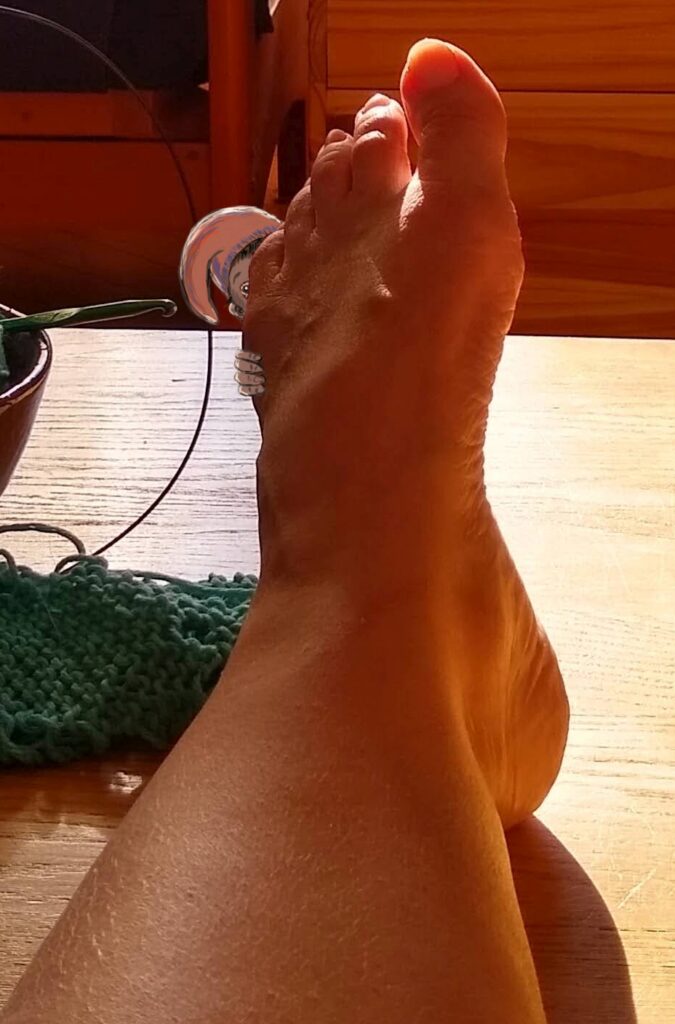
I looked at my toes, propped up on the coffee table in front of me. And looked again.
There was a small gnome hiding behind my foot.
I froze.
He peered around my big toe, then darted back to the other side. I could feel his tiny hand as he steadied himself against the side of my little toe, then his pointy cap slowly appeared, followed by his small, round face.
I just spent almost six weeks away from home. Six weeks, eight different places. Vancouver Island, Munich, Hesse, Stuttgart, London, Toronto… Visiting family, spending time with friends, going on errands and sightseeing trips and appointments with said family and friends, talking about their affairs and my affairs and the world’s affairs, experiences piled on impressions and filtered through yet more experiences. It was a wonderful time, a strenuous time, a time to be remembered.
And through it all, over and over, I was struck by just how pervasive Uppercross Syndrome is.
In case you don’t know about Uppercross, in Jane Austen’s Persuasion her heroine, Anne Elliot, has to watch her family move out of their mansion, Kellynch Hall, in a huge upheaval that is necessitated by her father’s imprudent spending habits. Once her father and sister are gone to Bath, where they intend to settle into a new life while Kellynch is rented out to pay their debts, Anne goes to her other sister’s home in the village of Uppercross and for a time becomes completely absorbed in the affairs of the Musgrove family.
“Anne had not wanted this visit to Uppercross, to learn that a removal from one set of people to another, though at a distance of only three miles, will often include a total change of conversation, opinion, and idea. She had never been staying there before, without being struck by … how unknown, or unconsidered there, were the affairs which at Kellynch Hall were treated as of such general publicity and pervading interest… [C]oming as she did, with a heart full of the subject which had been completely occupying both houses in Kellynch for many weeks, she had expected rather more curiosity and sympathy than she found in the separate but very similar remark of Mr and Mrs Musgrove: ‘So, Miss Anne, Sir Walter and your sister are gone; and what part of Bath do you think they will settle in?’ and this, without much waiting for an answer; or in the young ladies’ addition of, ‘I hope we shall be in Bath in the winter; but remember, papa, if we do go, we must be in a good situation: none of your Queen Squares for us!’ or in the anxious supplement from Mary, of—‘Upon my word, I shall be pretty well off, when you are all gone away to be happy at Bath!’”
(Jane Austen, Persuasion, Chapter 6)
In Uppercross and the neighbouring Lyme Regis, Anne and the Musgroves go through lifechanging events, but when it is time for Anne to join her father and sister in Bath, once again she experiences the total disconnect in mental states that a change in location and environment will bring about. Just as the Musgroves were more or less uninterested in the Elliots’ burning concern about their move, now the Elliots in Bath neither know nor care that the Musgroves nearly lost one of their daughters in a freak accident and that Anne was deeply involved in the matter. All they think of is showing off the size of their drawing room and discussing the arrival of a handsome cousin, and it is left to Anne to once again switch tracks from one of her deep concerns to the other.
But it doesn’t take a pair of self-absorbed aristocrats like Sir Walter and Elizabeth Elliot for Uppercross Syndrome to kick in. Like the kind and caring Musgroves, most of us are focused on the here and now, on the circle of friends and surroundings we find ourselves in today. What completely took up my attention in Vancouver faded into the background once we touched down in Germany; what mattered in Munich was left behind on the way to Frankfurt; in Stuttgart, I was so mentally occupied with what was happening there that I barely managed to send the few texts I needed to plan our time in Toronto. Now that I’m home, after I told everyone a bit about Niagara Falls and the family matters in Germany, we talked about the antics the cats got up to in my absence; and now thoughts of the garden and household and pottery and all the other work waiting for me here are swiftly taking over most of my available mental channels.
Uppercross Syndrome: the phenomenon that “a removal from one set of people to another … will often include a total change of conversation, opinion, and idea.”
There is nothing particularly wrong with it. Austen neatly contrasts the self-centred Elliots who care only about their position and appearance with the kindly Musgroves whose life is focused on their home and their children, but neither of them have much thought to spare for the other. I think it’s a human reality that our present environment takes most of our attention, with not much left for what is out of sight and hearing. Perhaps that’s just as well. It’s good to focus on how we live that here-and-now life—far better to be a Mrs Musgrove, concerned about her children, than a Sir Walter Elliot, obsessed with his looks.
But then, like Anne, we can learn “the art of knowing our own nothingness beyond our own circle”. We can live in the humble awareness that what is all-absorbing to us today, in this place, is of little concern or interest to most of the rest of the world—and that even for us, perhaps it’s not such a big deal after all. We can enjoy the joys, but need not hang on to the pain. It puts things in perspective.
Life, the Universe, and Uppercross Syndrome. Another place, another view.
As you might know, I’m fluently bilingual. English or German, I can make my desires know: “Excuse me, where do you keep curtain hardware?” or “Wo ist die Zahnpasta, bitte?” It’s not a problem—I jump from one track to the other, and operate in either system without having to think about it.
And then I went to France. For the first time in my life, I was confronted with being struck deaf and mute. The extent of my French is, pretty much, Bonjour, Au revoir, and merci beaucoup*. In Paris, I understand nothing, and can communicate nothing. And let me tell you, it is astonishingly disconcerting. You don’t realize how much you rely on your verbal prowess until it’s taken away from you. So, I decided it was time I did something about it, and I set out to learn at least a little bit of French. You’ll be glad to know that as of this morning, I have learned to say “Un café au lait avec du sucre, s’il vous plaît, et deux croissants.” You know, the necessities of life. I do not yet know how to ask where the bathroom is, but as I most likely wouldn’t understand the answer, that’s just as well.
But this whole process got me thinking about how to learn languages. It’s really not that hard, we’ve all done it! Yes, you have too—you’re reading this, aren’t you? You learned at least one language completely fluently, effortlessly, grammatically correct, with flawless pronunciation. So, all it should take is to repeat that process with another language, and you’re golden. I’m by no means the first person to come up with that idea; I don’t know how many times I’ve seen language learning programs advertised as being “completely natural” and “just like learning your first language.” It should work, shouldn’t it? No problem.
Das Baby und die Katze.
Now, as luck would have it, a couple of weeks ago I had a front seat to watching the process in action, courtesy of a visit of a young relative. This young gentleman, who recently obtained his first birthday, is a remarkably intelligent individual (of course he is, he’s related to me), who is very interested in language and in the world around him, particularly the four-footed variety. I observed him closely, and I’m now in a position to tell you exactly how this language learning thing is done. Here you are:
LEARNING A LANGUAGE THE NATURAL WAY, IN EASY-TO-FOLLOW STEPS
Step 1.) (Optional, but helpful) Be as cute as you can possibly be. Step 2.) Surround yourself with as many individuals as you can who adore you and are willing to repeat words to you on a continuous feedback loop. Step 3.) Point to an object of your interest and make gurgling noises (example: the cat). Step 4.) Wait for your adoring audience to supply the word in the language of their choice (“Die Katze!”). Step 5.) Copy the word to the best of your ability (“Tz-tz!”). Step 6.) Let your audience correct your pronunciation and try again. (“T-tz!”) Step 7.) Repeat steps 3.-6. approximately twenty times per hour during all your waking hours, every day, for the next two to three years. Vary the objects labelled as required and improve your pronunciation as needed.
By the end of four or five years, you should be completely fluent in your new language and will be able to move on to instructing others.
There you have it: the one, the only, the infallible completely natural method to learning languages. It really works.
Now if I could only find someone to repeat le chat to me, over and over and over and…
Life, the Universe, and Natural Language Acquisition. It’s the only proven method.
*being Canadian, I can also read some French food labels: I know that fraise is strawberry, framboise is raspberry, and bleuet is blueberry. I know my yogurt flavours. But they’re of limited usefulness in navigating the Paris metro system or buying museum tickets.