More Rabbit-Trailing, or: White Cliffs and China Clay

I’m still rabbit-trailing, uh, sorry, researching. And for some reason, I always seem to arrive in the early 19th century again – the time of the Regency, Jane Austen, the Brothers Grimm. What’s with that?

This is how the rabbit trail ran today: I was looking at the creation of porcelain or china (because that’s important for Septimus book #3, Checkmate, which I’m editing at the moment). Unlike regular clay, which you can just dig out of the ground and use more-or-less straight up, the clay body that makes up porcelain is a mixture – the recipe varies depending on what kind of china it is. Bone china, the fine English stuff invented by Josiah Spode in the late 18th century, contains a sizable proportion of actual bone (cow, for the most part, apparently), which is burned and ground up before it gets mixed with the other ingredients. Recipes for china clay were a closely guarded trade secret; in fact, when in 1712 a French Jesuit missionary transmitted the secret of how to make porcelain from China, where he was working, to Europe, it was considered one of the first instances of industrial espionage (however, some German scientists had already figured it out for themselves a couple of years earlier, establishing the porcelain manufacture in Meissen. Science beats spy work – so there!).
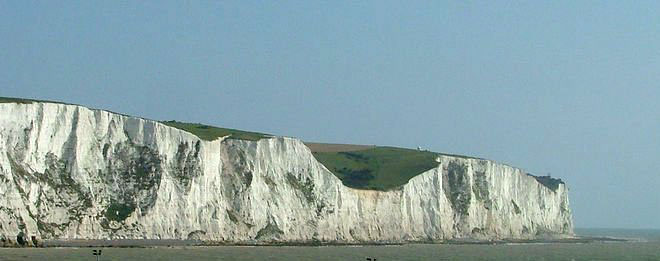
Now, that key “other ingredient” in porcelain is kaolin, also called, for obvious reasons, china clay. Kaolin, one of my sources informs me, is really white, and is primarily found in Malaysia and in Cornwall, England. And here’s where today’s rabbit trail comes in: my mind goes, “White deposits of mineral? In Southern England? Wait – the White Cliffs of Dover?” Back to Google I go, to find out what you probably already knew and I remembered just before Google brought it up, namely that the White Cliffs of Dover are made of chalk, not kaolin clay.

Caspar_David_Friedrich's_Chalk_Cliffs_on_RügenAnd then Wikipedia told me that the ones in Dover are by no means the only chalk cliffs around Europe, and that another famous instance of white-cliff-ness occurs on the German Island of Rügen. So, of course, I had to look that up, and remembered and found the famous work by Romantic painter Caspar David Friedrich, “Chalk Cliffs on Rügen”, from 1818.

And there you have it: the research rabbit trail arrived in the second decade of the 19th century. Just look at that dress, and the hairstyle of the lady! In 1818, Persuasion was published – can we picture Anne Elliot in that outfit? If it wasn’t for the two gentleman in the picture obviously being civilians, it might well be showing Captain and Mrs Wentworth on their honeymoon (they took a friend along on the hike to the cliffs, okay? There’s nothing wrong with spending time with friends, even if it is your honeymoon). Or it might be Jacob and Wilhelm Grimm, on holiday with their sister Lotte. And when they get back to their Pension (bed-and-breakfast, or inn), they’ll have a lovely Kaffee und Kuchen (afternoon coffee & cake) off a set of Meissen porcelain.

Life, the Universe, and Rabbit Trails from China to Jane Austen. The pleasures of a writer’s life.

Friday Frivolities

Steve was complaining about not getting enough screen time lately. Also, about my terrible habit of procrastinating instead of writing. Well, I said to him, what do you want me to do – write, or put up a blog post with a picture of you? I can’t very well do both. He chose the latter. Which goes to show just how seriously I need to take him when he grumbles at me about my procrastination.

IMG_20150424_092134So here he is, looking dapper in front of my screen. Now that he gets double screen time – in front on my screen, and displayed on yours – hopefully that’ll keep him happy for a while. It’s really hard to write with those bearly grumbles coming from the corner of the room.

In other news, it’s a gloriously sunshiny spring day, which makes me feel happy. I know, you don’t really care – but I don’t really have much else to tell you today. Unless you want to hear about my frustration with the bank, who is making me go through an incredible rigmarole to get them to stop sending me paper statements for my line of credit? No, I didn’t think so. Sunshine and stuffed bears it is.

Life, the Universe, and Friday Frivolities. Have a lovely weekend!

Just Me and Art

IMG_20150327_125032
Vancouver Art Gallery

It’s been quite some time since I got to be alone with art (I mean small-a art – visual constructions, not big-A Art – person named Arthur who had his name chopped down to a three-letter word; I don’t know any of the latter). But this past weekend I had some business to do in the big city – Vancouver, to be precise, a five-hour trip over the mountains – and when I was finished with what I had to do, I indulged myself with a visit to the Art Gallery.

It was lovely. They had a show of a collection that included works by Cezanne, Manet and Toulouse-Lautrec, and another of Chinese art that examines the interaction of traditional art with the modern. It was in the latter, when I was standing in front of a marvellous work – an installation of ceramic art by Liu Jianhua – that suddenly a realisation took  shape in my mind: visual art is something I need to experience alone. Inside my head, I was having a dialogue with an imaginary partner, telling them (it’s not a specific him or her, or it, for that matter) what I thought of this piece – half-baked sentences that bubbled up and sunk away again unfinished as my mind walked through the visual realities in front of me and then moved on to the next piece, focused on seeing. I was looking, I was responding – I was, pretentious though it may sound, communing with the art work.

In the fabulous art instruction book Drawing on the Right Side of the Brain author Betty Edwards talks about how visual art, or visual perception, primarily takes place in the right hemisphere of the brain, while the brain’s language centre is located in the left. Because of that, it’s not uncommon for artists to be unable to draw and talk at the same time. I know that’s certainly true for me – if I want to really focus on what I’m doing visually, my flow of words dries up.

I’ve had friends say “Let’s get together and make art!” Well, actually – that doesn’t do much for me. Sure, I have fun hanging around with friends and mucking about with art supplies, no question of that; but the result is practically never one of my better pieces, artistically speaking. If I am with another person, my thoughts are focused on that person – and as I think in words, by definition my brain is stuck in the wrong modus operandi for thinking of art. If I’m talking to someone else, I cannot communicate with the art.

So art is something I need to experience alone. In order to get the most of a visit to an art museum or art gallery, especially one of the calibre of the Vancouver Art Gallery, I need to be by myself. I need to be able to get stuck in front of a piece that grips me, just staring at it, letting it impact me, without having to get back out of myself and explain to whomever I’m with. It’s not that I don’t enjoy looking at art, or making art, with friends – but the experience of the art will be far more shallow than anything I could get on my own. I’d never realised it quite like that before – but for real depth, it has to be just me and the art.

So, what did you do last week? Me, I went on a date; we had some great conversations, myself and an installation of Chinese ceramics in celadon and oxblood glazes. We got real close.

Life, the Universe, Myself and Art. It’s got to be just the two of us.

2139PS: I wanted to post a picture of that marvellous Liu Jianhua piece, “Container”, but sadly, I don’t think it would be right under the fair use copyright law. If you go here and scroll down, the second picture on the left is of an earlier installation of the same work; at the VAG it was sitting on white ground, which made it even more amazing. But just so you’re not deprived of a photo of an interesting piece of pottery, here’s one of mine: “Squashpot, Untitled (2011)”. Yes, I know, it’s stunning.

Mishmash

The problem with blogging is that there comes a point when you feel the pressure to produce something. To come up with erudite, witty, cohesive pieces of writing on a regular basis because you figure that your readers expect it of you. (That’s on the assumption that you have readers. Let’s hold onto that illusion, shall we?) Well, I’ve had quite a few ideas for posts this past week, but I just didn’t get around to solidifying them in writing. And as with many things in life, if you don’t strike [the keys on the keyboard] while the [literary] iron is hot, you lose it.

But then it occurred to me that there’s no reason it always has to be cohesive, erudite or witty, never mind profound. Sometimes, life is made up of little bits and pieces, the mosaic of existence. So today, for your edification, amusement or wastage of time, here is a mishmash of matters – just some stuff going on in my life or going through my head.

IMG_20150309_094127a) I just finished reading Seraphina by Rachel Hartman. (Thank you, E. L. Bates, for recommending it!) That is one fantastic book. I’m so glad I only read it just now; the sequel (Shadow Scale) is coming out tomorrow, so I don’t have long to wait for hearing more about Seraphina and her world.  I bought the Kindle version, which happens to be on sale at the moment, and then I got a paper copy out of the library because a real book is still so much nicer to read. I’m not going to write a big review; others have done that. But just one point: the book is full of dragons who all have Asperger’s. It’s awesome.

b) Spring has hit in full force, more than a month earlier than we got it the last couple of years. Canada is, literally, polarised right now – while here in the West we’re scrambling to get our rear in gear and start our seedlings, the East is buried under a white blanket. Pretty soon we’ll have to start talking about the East Pole and the West Pole… So on that note, I’ll have to get myself out into the garden today, resurrect the beds from their winter slumber, and get the radishes, lettuces, peas and kohlrabis into the ground.

c) Steve says hi.

Life, the Universe, and Today’s Mishmash. I’ll tell you more when I think of it.

The Power of Story, or, RIP Leonard Nimoy

vulcan saluteIn case you hadn’t heard, Leonard Nimoy died this morning. The Internet is going to be buzzing with remembrance over the next few days; everyone and their pooch will be posting pictures of him, throwing each other the Vulcan salute, and discussing their favourite Star Trek episodes ad nauseam. The whole of Silicon Valley, I’m sure, will go into mourning.

But why? An 83-year-old Jew from Boston passes away peacefully in his LA home after a long and prosperous life – so who cares?

We do. Millions of us do. Because Leonard Nimoy was not just a person beloved by his friends and family, and a man highly gifted in his chosen profession. Leonard Nimoy was Spock. And as Spock, he brought something to our lives that was unique.

In fact, Leonard Nimoy’s passing, just like the tragic death of Robin Williams last year, illustrates with brilliant clarity just how powerful the impact of Story is on our lives. Nimoy became Spock; he became Story. His embodiment of this character, his telling us of who this – entirely fictional! – person was, allowed us to enter into Spock’s being, let us become, for a short time, another. He, like Robin Williams did in his many roles, gave us a powerful gateway into the realm of Story.

We need Story; we live in Story. And that is why so many of us are touched by the passing of a man who lived thousands of miles away from us; whom we have never spoken to; who, in real life, did not have pointy ears and go around classifying everything as “logical” or “not logical”. It almost feels heretical to say that – Spock is not real, he does not exist. But, actually, he does. He existed in what Nimoy created, and took root in our imagination. And as such, the death of Leonard Nimoy does not put an end to Spock’s existence. The power of Story simply carries on. There was no Spock before Nimoy became him (and created the all-memorable Vulcan salute – there is a very interesting video clip here, where he explains its origins). But now, there always will be Spock.

And we can continue to draw inspiration from his story, from the portrayal of the man who lives in logic but yet has to come to grips with the emotion seething inside him; a story that draws us out of ourselves and lets us grow with him. Leonard Nimoy brought us the empowerment of seeing Spock live – of being Spock.

Life, the Universe, and the Power of Story. Rest in Peace, Leonard Nimoy – you lived long and prospered.

Marmalade

marmalade (4)
A Paddington Bear notebook my daughter got for me at Paddington Station

So I promised you a post on marmalade, didn’t I? Well, now’s the time. We went and saw the Paddington movie last night, and when can you write about marmalade if not fresh from a viewing of a film starring The Bear With a Worrying Marmalade Habit? (The latter bit is a quote from Mr Brown, the movie version. The one in the book doesn’t seem to be worried about it at all.)

(In case you’re wondering, Steve didn’t come to the movie; they don’t have bears as a category at the ticket counter. Seniors, Children, and Generals, but no Privates, Corporals, or Bears. Also, even though I would have smuggled him in in my purse, he’s a little leery of watching things on a big screen. If you’re six inches high, even a large-screen television can be a little overwhelming.)

marmalade (1)So. Marmalade. Oh, the movie was quite good. However, I have to inform you that it presents a quite serious factual inaccuracy: they’re using the wrong kind of oranges for their marmalade. Yup. The movie shows Paddington and his Aunt Lucy making marmalade out of ordinary sweet oranges, the ones you get year-round in the grocery store – you know, navel oranges. How do I know that’s the ones? Because they chop them open, and they’re way too juicy on the inside. No, no, no. Just wrong. Marmalade is made from Seville or bitter oranges, which are a different thing; their flesh is quite dry.

Now, the funny thing is that nobody in my family actually eats marmalade except for me; and I only have it occasionally with a bacon-and-egg breakfast (the bitter taste offsets the grease something wonderful). It’s one of those acquired tastes, and I’ve acquired it in order to be able to feel more British. Well, yeah. It allows me to say “Pass the squish!” like Lord Peter Wimsey, and reminds me of the line in Gosford Park where Mrs Wilson, the housekeeper, asks Mary if her employer couldn’t have strawberry jam for her breakfast: “Only, we’ve run out of marmalade. Dorothy [the stillroom maid] didn’t make enough last January.” And then Lady Trentham (played by Maggie Smith at her most snobbish), the next morning on lifting the cover off her breakfast tray: “Boughten marmalade! I call that feeble.”

marmalade (2)Marmalade oranges are only available for a couple of weeks in January – hence the fictional Dorothy’s failings in producing enough for the household; if you don’t make it in January, you’ve missed the boat for the year. And I think that might be one of the reasons I like making marmalade: it’s the one preserve that you make in the dead of winter. The canning jars and rings and lids, the funnel and tongs, all the paraphernalia of canning season, which live in the kitchen all summer long, are put away in the storage room in the basement from October to June. But this one short stint of once again stirring the fragrant amber bubbling away in the big pot, of whirling around the kitchen to get the steaming hot jars out of the dishwasher and ladling the sticky-soft sweetness into the glass, clapping on the lids and then listening for that satisfying little snap when they seal – it’s an unmistakable reminder that even though the snow flies outside, summer’s warmth and harvest will be back.

I don’t have a worrying marmalade habit myself – although I might have a marmalade-cooking habit. And I have friends who are quite happy to support me in that habit by taking the product of my hands – or they say they are, anyway. Maybe they’re just being polite, being English and all? Paddington is a very polite bear – it’s the English way.

Life, the Universe, and Marmalade. Pass the squish.marmalade (3)

PS: Here’s the recipe, the short version: 2 lbs marmalade oranges, 8 cups water, 4 lbs sugar. Cut up oranges, take out pips. Chop whole oranges in food processor, boil with water for 1 1/2 hrs together with the pips tied in a little bag. When the orange peels are soft, take out the bag of pips, add the sugar, and boil for about 15 minutes, proceeding like for any other jam. Makes about 8 half-pints of marmalade. (Pardon the imperial measurements – I got the recipe from an older pre-metric English cookbook. Seems kind of suitable.)

This & That & CAT AND MOUSE

I have things I was going to tell you about. Marmalade, and Charles Dickens, and watching the last episode of Season 1 of Once Upon a Time and what I think of it. But we’ll leave that for later, because right now the big excitement is that it’s only two more days until Cat and Mouse is available for actual sale in actual, um, virtual, um, online book stores.

Steve was complaining that he hadn’t had enough screen time recently, so I let him and Horatio model the print copy of Cat and Mouse. He was also complaining that there aren’t enough bears in my writing, and I’m sorry to say this book is no exception. Not a single bear in sight, in this or in Seventh Son. But of course, there’s cats, so that’s where Horatio comes in. Well, a tiger is a cat; so even though there are no tigers in Cat and Mouse, only domestic cats, I thought he’d be a suitable advertising model.

The picture also gives you an idea of the size of those two. Some friends who’ve met Steve in real life were surprised at how small he is. He’s a Gund, only 9″ (22cm) on his tippy-toes, 6″ (15cm) when he’s sitting – but I guess his screen persona comes across as much bigger. He’s a large bear on the inside.

So here they are. Doesn’t Cat and Mouse look lovely?

Steve, Horatio, Cat & Mouse

But there’s one more thing I had to share with you. I just got this awesome comment on my “Clean Air” post from the other day. You know the one where I rant about rude, inconsiderate, pushy salespeople with tunnel vision about their product? Here’s the comment, verbatim:

“it is great to see about air purifier . how many people know about air purifier we should know about air purifier this the mean thing so everybody should know about air purifier you can check about air purifier here [spam link]”.

I liked that comment so much, I left it up, with the guy’s name and links removed (wouldn’t want to risk even the slightest chance of giving him any business from his spam). Gotta love it when spammers make your point for you.

So, just a couple more days, and you can have Cat and Mouse in your sweaty little hands – umm, on your sweaty little Kindles and Kobos and iPhones and computer screens. The hardcopies will be a bit longer in coming; I’ll let you know when I’ve got some on hand for locals to buy from me directly, or you can order it yourself from Amazon US or Europe (Amazon Canada will take longer).

Life, the Universe, This and That and Cat and Mouse. Steve and Horatio say hello.

Twitter

No, I’m not talking about the micro-blogging site (although you can find me on there now, too – follow me here). I’m talking about the racket the birds are making at the bird feeder. They are incredibly noisy. The sound of birds chirping isn’t exactly the auditory connection you make with the middle of winter, is it? Birds go with spring, 5:30 AM, sunrise, unable to sleep. Well, this morning (it’s a Saturday, so I got to sleep in) the sparrows, juncos and finches at the bird feeder were doing their best to get me up at about 8:00, not long after it got light.

Actually, no, they had no idea that this great lump of humanity who fills up the seeds in their buffet was trying to sleep just around the corner from Chez Birdy (Chez Oiseau?). They were just bickering over the food. It probably goes something like this: “Hey, move over! Hey, that was my seed! Hey, hey, you got three black sunflower seeds last time, hey, let me at it, it’s my turn now! Hey, out of the way! Hey, you got to mate with that pretty chick last season, at least you could let me at the millet! Hey, quit picking on me! Hey, I want those! Eeeep cheep cheep, movement at the window!” [Everyone flutters away.] “Hey, all clear now! Hey, let me have those! Hey, I saw that seed first! Hey…”

Here’s the bird feeder progression over the last month. From no snow and bitter cold, to a little snow, to a massive dump on Monday, to a thaw the last couple of days. As soon as there is any access to the feeder, the little chirpers are back again, and bickering. “Hey, that’s my seed! Hey, let me have that! Hey…”

birds (7)  birds (2)birds (5)birds (4) birds (6)

Life, the Universe, and Bird Feeder Bickering. The original Twitter.

Smartphone

smartphoneI have arrived! In the Twenty-teens, that is. That’s right: I got a smartphone. Hey, come on, it’s just 2015; I’m only about five years behind the times.

Okay, okay, I was never an early adopter – the only reason we got a computer when we did (1996, refurbished machine with Windows 3.1. I know, right?) was that I happen to be married to a nerd who figured it would be useful for business purposes sometime down the line (it was). And then we got on the Internet in 1997 because we signed up to an online homeschooling program that loaned us a fully-loaded computer complete with dial-up net connection. I can still hear that crreeech-bip-bip-bop-beep-bip sound of the modem when it was dialling. The password was an eight-letter string of gobbledigook which we memorised because we had to type it in every time we went online, for anything.

Other than that, the earliest adoption of new technology was my Kobo ebook reader – I got that in the fall of 2010, when ebook readers were the new & hot thing. And the only reason I got it then was that I wanted something other than a computer screen to read pdf’s on for school (I was still in undergrad at that time). Turned out the Kobo is lousy for pdf’s, but great for reading actual books – so I got sucked into using new technology sort of by a side road.

That’s what happened with the smartphone, too. I’ve had a cell phone for a year or two longer than the ebook reader, but it’s always been just a little flip phone – you know, a cellular telephone. It made phone calls. Ever heard of those? You talk into this hand-held device. With words, in your voice. Audio. That’s about all that phone did; you couldn’t get Google Maps on it or anything. Oh, it did have an alarm clock. And you could do texting on it, for a given value of “texting” (t-de-wx-t-ghi-mn-g, like that). Actually, it’s the texting that made me want to get a new phone; I just wanted some method of doing that more easily, as there are some friends who are most readily reached that way.

So with some birthday-gift money I had, I got myself the next-to-cheapest not-flip-phone my provider was offering, and well, it’s a smartphone. With, you know, Android and stuff. I didn’t even really know what that meant, and had no idea that those not-flip-phones come with (ooh, aah!) wi-fi, so you can do all that smart stuff even if you aren’t paying through the nose for a data plan. That’s right – I can do smartphoney things, even though I have no phone data plan, just some pre-loaded minutes on the phone that allow me to call home to find out if we need milk, or if we already own a copy of Sherlock Holmes: Game of Shadows. I can use my cheap phone minutes for dumbphone activities while I’m out, and do all those browsery smartphone things at home or wherever there’s free wi-fi.

So there I was, all of yesterday, learning smartphoney skills. The first apps I downloaded, of course, were e-book reader software (Kindle and Overdrive). Maybe I’ll finally get around to reading A Tale of Two Cities, in waiting rooms and what-not, if I have it in my pocket on the phone – that book has been on my to-read list for several years now. I should see if I can download it to the phone – or is that upload, if it’s coming from my computer? See, I don’t even have the terminology straight…

Once again I’ve been pulled through the back door into adopting new technology. I got a device for one purpose, and found it could do cool other stuff I hadn’t really looked for. And once you get used to the cool new technology, you don’t want to be without it. Well, mostly. Fancy cable TV, we’ve adopted and then un-adopted several times so far; it was just not worth it. The smartphone, though, I have a sneaking  suspicion will be a keeper, even if it does mean I can no longer look down my long luddite nose and feel superior because I can make do with a flip phone. But you have to make sacrifices somewhere.

Life, the Universe, and My New Smartphone. Welcome to the Twenty-Teens.

Blank Brain and Winter Birds

birds (1) I’ve got a serious case of blank brain right now. I just haven’t come up with anything wise, witty or weird to say on here – or at least haven’t been able to remember it long enough to put on screen (I had one or two really great blog posts plotted out – at 3:00 AM when I was lying awake with insomnia. Alas, they have vanished into the abyss of post-insomnia early morning sleep). So that’s why there’s been a bit of a dearth of postings here lately.

Of course, what’s in the forefront of my otherwise blank mind right now is my stories. The sequel to Seventh Son is actively in the works, and coming really soon! It’s largely a winter story, and was much easier to write at this time of year than Book #3, which is set around Summer Solstice. Maybe I should take a quick trip Down Under, and just live in summer for a while to keep that story moving forward. Any New Zealanders want to send me a plane ticket and put me up for a few weeks?

birds (3)Speaking of winter, I’ve been watching the birds bickering over seeds on my balcony bird feeder. And I got to wondering: how can they even survive the winter? At the beginning of December for several days in a row we had a cold snap where it was -15° C (in °F, that’s, umm, really really cold). How can those tiny little bodies make it through those temperatures without turning into little frozen lumps? But from what I could tell, they weren’t particularly bothered; they just puffed up their feathers a bit more than normal and became birdie puffballs instead of birdcicles. And then there were the ducks on the lake: the water was forming a rime of ice, and the ducks were still merrily paddling around in the unfrozen bits. That’s crazy – hasn’t anybody told them that warm-blooded creatures should have their feet freeze off in ice water?

Maybe it’s because they don’t know that that they can survive it. That was the theory I heard a little boy proclaim once, when I wasn’t all that big myself, about how birds can survive sitting on power lines. He was wondering aloud why they didn’t get killed by the electric power surge, and then he came to the conclusion that maybe it was because they didn’t know that by rights they should. From my superior vantage point of the ripe old age of seven or eight I was feeling vastly amused at his infantile theories (although I didn’t have anything better to offer, I figured that probably wasn’t it). But now I’m starting to wonder if he didn’t have something after all. How do birds survive the winter? It’s quite a miracle. And yes, I know there are wise explanations which are only a click of a Google button away – but really, when you think about it, it’s just simply astounding. Quite wonder-full, in fact.

Life, the Universe, Blank Brains and Winter Birds. Wishing you (and the birds) a good move into the New Year!

winter sunset
Midwinter Sunset