#WordlessWednesday: Untitled (Writing Candle)
life, the universe, and a few-odd other things
The world has become a bad place in the last few years. So many things are going wrong, so much strife, so much floods and fires and earthquakes and wars and rumours of wars.
But Story can set a counterpoint. Story allows us to escape the trap of perceived reality.
And that’s the key, isn’t it—perceived reality.
Story allows us to perceive a different reality. It lets us experience a different world, one in which plots resolve, problems come to a conclusion. Unlike the so-called real world, where everything is just a muddle, Story brings order to the world. As renowned folklorist Max Lüthi says*, the story world shows us not what could be, but what is.
Why do I tell Story? In order to create worlds and places for people to enter into, worlds of truth. Worlds of justice and joy. Worlds not without problems, but worlds where those problems can and will be resolved.
Story is not escapist in the sense of letting us run away from our problems. But is is escapist in the sense of setting us free from the confines of our perceived reality. It allows us to see the bigger picture, opens our eyes to what is actually there. Even when it is Story about ostensibly “unreal” things, about elves and fairies and little dwarfs under the mountain. Maybe especially then.
We need Story—the World needs Story. The world needs Story to make sense of itself, to keep from sinking into a morass of muddle and chaos.
And that is why I tell Story. Unabashedly and unapologetically, I tell stories of joy and pleasure and home and warmth and family, where tiny people live in tiny homes and big ones get whirled away into other worlds where they find belonging.
Because in entering into these worlds, entering into Story, we can step out of the bondage of perceived reality, and we can find what is really real.
The world needs Story. That is why.
[*Lüthi, The European Folktale: Form and Nature (Philadelphia: ISHI, 1982), p.89. I quoted the full piece in a post on my research blog some ten years ago, here.]

“So You Want to Write a Book?” is now available, all six parts in one document, on the website to download as .pdf (here) – just in case you want to save it to your computer, or print it out or something, and peruse or re-peruse it at your leisure.
You’re welcome! Now go write that book.
A fly buzzed against the window as slowly, outside, the rain dripped off the eaves.
“It’s kind of cozy,” he said, pulling the blanket closer around his shoulders.
“I know,” his friend replied. “I don’t know if I can stand it much longer.”

[Cue sonorous voiceover] Previously on “So You Want to Write a Book?”: Part 1, How I got started; Part 2, Other Ways of Writing a Book; Part 3, WRITE THAT THING; Part 4, What next?; Part 5, Getting it out there. How I wrote my first book by just starting to write; how to plan a book step by step; how to actually write that book; how to edit it once it’s finished, and how to self-publish it.
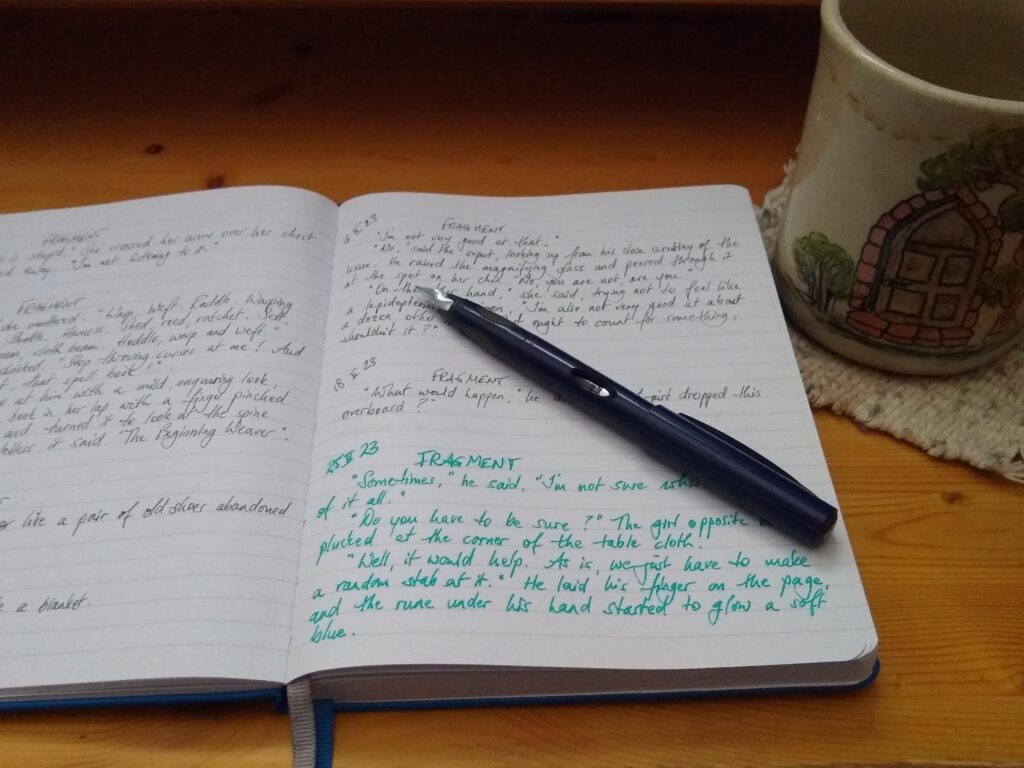
So perhaps, this whole thing of writing a whole, big, fat novel is overwhelming at this point. “I’d like to,” you say, “but right now all that stuff you talked about, with outlining and writing and editing and what-not, that’s just too much.” But this “writing” thing still tugs at you…
Or you’ve gone and self-published that book of yours, the one that you’ve been dreaming of all your life. But by now the euphoria has worn off, and you don’t have another idea for another book. So you pack away your notebook and pen, you unplug your laptop, and you think, “Maybe this was a one-off…”
But hold on!
There’s so much more to being a writer than “just” writing a book.
Don’t get me wrong, writing a novel is fantastic. But it’s a big endeavour, like climbing a mountain. We don’t need to always be climbing mountains; going for a walk around the block is a perfectly valid use for our feet.
So what else could you do to live the Writer’s Life? There is lots you could do, of course, lots and lots. But let me just fish out two points, two that I’ve found valid and valuable:
1.) Small Steps, and
2.) Community.
Small Steps
I’m not going to climb a mountain anytime soon—I’m not terribly athletically inclined. But every so often I go for very short walks on my street. And by “very short” I mean, literally, ten minutes. I set the timer on my phone for five minutes, walk out the door, and when the timer goes off I turn on my heel and walk home again. Ten minutes, but I’ve walked! Outside, in the fresh air! That’s a win.
For me to do anything, it has to start with a ridiculously small step.
And it works for writing, too. Sometimes I set out to write what I call a Fragment, literally just a few lines. I’ve done it by the clock (that ten minute thing again), or by “so many lines”. I’ve set myself projects where for one month I would “do some writing” every day; as long as I put a few “writerly” words on the page, it counts (other than grocery lists, I mean). I don’t do it all the time—I go through phases with it, like with everything else. But when I do do it I enjoy it.
You might wonder what the point of that is—what’s a few lines, what’s a Fragment? You’ll never get a book out of doing that! How is that going to get you closer to your dream?
What it does is it keeps my writing muscles honed. It keeps me thinking of words to describe what I see, in real life or in my head (not infrequently one leads to the other). It keeps me in the writing groove. Most of my Fragments aren’t that spectacular, but sometimes, the little sliver of fiction that comes out of it is amusing enough that I’ve posted it here, under the tag #FridayFragment. It’s a win!
And that brings me to my other point:
Community
I enjoy sharing my #FridayFragments on this blog, because even those little slivers of fiction deserve an audience. And I love it when I get a reaction, when friends let me know they’ve responded to the little vignette I’ve drawn, when I get a (virtual) chuckle out of someone. When I’ve put my work out to my community.
The Writer’s life, like so many other creative pursuits, is a lonely life—I sit here at my computer, tapping away at the keys, all by myself… But really, I’m tied into a Writers’ Community out there. And I highly, highly recommend that. Writers’ groups, conferences, critique partners, local or regional writer’s guilds or federations or whatever they’re called, even writing events like NaNoWriMo—without them, I wouldn’t be where I am as a writer. One of the few silver linings of the Pandemic (ugh!) is that a lot of events went online, and many of them retained at least an online aspect even now. So even if you don’t have any in-person writers’ groups close to where you are, or you can’t easily leave the house, chances are there’s some online event or group you could join and make friends with other writers.
Having a community can be a tremendous boost to your writing. Knowing that my monthly Zoom group will start with a Round Robin where everyone answers the question “How’s your writing month been going?” gives me motivation to actually have “a writing month”, in other words, do at least a bit of writing work of some kind. NaNoWriMo wouldn’t be half as much fun without the community of all those other crazies who try this 50,000-words-in-a-month feat. And knowing that whatever I write, Louise Bates, my editor and critique partner extraordinaire, is waiting for it as eagerly as I am for her latest work, is a gift beyond value.
Oh, and one more thing: what I enjoy so much about some of the groups I’ve been in is that there are so many different types of writers. Fiction, non-fiction, poetry, novels, experienced, brand-new—if you write anything other than grocery lists you’re welcome (and probably even those, if you do them with purpose). So don’t be shy about what “level” you’re at. If you want to write you’re a writer. Go find your tribe.
And then go write that book, or that other book, or that other other book. Or those short stories or poems or essays or fairy tales that you’ve got bubbling up inside you.
We’ll be here cheering you on.
[Cue sonorous voiceover] Previously on “So You Want to Write a Book?”: Part 1, How I got started; Part 2, Other Ways of Writing a Book; Part 3, WRITE THAT THING; Part 4: What next? How I wrote my first book by just starting to write; how to plan a book step by step; how to actually write that book; and how to edit it once it’s finished.

So you finished your book (Congratulations once again!) and you’ve edited it to the best of your abilities into a lovely, shiny manuscript that you’re not ashamed to have seen by other people (even ones who are not your mother). Way to go!
Now you have a number of options:
A) Put it back in the drawer and keep it there forever. (No, don’t! You’ve spent too much effort on it for that.)
B) Shop it around to publishers and/or agents to get it traditionally published. I don’t have much experience with that process myself, so can’t tell you much about it, but there’s plenty of information on it on the interwebs. It’s a very good option indeed, but extremely difficult to be successful at (there are many, many more writers writing manuscripts than publishers are publishing on a yearly basis).
Up until the early 2000s, those two options were pretty much the only ones available (barring so-called “vanity publishers” who said they would “publish your book” for a fee, but really only charged you large sums of money for printing your book with not much other services and left you with boxes full of hardcover copies sitting in your garage). But then the landscape changed. Now, you have a third and very viable option for turning your manuscript into a real book:
C) Self-publish it through an online bookstore.
Again, the internet is stuffed full of very good information about that process; go look it up, there are many people who have far better things to say about it than I do. But I’ll give you a brief overview of what it takes to self-publish your book and get it out there—or at least, how I do it; again, there are other options, and possibly even better ones. Ask Google, he knows.
How to Self-Publish Your Book
1.) Write the best manuscript you can. Spellcheck it. Spellcheck it again. (See Parts 1, 2, and 3 of this series.)
2.) Get it professionally edited. This is optional, but if you want to sell your book to strangers you can’t really do without it. It will cost you money, and probably more than you expect, but it’s worth it.
3.) Write a back cover blurb (a short description of the book that goes on the back of the print copy and on the ebook vendors’ sales page).
4.) Get a book cover. It optional to get it done by a professional graphic artist, but again, if you want to sell, it’s highly recommended. However, there are cheaper options available such as ready-made covers, and Amazon has a free cover creator built into their self-publishing platform. With all of this, you get what you pay for: a professional designer can make your book look good, but a free, cheap, or homemade cover could do the job quite adequately if you just want the book for yourself and your friends.
5.) Make an account with the online self-publishing platform(s) of your choice. KDP (Kindle Direct Publishing) is for Kindle books and print books that are sold on Amazon. Smashwords is for all other ebook formats, and they distribute to other ebook vendors like iBooks, Kobo, Nook etc. (Those are the two I’ve dealt with, and they’re free to upload your book.) IngramSpark also does print-on-demand books (I think there might be a fee involved for setting up, and they’re based in the US, so not that useful for other countries including Canada); Draft2Digital is another ebook publisher that has recently merged with Smashwords. Those are just some options.
6.) Format your manuscript for ebook and print (the self-publishing platforms will tell you how). You’ll need to create a .pdf or .docx for the print version and a .doc or .epub for the ebook.
7.) Upload your manuscript.
8.) Enter all the relevant information the publishing platform asks for (tags, keywords, blurbs, pricing etc.). Again, they’ll tell you how.
9.) Hit “Publish”.
10.) YOU HAVE PUBLISHED A BOOK!!!
And that, technically, concludes our series “So You Want to Write a Book?”—because now, YOU HAVE ACTUALLY WRITTEN A BOOK! That’s fantastic, and I’m immensely proud of you. Next time we meet, let’s trade: I give you one of mine, you give me one of yours. And we’ll sign them for each other, because that’s what authors do!
But, actually, that brings me to one more chapter. Now that you’ve written this book… or actually, maybe you haven’t written the book quite yet, after all. Maybe you’re not quite there yet. Maybe you want to start being a writer, but writing a full-fledged novel isn’t quite in your wheelhouse, or it’s too overwhelming at this point. But you want to be a writer.
So what else could you be doing on the writing front? How can you live the writer’s life?
Stay tuned…
…TO BE CONTINUED…
[Cue sonorous voiceover] Previously on “So You Want to Write a Book?”: Part 1, How I got started; Part 2, Other Ways of Writing a Book; Part 3, WRITE THAT THING. How I wrote my first book by just starting to write; how to plan a book step by step; and how to actually write that book.
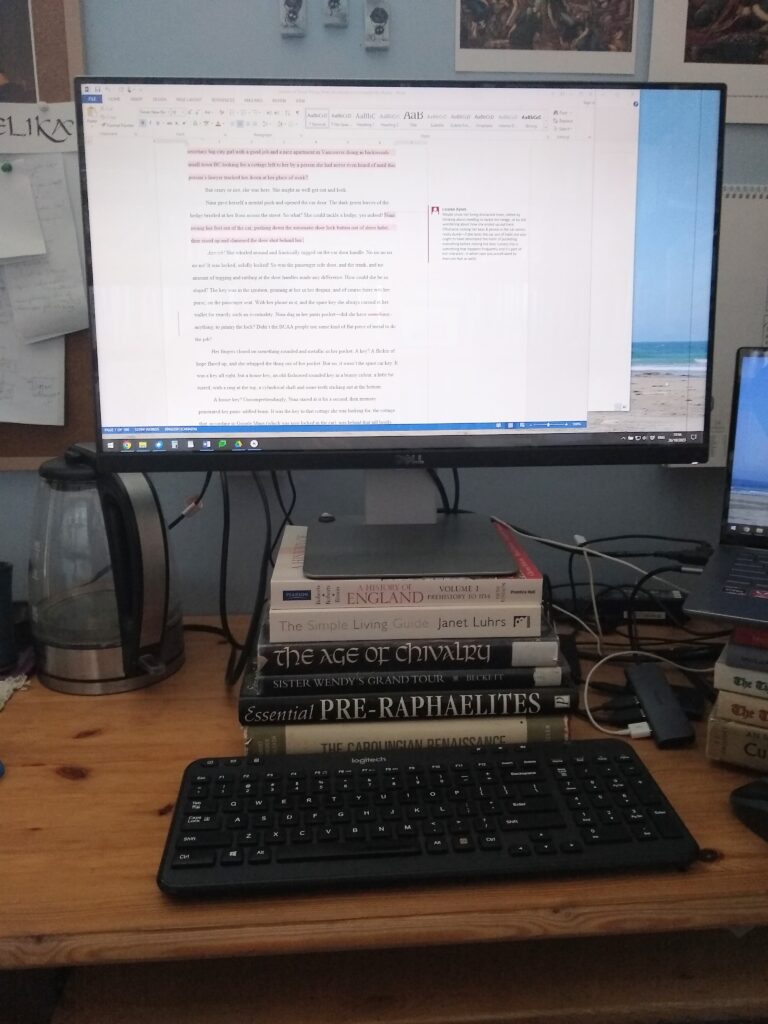
So you’ve gone and finished that book you’ve always been dreaming of. Wow! Hurrah! Congratulations! That is so awesome!
I mean all of what I just said. Having written a novel is a huge achievement, and you should be very proud of yourself. I am! (Proud of you, I mean. Although I’m also proud of myself for having done it, but that’s another point.) So, if nothing else, take some time to celebrate and pat yourself on the back (or on the shoulder, if, like me, you find that easier to reach).
However. (You knew there was a “However” coming, didn’t you?) What you’ve just written, while it is, in fact, a novel, is actually not entirely qualified to be inflicted on the public yet. (And not only because the public are Philistines and wouldn’t appreciate your genius.) What you have in your hands right now is a first draft.
As I said before, if all you wanted is to write that novel for the satisfaction of having written it, feel free to put it in your desk drawer or keep it in a lovely folder on your hard drive, where you can take it out once a year and gloat over it. That’s perfectly all right, and if that’s what you want to do, go for it. But if you would like to take it further, read on.
Wait, let me back up a bit: even if you do want to take your book further, stick it in your desk drawer. For a little while, at least—say, a month or two, if not longer.
You know how I said that when you’re in the thick of writing, you can’t trust your judgement as to the quality of your work? Putting the manuscript aside for a while helps to let the murk of your stirred-up imagination settle out a bit, and you gain some distance from your story. Then, when you come back to it, you can see it with a fresh eye.
So, after a month or four, take your novel back out of the drawer (or computer folder) and re-read it. One of the ways I like to do that is to convert the manuscript to an epub and put it on my ereader. I know writers who print out their story on paper to read it. The point of changing the format like this is to help your brain look at what you’ve written in a different way. You might even be able to make-believe that you’re looking at someone else’s writing, and decide if you like what they wrote.
For this process, let your inner editor back out of its cage; now it can come out to play and be as critical as it likes. You might want to run your manuscript through a spellchecker first, so the inner editor can’t be quite as mean as it would be otherwise. Let it do its job, just don’t let it bully you. Make sure to take note of everything that’s good about your novel—and I’m sure there will be plenty. But between you and your inner editor, you will probably find all kinds of mistakes and weird passages that you know you need to fix up.
So then you sit down and fix ‘em. And that is your second draft. If you’ve written your first draft with pen and paper, the second draft can be the point where you type that writing into the computer. You might find in your re-read that there are whole passages that need changing, or chapters that need rearranging, or scenes that need cutting. Change ‘em. Rearrange ‘em. Cut ‘em.
During this whole process, make sure you back up your stuff—save copies of what you’ve done. Each time you have a major version change, save it with a different file name, so you have backups of the various iterations.
Somewhere in there, after your second or third or fourth draft, you might be ready to show your writing to someone else. Find some beta readers (first readers)—trusted people who can read your story and give you an honest opinion on it. You’ll want someone who doesn’t just pat you on the back (if they can reach it), although that’s great too, but who will point out places where the story can be improved, without tearing it (and you) to pieces.
When you get feedback from your beta readers, you go back to your manuscript, and you implement the changes that have been suggested—or not. That’s the thing: you don’t have to accept people’s opinions on your story. It’s your story, you make the final decisions. Sometimes other people just don’t get what you’re trying to do, and it’s perfectly okay to say “Thanks, but no thanks!” to someone’s comment.
I’ve found, as a rule, that if one person comments on something needing to change, you acknowledge it and move on. If two people comment on the same issue, you sit up and take notice. If it’s three, it’s got to go. And I count myself as one of those people: not infrequently, I find places in my manuscript where I wonder if I need to change something, and then a beta reader comments on that very thing—so that’s two! It’s encouraging when that happens, because it means my own instincts about my writing are good, and I’ll change things accordingly.
So, now you’ve edited your novel again, incorporating the feedback from your beta readers and anything that you’ve seen yourself needs changing. That’s your third draft. Or maybe the fourth or fifth. You get the idea: edit, rinse, repeat.
Finally you’re satisfied that the novel is as good as you can possibly make it. Now you have a number of options, about which I’ll tell you when this is…
…TO BE CONTINUED…
[Cue sonorous voiceover] Previously on “So You Want to Write a Book?”: Part 1, How I got started; and Part 2, Other Ways of Writing a Book: How to write a book by just sitting down and writing it, or, conversely, how to plan, plot, and plunge deeply into the story before you begin writing, a five (or more) step process. Spoiler alert: Both methods work.

If you’ve skipped ahead to this part because you couldn’t wait to find out how to actually write that book, here’s a quick recap of Parts 1 and 2:
You can write a book by just sitting down and writing it with no previous planning.
Or you can do some plotting first, in as little or as much detail as you like. Here are five steps to doing so:
Step 1: Ideas
Step 2: The Overview
Step 3: The Rough Outline
Step 4: The Full Outline
Step 5: WRITE THE THING
This is where we are now, at Step 5. This is where you actually articulate the story. Where you tell what happens, describe the setting, make the characters talk. (Incidentally, if you’re pantsing your story, you’re starting the process here, without any of the previous steps. It works. So does plotting. If anyone ever tries to tell you that there is only one way of writing a book—their way—they don’t know what they’re talking about. Stop listening to them, and go and cast them as the villain in your next story.)
Incidentally, I’ve talked about all this with regards to story, i.e. fiction writing, but writing a non-fiction book is pretty much the same process: decide what it’s about, make an outline of what’s in it, then write it.
So, here we go! Take out your official fancy leather-covered storywriting notebook and your fountain pen (if you’re Neil Gaiman), or boot up your computer and start a new document in your favourite word processing or writing software.
And then start writing.
Where in your story should you start? Begin at the very beginning and go on to the end? You could—and personally, that’s my own preference; I’ve never done it any other way. But I know of plenty of people, some of them bestselling writers and Creative Writing profs, who jump around in the story. They write their favourite scenes first, the ones they see in their heads most vividly, which might be Chapters 3, 4, 15 and 27 in the final product, and then go back and fill in the gaps. It works too—so do whatever floats your boat.
The way I like to use my notes and outlines from Steps 1-4 is that I refer back to them: “I’m in Chapter 5,” I’ll say, “and here’s what my notes say needs to happen.” Then I make it happen on the page. I’ve done that with anything from a one-sentence description (“X meets Y”) to an outline that’s so detailed, it had every line of dialogue already written out like a stage play, and all I had to fill in was the speech tags and descriptions.
And so you write, and write, and write. Maybe you find yourself going back to Steps 3 or 4 or 5 or 7, adding more details to or refining your outline, before you go back to the text—that’s totally fine, this process is not linear.
This part of writing is the fun part, but also, the “hard work” part. It’s where the real craft of writing comes into play: drawing images with words, conveying your thoughts to the future reader so they can see what you’ve seen in your head and can think as you have thought. Show, don’t tell; write with sensory detail; get into your characters’ heads—all those great pieces of advice that any good book or class or YouTube video on “How to Write” will teach you. (Go look them up, there’s millions of them.)
Oh, one more thing: Spelling and grammar don’t matter at this point. Let me repeat that: SPELLING AND GRAMMAR DON’T MATTER AT THIS POINT. Do NOT keep going back to “fix” your “mistakes”. All that you’ll achieve with that is to break your momentum. Don’t do it.
In fact, do not go back to “fix” anything on this story right now. Editing is for later. Right now, you need to write. Just write. Get those words down. Lock up your inner editor (another NaNoWriMo phrase), turn off the automatic spell checker, and keep writing. If you can’t stand looking at what you wrote yesterday because it’s so bad and you just must fix it, then don’t look at it. I’m serious. At this stage of the game, what matters is getting the story down on paper (or screen).
And once you have it on paper, keep it there—don’t throw away or delete anything you’ve written until the story is finished. If, by any chance, you find there’s something you really can’t live with that absolutely drives you crazy—say, you’ve written something in Chapter 3 that flatly contradicts what you’re about to say in Chapter 10—then hide it from yourself for the time being. In a notebook, you could paperclip or tape together the pages with the offending passage; on a computer, highlight the section and change the font colour to white (if you’re writing on a white background). Voilà, you no longer need to look at it.
The point of this somewhat silly exercise is that when you’re in the depth of a story, your judgement is less than reliable. In fact, it’s possible that it’s completely out of whack. I’ve had times when I’ve sat at my keyboard, typing away to finish the story, all the while saying to myself “This is awful this is terrible this is horrible this sucks so bad,” but continuing because I needed to get the words down. And then later, I re-read it and discovered that the passage wasn’t nearly as awful as I thought and I could use quite a bit of it. I’ve also had the reverse happen: I wrote passages that I thought at that moment were brilliant, and later I found they, well, weren’t.
So, don’t trust your judgement in the midst of writing, and keep everything you write until you’re done. If on re-reading you find that your writing is, in fact, just that awful and completely unusable, you can always throw it away then.
So, you write and write and write and write. And then you do it again. And then, to vary it up a bit, you write. And write some more.
And then finally, one day … you’re done!
You have written a book! Hurrah!! Congratulations!!
You could leave it at that, and I know quite a few people who do just that. They’re happy they’ve written a novel, and are content to let it sit on their hard drive or in their desk drawer forever. That’s totally fine.
But you don’t have to stop there, not if you want to actually get your book to a point where you can share it with others or even hold a printed copy in your hands. So what happens next? This and a few other tips on how to facilitate this whole “Writing” thing shall be found next time when this post is…
…TO BE CONTINUED…