SO YOU WANT TO WRITE A BOOK? Part 2: How to Plan a Book

[Cue sonorous voiceover] Previously on “So You Want to Write a Book?”: Part 1, How I got started. Detailing in great, umm, detail, how a particular writer went from “I’m not ever going to be ‘a novelist’!” to being, well, just that. And how said writer wrote their first novel by sitting down and starting to type on a chilly November day in 2011.

Part 2: Other Ways of Writing a Book – How to Plan a Book

So, as I said last time, I didn’t even set out to “write a book”, because I didn’t know I could. But I could sit down and start typing, and tell myself a story I liked.

That’s one way of writing a book: sit down and start writing.

However, that’s not the only way. There are other options, possibly even better ones. And the rest of this post is going to be dedicated to telling you about one or maybe two others.

The option outlined above, the just-sit-down-and-start-typing one, in the NaNoWriMo community is knows as “pantsing”: writing by the seat of your pants. The other option is its exact opposite, and it’s called “plotting”.

It’s pretty much what it sounds like: planning your book before you start. Like a wily housebreaker plotting their crime, you plan how your book is going to unfold.

Hah, that’s an easy thing to say in one sentence. Doing it is a whole other matter. There are so many different ways of approaching this, people get whole MFAs and PhDs in this stuff, and there’s been reams and reams of books written about it. So, this is just to let you know that what I’m going to tell you next barely scratches the surface of this topic, and that if you enjoy learning about this, hurrah! You have a lifetime of fun ahead of you. (Just, for example, go to YouTube, type in “Outlining a novel”, and I’ll see you back here in about three months.)

And, another point: pantsing and plotting are not an either/or, they’re more of a continuum (yes, NaNoWriMo has a term for a point in the middle, too: “plantsing”). You can plot anywhere from just a little bit down to the tiniest detail. It’s all valid and it all works.

So, how to start?

Quite simply: a book has to be about something. You need someone who is somewhere doing something, and that something has to have a beginning, a middle and an end.

That sounds utterly obvious—but actually, I’ve just given you six different ways to start on your story.
Say what?
Let’s break it down:
Someone: the main character or characters (Who).
Somewhere: the setting, i.e. place and time (Where/When).
Something: the plot or events (What)
Beginning: how it all starts
Middle: what’s going on
End: how it finishes up

Any of those six points is a place to start your story. Maybe you know who your character is (Frodo Baggins, a hobbit). Maybe you know where and when it takes place (Middle Earth, the Third Age). Maybe you know what happens (there’s an evil magic ring that needs to be destroyed). Or maybe you have a beginning (“Netherfield Park is let at last!”). Maybe you have the middle (a botched proposal scene). Maybe you have the end (a wedding).

So, I suggest you get yourself something to write—pen and paper or a notebook, a laptop with word processing software, whatever. This is only the preliminary tool, not the one you’ll be writing your book in, so I’d recommend a paper notebook—much quicker to boot up than a computer.

Here are the steps to writing your novel:

Step 1: Ideas. Start making notes. Just jot down whatever comes into your head. Do you have a person in mind? An event? A setting? A scene, a few sentences of dialogue, an image… (C.S. Lewis started The Lion, the Witch and the Wardrobe from a picture of a faun with an umbrella standing under a lantern in a snowy woods.)
Write down anything and everything to do with your story that you think of. Even if it’s silly. Especially if it’s silly. Write it down even if it contradicts what you just wrote down before. Make lists of what you could possibly write about. Or if you already know where you want to go with the story, write that down too. Write down whatever you know about the characters, or the setting, or the plot. If you’ve got a big system of elvish lore and language knocking around in your head, write it down. If you know that your main character has a mole on their left shoulder blade, write it down.

Step 2: The Overview—fill in the first three points. By which I mean, decide on the Who, Where/When, and a single sentence of the What. If in Step 1 you’ve decided on a character, now find them a place & time to be in and something to do. If your starting point was a plot event, find the people who act it out and the place they do it in. If your starting point is the setting, find characters and a plot.

Step 3: The Rough Outline. In other words, the next three points: What’s the beginning, middle and end of the plot? What happens first that starts the story, what’s the central problem and how do the characters tackle it, and what’s the solution?

Step 4 (and possibly 5, 6, 7, and 8): The Full Outline—refine the rough outline (and refine it more, and more, if you want). This is where you decide section by section, and/or chapter by chapter, or even scene by scene (your choice), what happens.

Step 5 (or whatever comes next): WRITE THE THING. This is where you actually articulate the story. Where you tell what happens, describe the setting, make the characters talk.
But there is too much to be said about that than fits into this post.

…TO BE CONTINUED…
SO YOU WANT TO WRITE A BOOK? Part 1: How I Got Started

Note: When I started this series I thought it would be one post, maybe two. It turned into six. So I’ll be posting one of these every day this week.

Part 1: How I Got Started

A friend and I were talking the other day about things one could do with one’s life.
“Is there anything you really want to do?” I asked her. “Something you’ve always dreamt of?”
She didn’t even pause to think.
“Write a book!” she said.
Well, you know what my reaction to that was bound to be.
“Do it!” I shot back at her.
“But,” she said, “where would I start?”

I think there’s a lot of a people who have that dream in their life: “One day, I want to write a book.” Oddly enough, I was never one of them. Not because I didn’t always love books, but because it never occurred to me that someone like me could write one. To write a book you have to be really special, don’t you? You have to have some inner drive that makes you pick up the pen, that forces you to write or you’ll burst. You have to have the talent that just, I don’t know, crystallizes into a story. Writers are born, not made…

Or so I thought. But then I switched schools during my undergrad, and my new university had Creative Writing classes. Well, why not? I figured it couldn’t hurt to try. And it didn’t. I did well and had fun, and found that I’m not a bad writer. In Creative Nonfiction class, in particular, I found my voice, and not long after that I started a blog. However, the class that was aimed at teaching us to write novels left me with the conclusion that I was never going to be “a novelist”—I didn’t have what it takes. I didn’t have the stamina to complete that long a manuscript; I’d lose interest by Chapter 4. But more to the point, I didn’t have anything to say; the stories I had in my head were too boring, too silly; nobody would want to read them. Real writers write literary fiction. (Just to be clear, this wasn’t a prof telling me these things; I discovered them all on my own. Because I’m smart that way.)

I got my BA in spring of 2011. The previous year, I had heard about this NaNoWriMo thing—National Novel Writing Month: crazy people who sign up to write a 50,000 word novel in the month of November. I already knew that I wasn’t a novelist, but I had some time on my hands, and once again I thought, Why not? All you have to do to win the challenge is write 50,000 words in 30 days. Nobody said anything about it being good words, let alone quality writing anyone would want to read. Maybe I could do that. It might be fun.
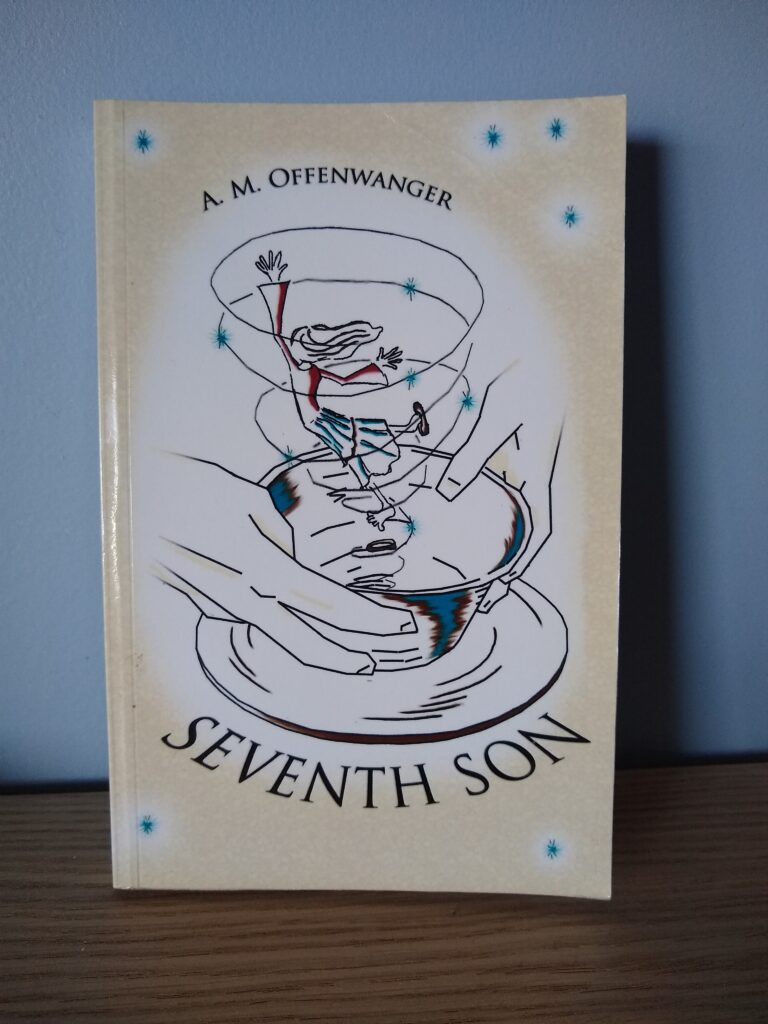
So I signed up. “Write 50,000 words, and have fun”—that’s all I aimed for, that first NaNo I participated in. I started with only a vague idea where I was going. “It was the blue bowl that started it all…,” I typed on November 1st.

And I kept typing, and typing. Telling myself a story I enjoyed, about a young woman who gets sucked off into another world and how she copes. Typing and typing. There’s a cute baby in it, and descriptions of cooking in an open fireplace, and a potter who makes pots on a kickwheel, and a bit of gentle magic. Typing and typing.

By November 30th, I had 50,000 words. I’d had fun. And, to my surprise, I had a novel. I went back and read it from the beginning, and, what do you know? I enjoyed it. As a novel. And then, wonder of wonders, I handed it to a couple of other people (notably among them Lee Strauss, who had just published her own first novel), and they enjoyed it too!

I had written a novel. A real, honest-to-goodness novel.

But this story isn’t quite done yet. That particular year, Createspace, which was Amazon’s print-on-demand arm, offered NaNoWriMo winners a coupon for five free print copies of their novel, which you had to redeem by the end of June. So I got my rear in gear, proofread this unexpected novel manuscript (then proofread it again), got help with making a cover from one of the Offspring who knows their way around Photoshop and has a knack for graphic design, and less than a year from that November 1st, I had in my hands five printed copies of a book that I had had no idea I’d be able to write.

I had written a book.

It didn’t stop there. The next November, I went back and wrote the sequel to Seventh Son. It was much harder that time, because not only was I in grad school by then, but I was invested: I had this novel planned and plotted out; it had to be a novel, and it had to be good—as good as the first one. I couldn’t just waffle on as I had the first time, this time it mattered. But I struggled on, and again I finished; that novel was Cat and Mouse.

The year after that, I’d learned my lesson (namely that trying to do grad school and writing “a real novel” is a little bit insane, or rather more so than NaNoWriMo is already), so when November rolled around I decided to write something simple that didn’t matter so much—I grabbed one of my favourite Grimm’s fairy tales, “Puss in Boots”, and retold it to the tune of 50,000 words. And again, I got a novel. That one became Martin Millerson, or: Something With Cats (because it has a whole bunch of extra cats in it, not just the booted one).

I kept doing NaNoWriMo, and wrote Checkmate, and Star Bright, and then a number of other novels that will see the light of publication eventually (I hope). Yes, novels. I’ve written novels, plural. I didn’t always “win” NaNoWriMo, and didn’t even do it every year since, but I call myself a novelist now.

Why am I telling you all this?

It’s because of my friend’s question: “Where do you start?”

This is the story of how I started. I didn’t even set out to “write a book”, because I didn’t know I could. But I could sit down and start typing, and tell myself a story I liked. And after a certain number of days of doing it, and then doing it again, and again, and again, I had a book.

That’s one way of writing a book: sit down and start writing.

However, that’s not the only way. I would say that’s not even the best way. There are other options…

…TO BE CONTINUED…

PS: NaNoWriMo 2023 starts this week – you still have time to sign up!

#FridayFragment: 27.10.2023

It glittered. The corner of the basement glittered. Naila was sure of it this time. She shook her phone to turn on the flashlight and shone it into the corner. The glitter vanished. She turned the light off, and there it was again, glittering like a million tiny, faint stars gathered in the corner of her basement behind the canning shelves.

Open Mic

I almost didn’t go to that Writers’ Social. I was tired, and it was quite a long drive into town. But I knew I’d enjoy it – hanging out with other writers is always a boost – and so I made myself go.

Should I do the Open Mic?, I wondered as I was driving down the highway through the twilight (I hate driving in twilight, it’s so confusing). I hadn’t prepared for it at all, just had a story in mind that I thought might work – it’s short enough.

And then a line popped into my head, I don’t remember where I heard it or who said it: “Never pass up the opportunity to read from your work.”

Okay then, I thought. What have I got to lose? So when I got there, I asked if there were any Open Mic spots left. I wasn’t really sure whether I wanted to read, I said, so just put me on the “maybe” list.

There were two others ahead of me – two lovely young Creative Writing students from the uni – and as it turned out, nobody else signed up. I was up!

And so I did my first reading at an Open Mic, at a Writer’s Gathering, among six other amazing writers. I pulled up the story on my phone, on Fairytale Magazine‘s old website, and read “Hitting the Wall” – the story of what happens when you stake everything on one particular version of a fairy tale.

It was fun! I really enjoyed reading, and I think the audience enjoyed it too. I even got a laugh or two. And even though my lighthearted, fun little story was rather different from all the serious work that came before and after, I felt okay about that. I’m unapologetic about writing fairy tales – they have things to say.

So there we are: one more new experience, another step in my journey of Telling Stories in Clay and Words.

Life, the Universe, and a Reading at an Open Mic. I’m so glad I got this chance.

I even had an author photo taken! Don’t I look literary?

(Photo credits Darlene Mulligan. Thank you, Darlene!)

It’s a Newsletter!

I’ve finally taken the plunge and set up a newsletter, to keep my faithful followers updated with some semblance of regularity (no more than once every month or two) on what’s going on in the Clay and Words studio and study.

If you’re interested in being among the first to find out when there’s a new book coming out or an art show in the offing, or you’d like to be introduced to my writing and my ceramics one piece at a time, go over here (the “Newsletter” tab in the menu) and leave me your email address.

There’ll be an unsubscribe link at the bottom of every mail so you can bail out again; I promise I won’t take it amiss!

(Just to clarify, the blog has two places where you can leave your email address: one is in the sidebar of every page and is for subscribing to blog posts, the other under the “Newsletter” tab at the top. The newsletter will only be sent out by email, you can’t read it on the web. So if you’re interested, please subscribe!)

Life, the Universe, and a Newsletter. See you on the mailing list?

Happy Bloggiversary to us!

I just saw that today is our ninth bloggiversary on WordPress. After four years of blogging on Blogger, Steve and I moved house and came over to WordPress, in anticipation of publishing Seventh Son, which happened on Oct. 18th, 2014.

Steve posing on my library books. Yes, he’s still around, even if he hasn’t said much lately (to me at least).

So, Happy Bloggiversary to us! If you feel like wasting, umm, I mean spending some time on browsing the Archives, there’s a handy button on the right entitled, fittingly, “Archives” (if you’re getting this per email, you’ll need to click on the title to go to the post in your browser to see it). Or you could type a keyword into the “Search” bar and see what there is to see on the topic – for example, “Steve”. You could find all about him; he’s a bear with history.

In other news, our main website just underwent a major overhaul; check it out at www.amoffenwanger.com (or www.clayandwords.com, that should get you to the same page).

And that, to keep it short and pithy, is Life, the Universe, and a Bloggiversary. More to come soon!

ArtWalk, a Retrospective

I know you’ve all been eagerly waiting for the verdict, and here it is: ArtWalk was fantastic. (If you can’t see a video above this paragraph because you’re getting this as an email, click on the title and it’ll take you to the post in your browser, where it should show the video properly.)

Just to catch you up on what this Lake Country ArtWalk thing is, it’s a giant art festival that has been held in our community on the second weekend in September for the last thirty years. Two days, three school gyms/halls/hallways full of art by close to two hundred local artists, live music, food, performances, visitors by the thousands. Complete sensory overload, inspiration, exhileration.

I had the best location – full sunlight on my sculptures for most of the morning.

So this year I finally got to take part, showing my ceramics. And sell my books! Book selling isn’t normally part of this, but this year there was an exception, because the theme was “Art and Story Bound Together“. I mean, that’s me! As I was telling everyone, I write books with potters in them, and make pottery sculptures with books in them. “Telling Stories in Clay and Words”, that’s my new motto.

Books about a potter…

I sold pieces! A friend who is an ArtWalk veteran told me to bring some small pieces, things that don’t cost the earth so visitors can go home with their very own piece of art without breaking the bank. So I took a whole lot of mugs – well, they’re honest-to-goodness stoneware mugs you can drink your coffee out of, but really, they’re paintings that happen to be on a mug instead of a canvas. And people liked them, and bought them!

Doors and towers (mostly SOLD, but there’s more where they came from)

Selling things was exciting. But the best part was the reactions I got from the show visitors. Over and over, someone would come around the corner, catch sight of my display, stop, come closer – and get a big smile on their face.

“This is so cute!”, “These are delightful!” “I want to live in that little house!” Several times, someone came back, towing a friend behind them: “You’ve got to see this! Look, isn’t it amazing?”

I can’t tell you how much that meant to me. My art makes people happy. It creates pleasure and delight; it brings joy.

That is what I wanted to achieve with my work. I have a lot of fun making my bookends and fairy houses and gnomes, but it was amazing to see how that joy transmitted itself to the viewers.

What I saw coming back from my lunch…

One of the things I had the most fun with at the show was introducing the gnomes to the kids that came by. Art shows can be rather overwhelming, and for children, maybe a bit boring.

So a family with young kids would wander by. One of them would catch sight of my booth.

“Oh, look! Look at the fairy house!” And they would zoom in on my table, their eyes lighting up. “It’s got a little bathtub! And look at the tiny mugs!”

I’d let them look for a minute, then I’d say, “Have you met the gnomes?” They’d shake their heads, and I’d point to the gnomes at the front of the long table, right at their eye level.

Gordon G’nome, 6″, stoneware

“Well, here’s Gordon,” I’d say. “His bug went to sleep, so he’s just hanging out. This one is Goldie. She just caught sight of a butterfly! Her bug isn’t so sure about this, I think he’s a bit jealous…”

The kids loved it. Over the course of the two days, the stories of Gordon and Goldie and Garth and Gabby kept growing in the telling. Goldie’s butterfly appeared fairly early – at first I didn’t know what she was looking at, but now it’s obviously a butterfly.

Gaeli’s G’nomes, and the bookends holding up my books

One young visitor wanted to know who lives in the little bookend rooms, and then she decided that it must be the gnomes, because they stood right in front of them. She was right, of course. So that became part of their stories.

Goldie, we thought, must belong to the room with the knitting – she looks like the kind of person who likes to keep busy. And Gordon obviously likes food, so he’d be at home in the tea party room. Garth the Dreamer got the library with all the books, and his sister Gabby, who is telling her bug a story, belongs in the writer’s study.

What, me, having fun? Naaah…

I knew I wouldn’t get any sales out of the kids. But that’s not what it’s about. I wanted the kids to have fun looking at my sculptures, as much fun as I had making them. And not just the kids, either.

For those thirty seconds that you look at one of my pieces, I want you to be drawn in. I want you to feel that you can live in one of the fairy houses, that the little bookend room is your own cozy corner, that Gordon and Goldie are your friends. I want you to come into my little ceramic world and be happy, safe, and warm.

And I saw that reaction on the faces of the ArtWalk visitors that came by my booth, over and over. See what I mean when I say ArtWalk was fantastic?

Life, the Universe, and ArtWalk 2023. I’m already planning for the next show.

Bathtime at G’nome Cottage, 9″ high. It’s all ceramics, i.e. safe to put in your flowerbed. You never know, someone might move in…