Camp NaNoWriMo

Camp-Participant-2015-Web-BannerCamp NaNoWriMo is upon us again! In case you don’t know, Camp Nano is the “light” version of November’s NaNoWriMo, world’s greatest yearly online writing event. During November, crazy writers all over the globe pledge themselves to writing a 50,000 word novel in one month, from Nov. 1st to 30th. If you’re not up for that level of insanity, or, conversely, if you’ve done NaNoWriMo and it has you gasping for more but you can’t stand the wait until November, there are a couple of easier events happening in April and July.

During Camp Nano, you can pick your own style of project. It can be anything from 10,000 to 100,000 words long, and, unlike the November Nano, can be fiction, non-fiction, novels, short stories, memoirs, poetry, or what-have-you – actually, it doesn’t even have to be a complete “writing” project; it can be editing or continuing a previous piece of work.

During the last couple of years, I’ve used Camp Nano to provide me with the motivation to finish grad school papers. But this April, being fresh out of grad school deadlines staring me in the face, I really got into the spirit of things. The great Kate M. Colby started a “cabin” (small message board with about a dozen participants) and invited other writers to join; so I jumped in – and we had some awesome pillow fights, mutual-support session, and marshmallow roasts, and wrote a whole bunch of words together. And in the process, I made some new writerly friends*, which is really what NaNoWriMo is all about.

But this time, Kate is kind of busy, so we decided that it’s my turn to start the cabin. So the cabin is created, I’ve claimed my bunk, and I’m waiting for my friends to sign up. If you want to participate, go to campnanowrimo.org, make a profile (or pull up your old one if you’ve already got one); create a project (that’s important; the site won’t let me invite you unless you’ve got a project); and then either send me a mail through my contact form or leave a comment below with your Nano username, and I’ll send you an invite so you can join (space is limited!). You can also find me on the site under amo1967.

Incidentally, I’m not writing a full-blown 50K novel this July – I’ve got too much other summerish stuff on the go. So if you’re scared of the “No” in NaNoWriMo (NAtional NOvel WRIting MOnth), don’t be. You can join our cabin and just be wimpy with me – write a couple of short stories, do some editing, stuff like that. It’ll be fun, I promise!

Life, the Universe, and Camp NaNoWriMo. I’ll share my marshmallows.

*for example, Kara Jorgensen, Zach Chopchinski, and Whitney of Wit & Travesty. And my great friend E. L. Bates was there too!

Allergic to E

Scrabble_letter_ESo I’ve been nominated twice for this challenge – thanks so much, Kate M. Colby and Zach Chopchinski. But seeing as I was a little busy graduating last week when they posted this, I didn’t get around to it then. But I guess I better buckle down and meet this challenge now.
The idea is to write a paragraph, in the English language, without using the letter e. So it can’t be about Extraordinarily Exciteable Elephants, absolutely none; or Effusive Elves, either.

I’m not very good at treating words like nothing but permutations of letter patterns – for me, language is about nuance of meaning and, to a lesser degree, sound. I’m lousy at Scrabble or crossword puzzles. So this wasn’t easy. But I did it anyway, just because.
Here goes (or, in the spirit of the challenge, That’s It):

This is a paragraph construction without that most common form, that fifth mark of all marks which construct words, among d and f. Sadly, it is too difficult to say anything of sanity without calling on its aid, so I shall quit trying. Good luck to all who want to sail into this trial.

One of the rules of the challenge is to pass it on to five other bloggers, but, actually, I feel rebellious. I can’t think of five others I’d want to inflict this on. So if you’re a blogger, and you feel like trying this, go for it – you can even say I nominated you if you want. You’re welcome. (And if you’re not a bloggy person but are itching to try this, leave an e-less paragraph in the comments. Come on, you know you want to!)

Life, the Universe, and the Letter E. Exceptionally excellent effusions.

Magistra Artium, or: I’ve Mastered the Arts

3607So this past Thursday, I finally got to walk across the stage of my university in a hood and gown to have my hand shaken by my prof, and I now get to call myself an MA.

Actually, technically I’ve been able to call myself that ever since last September, when I got the parchment – that folder they handed me on stage was just a prop; it had a piece of paper inside that said, in effect, “Congratulations; this is a piece of paper which we would like you to give back to us afterwards.”

But for some reason, having done the hood and gown and pomp and ceremony makes a difference. Getting the parchment in the mail was nice, but there wasn’t much to it – I didn’t particularly feel any more graduated that day than the day before. But attending convocation, striding into the auditorium to the rousing heartbeat of the First Nations drum, sitting on the stage under the glare of the spotlights and watching graduate after graduate going across the stage, then taking my own turn and looking into the sea of darkness that was the audience, knowing my family was out there somewhere (and though I didn’t know it, some were even watching the livestream from more than a 1000 km away); receiving that black folder, shaking the hands of several official people in fancy chairs of whose identity I was rather clueless (I believe one was the university president), and then walking in the procession back out of the auditorium, through the double line of our professors in their gowns cheering and applauding our achievement – I really did feel different then. I still do.

3595
The prof and I big on the screen on the right, and small and blurry on the left on the stage

No, being a Master of Arts doesn’t mean I’m any different than I was last Wednesday, or last August, for that matter. But all the lovely ritual brought it home to me that I really did finish that degree, that it is a big deal to have put in all those years of work – seventeen, to be precise, for the equivalent of five years’ full-time study, during which I also birthed, raised, homeschooled and graduated several of my children.

I don’t mean to brag – although, actually, yes, I do mean to brag. I think we don’t brag nearly enough about the right kinds of things, sometimes. I know I’m very prone to getting down on myself, to not acknowledging to myself what I have, in fact, accomplished. And what that does is raise the bar for everyone else. If all we’re doing is looking at our failures, it’s very easy to get the impression that nothing we have done matters, that success is an elusive thing. But it’s not. It’s totally possible.

And that was the key phrase in the hugely inspiring speech my awesome friend Desi (whom I finally got to meet face-to-face after three years of online friendship) gave to all of us graduates: There is no “impossible”.

That’s why I dare to brag about this, to show off my hood and gown: to let you know that it can be done. I got my whole degree by distance education – last Thursday was the first time I ever set foot in my university and met some of my professors and classmates face-to-face. It was exhilarating. One of the students who was graduating that day was a frail white-haired woman who needed a supporting arm to lean on to make it across the stage. She had begun her studies in 1979 – that’s right, nineteen-hundred-seventy-nine – and last Thursday, she got her Bachelor of Arts degree. As she turned to be helped back to her seat, a man’s voice in the auditorium yelled out, “WAY TO GO, MOM!!”

Yes, I cried. In fact, I’m doing it again as I write this. There is no “impossible”.

Life, the Universe, and at long last, a Master of Arts. It can be done.

3614
They don’t call it a hood for nothing

PS: In case you’re wondering, my uni is Athabasca University, the Canadian Open University (which isn’t just for Canadians, either). I’m not sure what the equivalent US institution is (I’ve heard something about the University of Phoenix?), but I’m sure there is one; and in Germany, there is the FernUniversität Hagen. Where there’s a will there’s a university. Oh, and here you can click through to my final Master’s project (the link goes to quill and qwerty, the blog that I kept for documenting my research).

Write What You Know

I just read a quite interesting guest post on Kate M. Colby’s blog, by one Fia Essen. The topic of the post is “Write What You Know”. Essen talks about how her own experiences have inspired her to write about women quite like herself, in similar life circumstances, and how it made for good books (I haven’t read her books, so I’ll take her word for it; but the excerpt posted on Amazon looks not bad).

It’s a good post, and a good piece of advice – one that I have followed in my own writing. Seventh Son is, as you know, about a woman named Cat who looks into a blue pottery bowl and gets whirled off into a magical medieval world. And that, of course, is what… umm… happens to me on an… uh… regular basis? Right. Maybe that piece of advice does break down when you’re dealing with Fantasy. I’m quite sure Tolkien was not intimately acquainted with hobbits, and his personal experience with battling orcs was probably somewhat limited, too.

However, there’s still a lot of truth to this, even if you’re writing about magical faraway places. Because people are always people, and in order for readers to get into your story, your people have to be believable people. So Cat is, magical dimension-travel aside, pretty much me. Or at least she was in the first book. Seventh Son started from this basic premise: if I was suddenly thrown into another world (à la the Pevensie kids in The Lion, the Witch and the Wardrobe), how would I react? I’d freak out, that’s how. So that’s what Cat does. She has a fit. And then she tries to cope with the situation in the best way she knows how – by trying to be rational about it, and calling up all the bits and pieces of information she’s garnered in the course of her career as librarian and avid reader.

IMG_20150607_132347But there’s even more of me that’s in that book than Cat’s personality and voice. I gave Guy, the potter, my own pottery wheel, and my own pottery technique, the one I learned at the local art centre almost ten years ago. See, that’s it in the picture. My man built it for me for my birthday the year I finally learned to throw pots on the wheel (one item scratched off the bucket list). Guy, being a professional, has a metal wheelhead with concentric grooves cut into it – for my amateurish throwing a wooden one does the job. Also, he doesn’t have plastic ice cream buckets sitting on the bench for his water and clay slurry, of course; his are old pots or maybe tin buckets. But other than that, this is it. If you go to Chapter 14 in Seventh Son, you get the exact description of how to make pottery on a kick wheel like this one.

In Cat and Mouse, Cat learns to make sourdough bread, and ink made from black walnut husks. And yes, I’ve done both of those things; they work. You can pretty much follow the instructions in the book to get bread and/or ink. Also, most of the technologies, recipes and remedies in my stories are ones that could have been used in the European Middle Ages. The climate and landscape of Isachang, the land I tossed Cat into, is more or less Central Europe – because that’s the place I’m familiar with. So yes, I write what I know.

IMG_20150607_132735
Not THE bowl – but one that came off my pottery wheel. And it IS blue.

I do make up the occasional fact, or plant, for that matter – for example, the spikeberry bush which is important in Cat and Mouse is my own invention. It kind of appeared in the pages of Seventh Son early on, just because I needed something to fill out the visuals of the scene when Cat arrives in the Wald of Ruph, and then it came in handy when I needed a plant that would have a particular medicinal effect for the climax of Cat and Mouse. But for the most part, everything in my stories is real, even for this world.

So, “Write What You Know” still holds true even for places and times far removed from  your own. Tolkien may not have been personally acquainted with any hobbits, but there is a great deal of him in the hobbits, from their love of a pipe smoking to their appreciation of creature comforts (no one who wasn’t a lover of good food could have written the Hobbiton parties like he did), not to mention how Bilbo feels about foolish and unnecessary adventuring to start with.

Life, the Universe, and Writing What You Know. One of these days Cat is going to make soap.

What I Did On My Holidays, or: A Visit to Storybrooke

On my holidays, I went to Storybrooke. Yes, the Once Upon a Time town. No, really!
As I mentioned before, I just spent a couple of weeks with family, and we went to the big city (aka Vancouver). And while we were there, I got a chance to go to Storybrooke. Yes, I know they tell you it’s in Maine, but actually, it’s in BC (the geographic location, British Columbia, not the time period, Before Christ). See?

Storybrooke (1)On the map, it’s actually called Steveston (which, contrary to the opinion of a certain family member, is not named after a small stuffed bear). Steveston is a really cute fishing village on the outskirts of Greater Vancouver, with a nifty harbour and an old cannery just down the street from the relevant places.

So, here I am in front of Mr. Gold’s pawn shop:
Storybrooke (2)And it really is proof that I was there myself – if I had photoshopped myself into the picture, I wouldn’t have chosen such a hideously unflattering shot of me. But because I like you, and need to show you that I was, indeed, there in the flesh, I’m letting you see this photo of me (take note of the Cinderella’s Coach pin on my shirt – I was even dressed appropriately).

This, I think, is Granny’s Diner.
Storybrooke (4)There wasn’t a single werewolf in sight, though, nor indeed any Evil Queens, Princes (Charming or otherwise), Princesses, Pirates, Dwarfs, Fairies, or Bondsbailpersons in yellow VW beetles. And the only teenagers around were, alas, Not Henry. If I’d stuck around a few weeks or months, though, I might have been able to get a glimpse of one or two of them; apparently Season 5 is slated to start filming soon.

And here is me going into the Storybrooke Library.
Storybrooke (3)Well, actually, it’s me pulling on the handle of the locked-up building which is falling apart and for sale. Anybody want to chip in to buy it?

Life, the Universe, and a Visit to Storybrooke. That’s what I did on my holidays.

Real Life Takes Precedence

Apologies for the blogging silence over the last couple of weeks. I’ve been busy with real life –  house guests, to be precise – and, well, real life takes precedence over cyber effusions. Or at least it ought to.

And Steve hasn’t stepped up to the plate with a blog post either; his excuse is that it’s hard to type when you’ve only got paws with no fingers. Whatever, says I.

But just so you don’t get bored while you wait for our next effusion of erudition, here’s a picture from yesterday’s outing: a historic railway line that has been converted into a hiking/biking trail. This is one of the trestle bridges.

3456

Life, the Universe, and the Precedence of Real Life. See you next week!

Tangles and Darkness

This week in telegram style: RAN ERRANDS STOP DID SOME GARDENING STOP TRIED TO UNTANGLE THE STORYLINES OF CHECKMATE STOP TRIED TO UNTANGLE THE TANGLES I CREATED BY UNTANGLING STOP SIGH STOP (In case you’re wondering what a telegram is, it’s a form of communication from the last century that no longer exists. It was kind of like texting on paper. The world’s last telegram was sent in July 2013 in India.)

With the way I write, events tend to flow from one scene to the next – I write something, and then the next thing is the logical step after that, referring back to a small piece of information that I’ve given in the last chapter, or the one before that. Now, when it comes to implementing some of my most excellent beta readers’ suggestions to the tune of “This really ought to happen sooner/later/not at all/much more often”, I can’t just take one scene and drag and drop it into an earlier part of the story. It would have the effect of taking a chunk of fish net and yanking really hard – the whole weave is destroyed. So I have to carefully un-knot the section and reconnect it elsewhere – this sentence could go here, three chapters previously; while this piece of information could come in there, in the middle of chapter 22; and this bit here could be deleted altogether, but then we better add another paragraph over here. Speaking of chapter 22, that got moved about three times this week – first up behind chapter 16 (so it, and all the intervening chapters, had to be renamed); then both of them back down again to become chapters 22 and 23 (or maybe it was 21 and 22, can’t remember); then back again to position 16 & 17… Oh what a tangled web we weave / when first we practise to, umm, write a story.

IMG_20150515_092758In other news, I’m reading a fascinating book at the moment: At Day’s Close: Night in Times Past, by A. Roger Ekirch. It’s totally shifting my thinking about history, about my fictional world (which is, after all, a pseudo-pre-industrial-European setting), and even about our current sleeping habits and lifestyles. What is so revolutionary about this is the realisation that up until about 150 years ago, nighttime was dark. I know, I know, that’s pretty much a “d’uh” – but is it? Today, we can have daylight brightness whenever we want. Even when we’re gingerly making our way along a dark campground lane towards the outhouse and back to our tent, we know full well that when we go home tomorrow, we’ll be right in 100-Watt-lightbulb range again. And even then, the little flashlight we carry to keep us from tripping over roots on the way is multiple times brighter than any lantern our ancestors had. We only play at being in the dark, but in the past, once nighttime fell, that’s all you had until the sun came up again in the morning. I wonder if the invention of artificial light wasn’t one of the most revolutionary moments of history.

Life, the Universe, Tangles and Darkness. That’s today’s news from the writing and reading trenches.

Friday Frolics

I’m knee-deep in edits on Checkmate (Septimus book 3), and in consequence I don’t have much to say today (I’m using my words on my book). So I went into the “Unused Pics” folder in my “Blog” files, and found a couple of little irrelevancies to share with you. An old piece of magnetic poetry (ain’t it profound?), and a picture of a rose bud from my garden from last year.

Happy Friday!

magnetic poetry 2013 (4)

Rose (1)

More Rabbit-Trailing, or: White Cliffs and China Clay

I’m still rabbit-trailing, uh, sorry, researching. And for some reason, I always seem to arrive in the early 19th century again – the time of the Regency, Jane Austen, the Brothers Grimm. What’s with that?

This is how the rabbit trail ran today: I was looking at the creation of porcelain or china (because that’s important for Septimus book #3, Checkmate, which I’m editing at the moment). Unlike regular clay, which you can just dig out of the ground and use more-or-less straight up, the clay body that makes up porcelain is a mixture – the recipe varies depending on what kind of china it is. Bone china, the fine English stuff invented by Josiah Spode in the late 18th century, contains a sizable proportion of actual bone (cow, for the most part, apparently), which is burned and ground up before it gets mixed with the other ingredients. Recipes for china clay were a closely guarded trade secret; in fact, when in 1712 a French Jesuit missionary transmitted the secret of how to make porcelain from China, where he was working, to Europe, it was considered one of the first instances of industrial espionage (however, some German scientists had already figured it out for themselves a couple of years earlier, establishing the porcelain manufacture in Meissen. Science beats spy work – so there!).

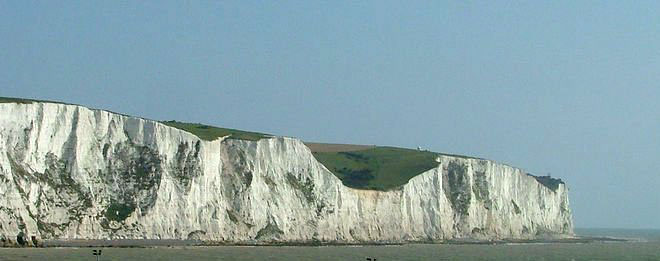
Now, that key “other ingredient” in porcelain is kaolin, also called, for obvious reasons, china clay. Kaolin, one of my sources informs me, is really white, and is primarily found in Malaysia and in Cornwall, England. And here’s where today’s rabbit trail comes in: my mind goes, “White deposits of mineral? In Southern England? Wait – the White Cliffs of Dover?” Back to Google I go, to find out what you probably already knew and I remembered just before Google brought it up, namely that the White Cliffs of Dover are made of chalk, not kaolin clay.

Caspar_David_Friedrich's_Chalk_Cliffs_on_RügenAnd then Wikipedia told me that the ones in Dover are by no means the only chalk cliffs around Europe, and that another famous instance of white-cliff-ness occurs on the German Island of Rügen. So, of course, I had to look that up, and remembered and found the famous work by Romantic painter Caspar David Friedrich, “Chalk Cliffs on Rügen”, from 1818.

And there you have it: the research rabbit trail arrived in the second decade of the 19th century. Just look at that dress, and the hairstyle of the lady! In 1818, Persuasion was published – can we picture Anne Elliot in that outfit? If it wasn’t for the two gentleman in the picture obviously being civilians, it might well be showing Captain and Mrs Wentworth on their honeymoon (they took a friend along on the hike to the cliffs, okay? There’s nothing wrong with spending time with friends, even if it is your honeymoon). Or it might be Jacob and Wilhelm Grimm, on holiday with their sister Lotte. And when they get back to their Pension (bed-and-breakfast, or inn), they’ll have a lovely Kaffee und Kuchen (afternoon coffee & cake) off a set of Meissen porcelain.

Life, the Universe, and Rabbit Trails from China to Jane Austen. The pleasures of a writer’s life.