Apologies for the Funkstille (radio silence) over the last week or so. I’ll spare you the excuses; suffice to say they involve busyness, weather, not-feeling-well, editing work (yes, Checkmate is being beaten into shape, and will be coming to an online bookseller near you! Soon. Well, soon-ishly. I’ll let you know.) and stuff like that.
I was going to write an erudite post about Story, and narrative structure, and why I don’t like it when silly, fun movies use Queen Elizabeth or Queen Victoria as one of the characters. But then I got busy cooking lasagne for dinner (I make it in the slowcooker – another post for another day), and the writing inspiration leaked out of my ears, so QE and QV will have to wait. Besides, I want to get back to reading the mystery novel I’m into (P. D. James, Death in Holy Orders. Yet another post: why, oh why did she have to write a sequel to Pride and Prejudice, when she’s such a good writer in her own right? However).
Anyway, just so’s not to leave you hanging for too long without any effusions from amo vitam, here is some random imagery for you. One a sweet pea flower that’s blooming in the box on my balcony; the other a very random bit of magnetic, umm, poetry (for lack of a better term), which has its own, uh, imagery. And a magnetic ladybug.
And here’s a commentary on the previous one. Just sayin’.
Life, the Universe, and Random Imagery. Until further ramblings!
This week in telegram style: RAN ERRANDS STOP DID SOME GARDENING STOP TRIED TO UNTANGLE THE STORYLINES OF CHECKMATE STOP TRIED TO UNTANGLE THE TANGLES I CREATED BY UNTANGLING STOP SIGH STOP (In case you’re wondering what a telegram is, it’s a form of communication from the last century that no longer exists. It was kind of like texting on paper. The world’s last telegram was sent in July 2013 in India.)
With the way I write, events tend to flow from one scene to the next – I write something, and then the next thing is the logical step after that, referring back to a small piece of information that I’ve given in the last chapter, or the one before that. Now, when it comes to implementing some of my most excellent beta readers’ suggestions to the tune of “This really ought to happen sooner/later/not at all/much more often”, I can’t just take one scene and drag and drop it into an earlier part of the story. It would have the effect of taking a chunk of fish net and yanking really hard – the whole weave is destroyed. So I have to carefully un-knot the section and reconnect it elsewhere – this sentence could go here, three chapters previously; while this piece of information could come in there, in the middle of chapter 22; and this bit here could be deleted altogether, but then we better add another paragraph over here. Speaking of chapter 22, that got moved about three times this week – first up behind chapter 16 (so it, and all the intervening chapters, had to be renamed); then both of them back down again to become chapters 22 and 23 (or maybe it was 21 and 22, can’t remember); then back again to position 16 & 17… Oh what a tangled web we weave / when first we practise to, umm, write a story.
In other news, I’m reading a fascinating book at the moment: At Day’s Close: Night in Times Past, by A. Roger Ekirch. It’s totally shifting my thinking about history, about my fictional world (which is, after all, a pseudo-pre-industrial-European setting), and even about our current sleeping habits and lifestyles. What is so revolutionary about this is the realisation that up until about 150 years ago, nighttime was dark. I know, I know, that’s pretty much a “d’uh” – but is it? Today, we can have daylight brightness whenever we want. Even when we’re gingerly making our way along a dark campground lane towards the outhouse and back to our tent, we know full well that when we go home tomorrow, we’ll be right in 100-Watt-lightbulb range again. And even then, the little flashlight we carry to keep us from tripping over roots on the way is multiple times brighter than any lantern our ancestors had. We only play at being in the dark, but in the past, once nighttime fell, that’s all you had until the sun came up again in the morning. I wonder if the invention of artificial light wasn’t one of the most revolutionary moments of history.
Life, the Universe, Tangles and Darkness. That’s today’s news from the writing and reading trenches.
I’m knee-deep in edits on Checkmate (Septimus book 3), and in consequence I don’t have much to say today (I’m using my words on my book). So I went into the “Unused Pics” folder in my “Blog” files, and found a couple of little irrelevancies to share with you. An old piece of magnetic poetry (ain’t it profound?), and a picture of a rose bud from my garden from last year.
I’m still rabbit-trailing, uh, sorry, researching. And for some reason, I always seem to arrive in the early 19th century again – the time of the Regency, Jane Austen, the Brothers Grimm. What’s with that?
This is how the rabbit trail ran today: I was looking at the creation of porcelain or china (because that’s important for Septimus book #3, Checkmate, which I’m editing at the moment). Unlike regular clay, which you can just dig out of the ground and use more-or-less straight up, the clay body that makes up porcelain is a mixture – the recipe varies depending on what kind of china it is. Bone china, the fine English stuff invented by Josiah Spode in the late 18th century, contains a sizable proportion of actual bone (cow, for the most part, apparently), which is burned and ground up before it gets mixed with the other ingredients. Recipes for china clay were a closely guarded trade secret; in fact, when in 1712 a French Jesuit missionary transmitted the secret of how to make porcelain from China, where he was working, to Europe, it was considered one of the first instances of industrial espionage (however, some German scientists had already figured it out for themselves a couple of years earlier, establishing the porcelain manufacture in Meissen. Science beats spy work – so there!).
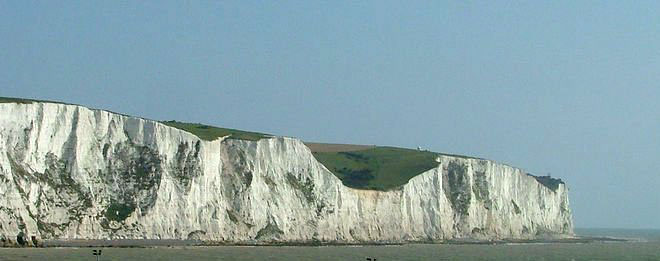
Now, that key “other ingredient” in porcelain is kaolin, also called, for obvious reasons, china clay. Kaolin, one of my sources informs me, is really white, and is primarily found in Malaysia and in Cornwall, England. And here’s where today’s rabbit trail comes in: my mind goes, “White deposits of mineral? In Southern England? Wait – the White Cliffs of Dover?” Back to Google I go, to find out what you probably already knew and I remembered just before Google brought it up, namely that the White Cliffs of Dover are made of chalk, not kaolin clay.
And then Wikipedia told me that the ones in Dover are by no means the only chalk cliffs around Europe, and that another famous instance of white-cliff-ness occurs on the German Island of Rügen. So, of course, I had to look that up, and remembered and found the famous work by Romantic painter Caspar David Friedrich, “Chalk Cliffs on Rügen”, from 1818.
And there you have it: the research rabbit trail arrived in the second decade of the 19th century. Just look at that dress, and the hairstyle of the lady! In 1818, Persuasion was published – can we picture Anne Elliot in that outfit? If it wasn’t for the two gentleman in the picture obviously being civilians, it might well be showing Captain and Mrs Wentworth on their honeymoon (they took a friend along on the hike to the cliffs, okay? There’s nothing wrong with spending time with friends, even if it is your honeymoon). Or it might be Jacob and Wilhelm Grimm, on holiday with their sister Lotte. And when they get back to their Pension (bed-and-breakfast, or inn), they’ll have a lovely Kaffee und Kuchen (afternoon coffee & cake) off a set of Meissen porcelain.
Life, the Universe, and Rabbit Trails from China to Jane Austen. The pleasures of a writer’s life.
One of the pleasures of writing fantasy fiction is world building. In fantasy, anything goes. You want your characters to have interesting-coloured eyes? Make ’em purple. Or better yet, turquoise. (Just as an aside, the turquoise-coloured eyes of some of the main characters in Seventh Son simply appeared in the course of writing the story. I sat down and started to write, and when it came to finding a simile for the colour of the pottery bowl – you know, the one that sucks Cat off to Ruph – I wrote “It was a turquoise blue, very much like the eyes of the weird guy that had stared at Cat so disturbingly…” Completely unplanned, but there they were – turquoise eyes. When I wrote that, I had no idea who this person was, or that he was important in any way. Turns out he was; very much so. Good thing he strolled into the pages of the story with his turquoise eyes just when I needed something to compare the glaze colour to.)
Anyway, point being that in fantasy fiction, you can just make things up. But still, they have to be coherent. In the Septimus world, for example, it turns out that turquoise eyes are unusual. Most people have ordinary-coloured eyes – blue or brown or grey; and their skin tones are just normal people-colours, too. In other words, that whole world is pretty much like ours here, with a bit of magic (and turquoise eyes) tossed into the mix. Well, it’s like ours was a long time ago. Being an inveterate history nerd, I made the setting something akin to the European Middle Ages. And within that setting, things have to work together. I’m not dealing with actual history, so I can get away with giving my quasi-medieval characters a closed cook stove with an integrated water heater – something that wasn’t invented in Europe until almost Victorian times. They also have a town clock. But no electricity or steam power, and no magical equivalent thereof, either (at least not yet. I think. Maybe. Who knows, something might stroll into the pages again…).
And so, taking together the requirement for coherence with the freedom to make things up, I have to do research. Yup. Must. It’s one of the hardships of writing fiction that is set anywhere other than the here-and-now. I’m forced to google things, and it is my writerly duty to keep running after the rabbit trails that appears in the process.
So, today’s starting question was: if Ilim is two days’ travel from Ruph (which is a fact that strolled into the pages of Cat and Mouse), and Rhanathon five days (which is something you’ll find out in Checkmate), just exactly how far is that in physical distance? Given that Ruph is in the mountains with a fair amount of forest around it, and that they travel by horse carriage or on foot, well…?
Some two-and-a-half hours later, I had more than a dozen windows open in my browser, and had arrived at reading about the average income of a Regency labourer and the cost of taking the stage coach from London to Bath in the time of Jane Austen. (In case you’re wondering, according to this page it was approx. £2. Given that a worker earned no more than £25/year, that’s pretty much the equivalent of the cost of an airplane ticket from Canada to Europe today. Hiring a post-chaise, as the likes of Mr Darcy would have done, meant renting a private jet – it was about £100 for the trip.)
Anyways, see how that happens? You start out researching how long it takes for a horse carriage to travel from one point to another, and end up with Jane Austen. And you find out all kinds of interesting things about the Pony Express on the way – those guys were fast! And really young – just kids, most of them. Oh, sorry, where were we? Travel distances, right.
Life, the Universe, and Writer’s Research Rabbit Trailing. Those are the pleasures of creating.
Steve was complaining about not getting enough screen time lately. Also, about my terrible habit of procrastinating instead of writing. Well, I said to him, what do you want me to do – write, or put up a blog post with a picture of you? I can’t very well do both. He chose the latter. Which goes to show just how seriously I need to take him when he grumbles at me about my procrastination.
So here he is, looking dapper in front of my screen. Now that he gets double screen time – in front on my screen, and displayed on yours – hopefully that’ll keep him happy for a while. It’s really hard to write with those bearly grumbles coming from the corner of the room.
In other news, it’s a gloriously sunshiny spring day, which makes me feel happy. I know, you don’t really care – but I don’t really have much else to tell you today. Unless you want to hear about my frustration with the bank, who is making me go through an incredible rigmarole to get them to stop sending me paper statements for my line of credit? No, I didn’t think so. Sunshine and stuffed bears it is.
Life, the Universe, and Friday Frivolities. Have a lovely weekend!
As I mentioned last time, reading Thursday Next: First Among Sequels by Jasper Fforde got me thinking about what I’ll call, for lack of a better word, cross-gender writing: when an author writes a character who is of the opposite gender from their own.
Interestingly enough, both of Fforde’s series I’ve read so far, the Thursday Next novels and the Last Dragonslayer ones, feature a female protagonist. They’re great books – don’t get me wrong: I’ve thoroughly enjoyed them (in fact, I’m still thoroughly enjoying them, as I haven’t finished reading either series). But one thing that stuck out to me about the Thursday in First Among Sequels is that she is, pretty much, a tough chick. Oh, she’s a loving mother and wife, very much so. But there is a certain kind of – I just have to say it – manliness about her. She’s a kick-butt leather-wearing gun-toting girl (who, at age 52 and after two pregnancies, still has a “devastatingly good figure and boobs to die for” [p. 346 of FAS]). Thursday’s calling in life is to go adventuring in the BookWorld; regularly pulling a gun with an EraserHead is all in a day’s work. Thursday is a man’s woman.
Now, one of the things that got me started on this train of thought quite some time ago was a post by Christopher Bunn on this very matter from the opposite angle. He’d noticed that a lot of male protagonists written by female writers are, kind of, women’s men, particularly when they appear in romance stories. (He then set out to write his “Sleeping Beauty” adaptation, Rosamunde, in part as an exercise in doing a female voice. Go read it and decide for yourself whether you think he succeeded; it’s a great little book overall, well worth reading.)
So when Christopher said that about female writers creating men in their own image, I started mentally sifting through some of my favourite literary characters, and I have to admit he is right. Many of my favourite literary males were written by women, and perhaps the reason they’re my favourites is that they’re idealised women’s men. Dorothy L. Sayers’ Lord Peter Wimsey is one – he is eminently swoon-worthy, and never more so than in his romantic pursuit of Harriet Vane. Lord Peter is by no stretch of the imagination girly – but he is sensitive, cultured, caring, yet strong and intelligent… everything a woman wants a man to be, with none of those inconvenient traits like not wanting a woman to depend on him or being more concerned with the task at hand than with the woman’s feelings at the moment.
On the flip side, quite a few of the manly women written by male writers are, pretty much, what a man wants a woman to be (or so I imagine): tough, independent, beautiful/sexy (see “devastatingly good figure and boobs…” above), with none of those inconvenient traits like wanting a man to listen to her feelings or having physical issues like getting cramps once a month or morning sickness resulting from some passionate bouts of lovemaking.
Steve and Horatio – a Bear’s Bear and a Tiger’s Tiger
This “writing characters in the image of one’s own gender” even extends down to children. Terry Pratchett’s Tiffany Aching is one of the best characters he created (and he created many) – and she is one tough little girl, with an utterly unsentimental attitude to life (the very first time we meet her, she takes out one of the baddies with a cast iron frying pan. Bam!). Come to think of it, she is a childhood incarnation of another brilliant Pratchett character, Granny Weatherwax. You couldn’t imagine either of them cooing over babies or kittens (Granny has a couple of feeble cooing episodes in the first book in which she appears, but that flaw was speedily expunged from her personality). In fact, Granny’s friend Nanny Ogg, who is yet another tough broad, does coo over her pet cat Greebo – but he’s the roughest, meanest, nastiest specimen of feline you could imagine, so it’s a big joke. All of these women are far more likely to slap a crying person upside the head and tell her to pull herself together than to give her emotional support and a warm hug. They’re loving and care deeply about people, but it’s tough love – more the kind that is (stereotypically) doled out by fathers than by mothers.
Cooing, cuddling, and anything resembling emotional softness or sentiment, on the other hand, are castigated by both Pratchett and Fforde as “wet” or “soppy” – the girls (and it is always girls) who are prone to such exhibits are mercilessly made fun of. Yes, they do exist in the books – in Pratchett’s “Witches” series it’s Magrat Garlick, in “Thursday Next” it’s Thursday5, and in both cases they’re described as New Age hippie types who like to weave floral wreaths, wear unbleached cotton, and are annoyingly fond of hugging and emotional encounter groups; part of their character growth consists in getting over their emotionality – to become, in short, more of a manly woman.
A while ago I promised you a post on Charles Dickens, which I have yet to make good on. However, for now, here’s one of the points I wanted to make about Dickens: he can’t write female characters – they’re either perfect angels of light or corrupt, demonic slatterns. Dickens is in good company among his fellow Victorians in that; in fact, I have yet to read a male Victorian writer who could write a good woman. Sickly sweet, or evilly corrupt, those seemed to be the only two registers male Victorians had at their disposal for writing females; all the believable literary women were created by woman writers. (That’s not to say there aren’t well-written women that sprang from the pen of a male writer in the 19th century – just that I haven’t run across them. I’ve yet to read Tess of the d’Urbervilles – perhaps she meets the requirements? But then, she dies. I’m not sure that qualifies her for well-written – if you can’t be believable and live, well…)
I can’t really speak much to the issue of the believability of males written by females – I’ll have to take Christopher’s word for it that many of them don’t quite read true. But I think I know what he means, because I can see it in the mirror image of the female written by the male.
However, none of this means that I have a problem with those literary heroines. I love identifying with Tiffany Aching’s frying pan prowess or Thursday Next’s accuracy with an eraser gun (which reduces bad guys down to their phonemes). BAM! POW!
But it’s something to keep in mind, particularly as a writer – do I create my characters in my image, even just the image of my gender or of what I wish the opposite gender was like? Perhaps, to a certain extent, it can’t be avoided. And maybe that’s not such a bad thing – maybe in reading about and identifying with what an author of the opposite gender imagines or wishes a character of ours to be like, we can come to a deeper understanding of their perspective. Perhaps in having characters of one gender created in the image of the opposite one the gap between the genders can, in one spot or another, be bridged.
Life, the Universe, Manly Women and Womanly Men. Pass the frying pan.
I have a problem with my books: Seventh Son and Cat and Mouse, I don’t know what genre to stick them in.
People ask me what kind of books they are, and I usually say “fantasy” – but then I always feel compelled to qualify: “Well, it’s light fantasy,” or “It’s kind of a romance,” or “It doesn’t have any orcs in it.” Because, you see, when someone classifies a book or movie as “fantasy”, what is the first thing that comes to mind? For me, and I suspect for most people, it’s Tolkien. Well, he did start the whole thing, really. Yes, yes, I know about George Macdonald’s Phantastes and that there were other fantasy writers before Tolkien. But he is the one who made the genre popular and who is unfailingly copied. Fantasy fiction, for the most part, means pointy-eared elves, vicious-looking orcs, and pseudo-medieval knights in more-or-less-shiny armour. There has to be at least one sorcerer and plenty of swords, and a dragon or other mythical creature is pretty much mandatory – that’s the essence of “fantasy”.
But my stories haven’t got any of that. Not a single pointy-eared person in sight. To date, in Ruph nobody even owns a sword, let alone has drawn it; and as for dragons, they’re mentioned once, in Chapter 6 of Cat and Mouse, but only in passing, when Cat is wondering if they’re real or just as mythical as in our own world (the jury is still out – Nikor, the librarian, thinks they might exist, but he doesn’t really care, as long as he has a good way of shelving the books about them).
So, the Septimus series is definitely not classic fantasy (nor epic, nor high, nor whatever other flattering epithet one might bestow on Tolkienesque fiction). So what is it? Well, there’s romance, in the first couple of books at least. But, then again, the books aren’t “romances”, either. No ripped bodices, heaving bosoms, or lust in the dust (nor anywhere else, for that matter); no perpetual belly-aching about “he loves me, he loves me not”; not even the high-class tension-filled relationship dance of an Elizabeth and a Mr Darcy – this is not “boy meets girl, boy falls in love with girl, boy has to overcome obstacles to get girl, boy gets girl”. Not that there’s anything wrong with that storyline (I lurv me a good romance) – but Seventh Son and Cat and Mouse don’t really run along those tracks.
They aren’t fantasy. They aren’t romance. I’ve also had readers comment that Seventh Son feels like a Young Adult novel – but Cat is twenty-eight, hardly your typical YA teen protagonist. So, really, not YA either (which is at best a somewhat controversial category, anyway – is a YA a book for teens, or about teens? Just like the Ruphian dragons, the jury is still out on that one). And then there’s mystery in those stories, but nobody dies (or at least not mysteriously), and Cat is not a Ruphian equivalent of a gum-shoed, pipe-smoking and/or mustachioed sleuth who has to figure out whodunnit. So not mystery, either.
But what to call them? Because really, the Septimus books are fantasy. And they are romance, and mystery. Just not your typical example of either of those genres. And when I thought about how to describe these stories, a term popped into my mind: Cosy Fantasy.
You see, one of my favourite genres to read is Cosy Mysteries. You know, Agatha Christie, Ngaio Marsh, Dorothy Sayers (to name just three of the queens of the genre): mystery novels which usually deal with a limited cast of characters (often in the typical English country house setting), have very little violence (and what there is of it, usually happens off-stage), and above all, focus on people and their relationships.
And that’s exactly what the Septimus series is like – but in a fantasy setting. So I coined this phrase, Cosy Fantasy, to describe my books – and then I found out that I’m by no means the only one who has come up with that descriptor for this kind of stories. Goodreads, for one, has whole lists of books that fit into that category (which is exactly where I’m going to go next time I’m looking for a good new read).
But here’s another snag: how to spell it? Is is Cosy Fantasy, or Cozy Fantasy? Goodreads, again, has two lists, one under each spelling – and they’re different lists. I have a feeling the Cosy Fantasies are the British ones, and the Cozy ones the American-published. Yet another dilemma – I’m publishing my books in Canada, though US venues (Amazon, Createspace and Smashwords), with British spelling… Cosy, or Cozy?
I think for the time being, I’ll stick with Cosy, to go with the rest of my spelling. But if you would rather cosy up with Seventh Sonand Cat and Mouse under the name of Cozy Fantasies, please do.
Life, the Universe, and Cosy Fantasies. All that matters is that you enjoy them.
I just read a quite interesting article about “The Seven Deadly Sins of Dialogue”, i.e. what not to do when you’re writing fiction dialogue. And yes, I quite agree with the author on almost all points.
For example, a nasty writing habit is replacing “said” with other verbs like “queried” or “cajoled”. Or even worse, practising what they call “Impossible Verbing”. “As a reader, that jolts me right out of the story,” I shuddered. ← There, that was one of those. One does not shudder a sentence. Try it – scrunch up your shoulders, let that shiver run over yourself from your head down your arms into your finger tips, and see if you get any sound out of that, let alone words. If you do, you’re a better vocal cord acrobat than I am.
However, there is one point on which I beg to differ with the authors of that article. Well, one sub-point. Under “Impossible Verbing”, they emphatically state that you should never use any verb other than a variant of “to say” as your speech tag, and they continue: “[E]ven more experienced writers can sometimes have a character laugh or sigh or cry a line that could not logically be produced in any of these ways.” That’s a statement I’ve heard more than once. But I’m sorry, just because people who lecture others on writing – uh, sorry, give out writing advice – like to repeat that statement that does not make it true. You can so laugh a line.
How would they suggest you describe it when someone says something while laughing? I presume the approved form would be “he said with a laugh” or something like that. But think about it: that’s actually quite a different thing than “laughing” the words. I don’t know about you, but laughing makes noise come from my vocal cords. Right? Hahaha. That’s sound. So, try this: ‘”That’s funny!” he said and laughed.’ What are you hearing in your head? Me, that arrives as: “That’s funny! Hahaha!” But now look at this: ‘”That’s funny!” he laughed.‘ Mental audio: “Thahahahat’s fuhuhuhunny!” Two different effects, no?
Okay, I’ll give you that you could write the latter as ‘”That’s funny!” he said laughingly.’ or even ‘with a laugh.’ But there’s a certain amount of clunkiness in that – too many “-ly” or “with a” would yank me out of the story more effectively than the occasional “he laughed” and “she sobbed”. (‘”You don’t love me!” she said sobbingly.’ Uh, no. Not with clunky language like that, I don’t.)
So, Impossible Verbing aside (she shrugged), I vote that laughing, sobbing, hissing, snarling, groaning, and sighing can take their occasional (very occasional) place alongside shouting and whispering in the lineup of acceptable synonyms for “saying”. After all, they do all make sounds. I will, however, draw the line at burping – yes, I know there are people who can burp the alphabet, but really, there are limits. If not of language, then of good taste.
“Life, the Universe, and Speech Tags,” she said. “Try laughing it sometimes.”
So the first draft of Checkmate, Septimus Series Book 3, is in the bag, as of two hours ago. And by first draft, I mean raw, unvarnished, un-spell-checked, NaNoWriMo-ish, plot-hole-riddled, wordy etc etc. (you get the picture). I had frozen in place at the end of NaNo in the middle of a scene, having crossed the 50K-word finish line. Then Christmas happened, aka no writing for about a month, and then a January full of sort of limping along, stuttering my way to the completion of the book. But now it’s done – there is a STORY here.
And I’m exhausted. Writing is tiring, you know? Especially if you write the way I do, which is in spurts – nothing, nothing, nothing, writewritewritewrite, nothing, nothing… I’ve yet to master the fine art (which some of my friends are experts on) of writing so many words a day, come rain, shine, or cloudy-with-a-chance-of-meatballs. I don’t know if there’s anything I can do in little bits every day – I tend to be an all-or-nothing person, sort of a single-track mind. I obsess on whatever-it-is until I’m done, or lose interest and pick up the next subject.
So, draft is finished, dinner has been had, and now I think it’s time for another glass of wine and an episode or two of Once Upon a Time (we’re up to Season 2, Episode 10). And tomorrow, or whenever, it’s back to the drawing board for Checkmate. Re-read, re-write, rinse and repeat.
Life, the Universe, and Finished First Drafts. Checkmate!
Sunrise on sea of fog – this morning as I started writing.
 Anyway, just so’s not to leave you hanging for too long without any effusions from amo vitam, here is some random imagery for you. One a sweet pea flower that’s blooming in the box on my balcony; the other a very random bit of magnetic, umm, poetry (for lack of a better term), which has its own, uh, imagery. And a magnetic ladybug.
 And here’s a commentary on the previous one. Just sayin’.
 Life, the Universe, and Random Imagery. Until further ramblings!